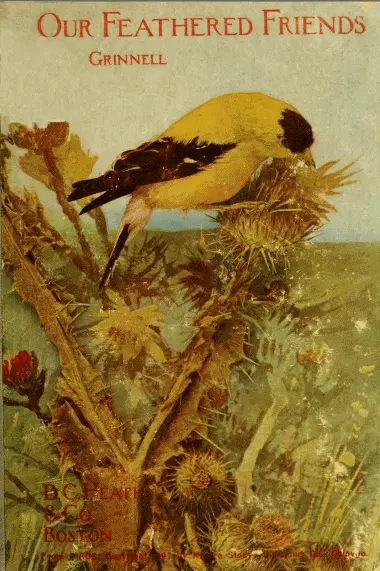
Our Feathered Friends
Elizabeth Grinnell & Joseph Grinnell

THE CLASSIC COLLECTION · 1901
"Gold Hunting in Alaska" by Joseph Grinnell is a narrative nonfiction work written in the late 19th century. The book recounts the true experiences of a group of gold-hunters who embark on a journey to Alaska during the gold rush of the late 1800s. The narrative provides insight into the lives of the men in the expedition, their hopes for gold, and the challenges they face in the harsh Arctic wilderness. The opening of the book introduces us to a party of twenty men, all driven by the allure of gold as they set sail for Kotzebue Sound in Alaska. Among the crew are colorful characters, including an undertaker-turned-miner and a doctor, who add depth to the group dynamic. The captain's humorous disposition contrasts with the serious nature of their quest, as they journey on the ship "Penelope," facing storms and sea sickness while sharing meals and camaraderie. The diary-like entries reveal both the hardships and the lighter moments of their travels, setting the stage for their adventures in search of fortune in an unforgiving territory.
Introduction adapted from the source catalogue; source summaries may be automatically generated.
Free to read · English · 70,169 words · No account needed
MAKE TIME FOR A GOOD BOOK
On by default. Untick to stop anonymous reading totals. Each page counts after 10 seconds in view. How this works.
Anonymous counting is on unless you have switched it off.
We feel pretty sure of our return tickets. But the "Penelope" is at the mercy of Arctic demons, and if she is saved it will be marvelous.
Feb. 26, Sunday.--I will confess that I did not behave well in church this morning. I took a seat over in the corner behind Rivers, where I thought my scribbling would not be noticed, and there I am writing. I guess no one will be harmed by it unless it be myself. 10:30 a. m., and the first arrivals for meeting are Charley Lund and Beam of the first Iowa Camp--that is, representing the white population. Services are supposed to begin at eleven, but two benches of Eskimo are already seated. They are quite well behaved, but keep up an incessant jabbering. Charley Lund, Beam and the doctor are holding an animated conversation about the sick man B. B. is a good deal better.
Guy Solsbury and Normandin of the Hanson Camp have just arrived, all muffled up, their masks thickly frosted. It is forty-five degrees below zero, but they report that their three-mile walk was "quite comfortable." Normandin brought me a big box nicely finished with cover and shallow trays, for my skins. It is in trade for a stuffed ptarmigan. He is quite a genius in the mechanical line. The box was rather too heavy to carry, so he fastened a pair of runners on blocks at the bottom and dragged it up by a rope tied to a handle on one end. Lyman comes in with his clarionet case under his arm. Dr. Gleaves and D. arrive, and then Young. Dougherty and Montgomery, from the middle Iowa cabin, and Legg of the Jesse Lou, who is staying with them. Several more natives come in with friendly "Halloas!" "Big Jones" from the further Iowa Camp arrives, and Brennan and Malcolm from the Sunnyside. Brennan is nicknamed "Noisy." because he is always very quiet and has nothing to say to anyone. Remarks as to the "cold weather," wooden snow-glasses and snowshoes, are numerous. The conversation is mainly desultory, carried on piecemeal from opposite sides of the room. But there is a low hum from two or three couples who are carrying on a more earnest conversation. Dr. Coffin and Dr. Gleaves, for instance. I overhear discussing Fish's condition. Fish is the man whose toes were amputated. One can see that Sunday services on the Kowak are rather of a social nature. The orchestra begins to tune up; general silence falls on the congregation, and individuals seek permanent seats. Dr. Coffin gives out the song books, of which C. C. brought plenty. The orchestra consists of the banjo by C. C, violin by Normandin, and clarionet by Lyman. There is some delay and more tuning of the banjo and clarionet, which do not seem to jibe (to use a musical term). A low buzz of conversation is again audible, and the leaves of the hymn books rustle. Several of the natives have colds and there is considerable coughing. It is very quiet: sort of an air of suspense. The sunshine streaming across the room, reflected from yellow Mackinaw suits, gives a brownish tint to the scene. Normandin and C. C. are discoursing "sharps" and "flats" in a low voice, yet audible in the room. The violin and banjo are not quite tuned together. Solsbury is talking aloud about "Moth balls in furs, back in the States." At last C. C. announces the number of the hymn in a loud, hurried voice, as though he were just startled out of a reverie, "No. 17, Jesus Saves." The clarionet sounds the pitch and C. C. leads in the singing. The time is awfully slow. Nearly everyone sings, the Eskimos following the air nearly as well as the whites. Although many sing out of tune, and individually would make a horrible discord, the aggregation is a somewhat musical droning of a quality that would soon put one to sleep. After four verses of this hymn. "No. 64" is announced. "Wait and Murmur Not." Some further tuning, and four verses of this hymn are gone through with. They always do sing all the verses of any hymn. Dr. Coffin now rises and reads the second chapter of Matthew. Mr. D. is in charge of the meeting to-day, and he calls on Mr. W. to "lead in prayer." Uncle Jimmy slowly rises, takes a step or two forward, clasps his hands in front of him, and, closing his eyes, raises his face slightly. He is a good man and I like to see and hear him pray. I haven't anything against Uncle Jimmy. When anyone prays the Eskimos always bow their heads low, resting their elbows on their knees. They say "Amen" in unison when the prayer is finished. So much is the result of Mr. and Mrs. Samms' missionary work. Uncle Jimmy terminates with the Lord's Prayer, in which all join. When the praying is over there is quite a hubbub of coughing and sneezing. C. C. announces "No. 49." and the orchestra tunes. "There shall be showers of blessing." four verses. The clarionet doesn't seem to know this very well and makes several breaks. Toward the end of the last verse the hymn-books are closed and there is a general settling down. D. rises and, after a pause, proceeds to apologize for his inability as a public speaker. But he tells us he will do the best he can, and we ask for nothing more. His subject is "The Divinity of Christ." I should like to take down the various points, but my continued scratching is noisy and attracts attention. I might get taken out of meeting by the ear and so suffer for being a "naughty little boy." A couple of men came in late during the sermon and caused some disturbance until they finally got seated, mopping the melting ice from their beards. D. winds up his discourse with a prayer. The most of his sermon was written, and delivered in his usual halting manner, but the substance was good for any location and showed that he had given a good deal of study to his subject. After the prayer and a chorus of "Amens" from the natives, who haven't understood a word of what was said, there is a sort of recovery, with coughing and clearing of throats and shuffling of feet. "No. 139" is announced. "Bringing in the sheaves." three verses. C. C. starts another song, which he observes "will be familiar to the natives," "No. 39, At the Cross." The Eskimos catch a tune quite readily, the women and children carrying the air very nicely. They try hard to imitate the words. Two verses conclude this song. "No. 14, Jesus, I Come." is announced. It is a new piece and is sung very scatteringly. Guy Solsbury calls for "Sunshine." He thinks it appropriate, because at this moment the sunshine is flooding the room with more than usual brightness. But C. C. says he hasn't the music, so the orchestra can't play it. C. C. asks all to rise, and he prays and gives the benediction. The congregation slowly disperses, little knots remaining to discuss various topics. Legg declares he will not go back to the Jesse Lou until the weather moderates. Thus with gossip and swapping of news the Kowak Sunday services are finally ended and the room is cleared in time for the 2 o'clock dinner.
Your reading position is saved on this browser. Take it to another device with a library code. Reading pages adapt to text, rather than matching a printed edition.
Elizabeth Grinnell & Joseph Grinnell
Elizabeth Grinnell & Joseph Grinnell
Joseph Grinnell
BEHIND THE BOOK
This eBook is for the use of anyone anywhere in the United States and most other parts of the world at no cost and with almost no restrictions whatsoever. You may copy it, give it away or re-use it under the terms of the Project Gutenberg License included with this eBook or online at www.gutenberg.org. If you are not located in the United States, you will have to check the laws of the country where you are located before using this eBook. Read the source licence.
The original source file, including credits and licence, is retained by this library. Request an original-format copy at no charge. Please include the book title and Project Gutenberg identifier #65123.
KEEP YOUR CURIOSITY GOING
Wilfrid Scawen Blunt
Wilfrid Scawen Blunt

E. W. (Edgar Watson) Howe
Cécile Tormay

Moritz Busch
John L. Ransom