The princess and the tiger
Johann Wolfgang von Goethe
THE CLASSIC COLLECTION · 1810
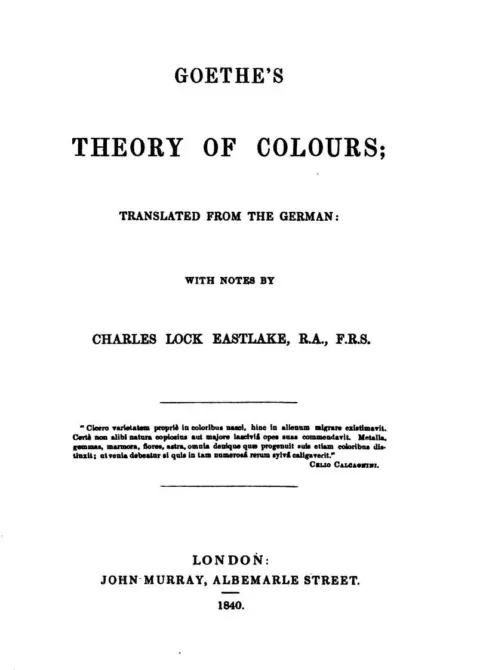
"Goethe's Theory of Colours" by Johann Wolfgang von Goethe is a book published in German in 1810. The poet challenges Isaac Newton's spectral theory, arguing that color arises from the interaction between light and darkness rather than from light alone. Through extensive observations of colored shadows, refraction, and prisms at varying distances, Goethe presents a phenomenological approach focused on human perception. His work profoundly influenced artists including Turner and Kandinsky, while sparking debate among physicists and philosophers about the nature of color itself.
Introduction adapted from the source catalogue; source summaries may be automatically generated.
Free to read · English · 93,436 words · No account needed
MAKE TIME FOR A GOOD BOOK
On by default. Untick to stop anonymous reading totals. Each page counts after 10 seconds in view. How this works.
Anonymous counting is on unless you have switched it off.
[2] Introduction to the "Ricche Minere della Pittura Veneziana," Venezia, 1674. The Italian annotators on older works on painting are sometimes at a loss to find modern terms equivalent to the obsolete names of pigments. (See "Antologia dell 'Arte Pittorica.") The colours now in use corresponding with Boschini's list, are probably yellow lakes, smalt, verditer, and Naples yellow. Boschini often censures the practice of other schools, and in this emphatic condemnation he seems to have had an eye to certain precepts in Lomazzo, and perhaps, even in Leonardo da Vinci, who, on one occasion, recommends Naples yellow, lake, and white for flesh. The Venetian writer often speaks, too, in no measured terms of certain Flemish pictures, probably because they appeared to him too tinted.
[3] "La Carta del Navegar Pitoresco," p. 338.
[4] Ib. p. 341. In describing Titian's actual practice ("Ricche Minere"), he, however, adds yellow (ochre). The red is also particularised, viz., the common terra rossa.
[5] High examples here again prove that the opposite system may attain results quite as successful.
[6] Introduction to the "Ricche Minere."
[7] See Note to Par. 555. Here again, assuming the description to be correct, high authorities might be opposed to the Venetians.
[8] The following quatrain may serve as a specimen; the author is speaking of the importance of the colour of flesh as conducive to picturesque effect:--
"Importa el nudo; e come ben l'importa!
Un quadro senta nudo è come aponto
Un disnar senza pan, se ben ghe zonto,
Per più delicia, confetura e torta."--p. 346.
In his preface he anticipates, and thus answers the objections to his Venetian dialect--"Mi, che son Venetian in Venetia e che parlo de' Pitori Venetiani hò da andarme a stravestir? Guarda el Cielo."
[9] The word Macchia, literally a blot, is generally used by Italian writers, by Vasari for instance, for the local colour. Boschini understands by it the relative depth of tones rather than the mere difference of hue. "By macchia," he says, "I understand that treatment by which the figures are distinguished from each other by different tones lighter or darker."--La Carta del Navegar, p. 328. Elsewhere, "Colouring (as practised by the Venetians) comprehends both the macchia and drawing;" (p. 300) that is, comprehends the gradations of light and dark in objects, and the parts of objects, and consequently, their essential form. "The macchia," he adds, "is the effect of practice, and is dictated by the knowledge of what is requisite for effect."
"Ma l'arivar a la maniera, al trato
(Verbi gratia) de Paulo, del Bassan,
Del Vechio, Tentoreto, e di Tician,
Per Dio, l'è cosa da deventar mato."--p. 294, 297.
Your reading position is saved on this browser. Take it to another device with a library code. Reading pages adapt to text, rather than matching a printed edition.
Johann Wolfgang von Goethe
Johann Wolfgang von Goethe
Theodor Fontane & Johann Wolfgang von Goethe & Gottfried Keller & Theodor Storm
Johann Wolfgang von Goethe
BEHIND THE BOOK
This eBook is for the use of anyone anywhere in the United States and most other parts of the world at no cost and with almost no restrictions whatsoever. You may copy it, give it away or re-use it under the terms of the Project Gutenberg License included with this eBook or online at www.gutenberg.org. If you are not located in the United States, you will have to check the laws of the country where you are located before using this eBook. Read the source licence.
The original source file, including credits and licence, is retained by this library. Request an original-format copy at no charge. Please include the book title and Project Gutenberg identifier #50572.
KEEP YOUR CURIOSITY GOING

David Patterson (Spirit) Hatch
Coulson Kernahan

Ralph Waldo Emerson
Frances Wright

Edwin Abbott Abbott

Joseph Droz