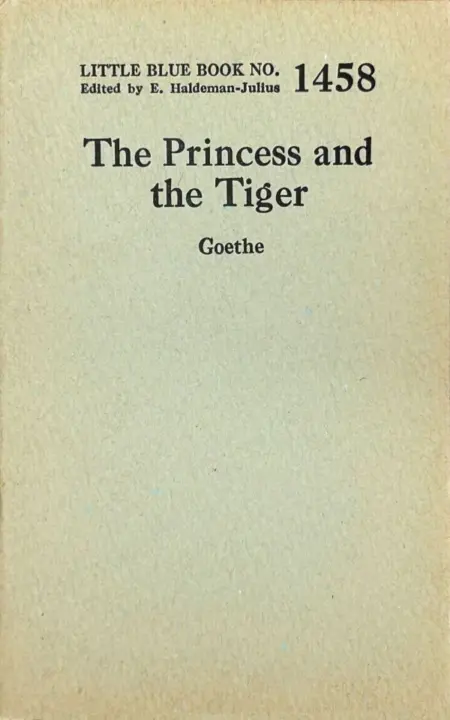
The princess and the tiger
Johann Wolfgang von Goethe
THE CLASSIC COLLECTION · 1921
"Goethe's literary essays: A selection in English" by Johann Wolfgang von Goethe is a collection of critical essays written in the late 18th to early 19th century. It gathers Goethe’s reflections on art, literature, and theatre, articulating a comprehensive aesthetics that ranges from architecture and classical sculpture to dramaturgy and criticism itself. The focus is on how beauty, character, form, and style interrelate, with a strong classical sensibility tempered by wide curiosity and practical judgment. The opening of the collection frames Goethe as a preeminent critic through a chorus of admirers and a foreword by Viscount Haldane, who highlights Goethe’s breadth—from lyric poetry and natural observation to the philosophical reach of Faust—and urges readers to learn from his critical outlook. A detailed contents list maps the scope: theories of art and literature, essays on Shakespeare and other writers, and selected conversations. The first essays then set the program: a passionate defense of “German” architecture via Strasbourg Cathedral against formulaic classicism; an introduction to the Propylæa stressing the need to keep each art true to its own laws; and a searching analysis of the Laocoon that defines the highest aims of sculpture—living form, character, ideality, agreeableness, and beauty—while explaining how the chosen moment and composition temper pathos with harmony. Further pieces unfold as dialogues: a debate pitching “character” against “beauty” in ancient art, a discussion of truth versus plausibility on the stage (especially in opera), and precise definitions of simple imitation, manner, and style, with style crowned as the deepest, most knowing form of art.
Introduction adapted from the source catalogue; source summaries may be automatically generated.
Free to read · English · 74,577 words · No account needed
MAKE TIME FOR A GOOD BOOK
On by default. Untick to stop anonymous reading totals. Each page counts after 10 seconds in view. How this works.
Anonymous counting is on unless you have switched it off.
Spectator.--In fact, when I consider, I could not say it had. None of
these things seems true.
Agent.--And yet you are completely pleased and satisfied with the
exhibition?
Spectator.--Beyond question. I still remember how the opera used to be ridiculed on account of this gross improbability, and how I always received the greatest satisfaction from it, in spite of this, and find more and more pleasure the richer and more complete it becomes.
Agent.--And you do not then at the opera experience a complete
deception?
Spectator.--Deception, that is not the proper word,--and yet,
yes!--But no--
Agent.--Here you are in a complete contradiction, which is far worse
than a quibble.
Spectator.--Let us proceed quietly; we shall soon see light.
Agent.--As soon as we come into the light, we shall agree. Having reached this point, will you allow me to ask you some questions?
Spectator.--It is your duty, having questioned me into this dilemma,
to question me out again.
Agent.--The feeling you have at the exhibition of an opera cannot be
rightly called deception?
Spectator.--I agree. Still it is a sort of deception; something
nearly allied to it.
Agent.--Tell me, do you not almost forget yourself?
Spectator.--Not almost, but quite, when the whole or some part is
excellent.
Agent.--You are enchanted?
Spectator.--It has happened more than once.
Agent.--Can you explain under what circumstances?
Spectator.--Under so many, it would be hard to tell.
Agent.--Yet you have already told when it is most apt to happen, namely, when all is in harmony.
Spectator.--Undoubtedly.
Agent.--Did this complete representation harmonize with itself or
some other natural product?
Spectator.--With itself, certainly.
Agent.--And this harmony was a work of art?
Spectator.--It must have been.
Agent.--We have denied to the opera the possession of a certain sort of truth. We have maintained that it is by no means faithful to what it professes to represent. But can we deny to it a certain interior truth, which arises from its completeness as a work of art?
Spectator.--When the opera is good, it creates a little world of its own, in which all proceeds according to fixed laws, which must be judged by its own laws, felt according to its own spirit.
Agent.--Does it not follow from this, that truth of nature and truth of art are two distinct things, and that the artist neither should nor may endeavor to give his work the air of a work of nature?
Spectator.--But yet it has so often the air of a work of nature.
Your reading position is saved on this browser. Take it to another device with a library code. Reading pages adapt to text, rather than matching a printed edition.
Johann Wolfgang von Goethe
Johann Wolfgang von Goethe
Theodor Fontane & Johann Wolfgang von Goethe & Gottfried Keller & Theodor Storm
Johann Wolfgang von Goethe
BEHIND THE BOOK
This eBook is for the use of anyone anywhere in the United States and most other parts of the world at no cost and with almost no restrictions whatsoever. You may copy it, give it away or re-use it under the terms of the Project Gutenberg License included with this eBook or online at www.gutenberg.org. If you are not located in the United States, you will have to check the laws of the country where you are located before using this eBook. Read the source licence.
The original source file, including credits and licence, is retained by this library. Request an original-format copy at no charge. Please include the book title and Project Gutenberg identifier #76103.
KEEP YOUR CURIOSITY GOING

David Patterson (Spirit) Hatch

David Patterson (Spirit) Hatch

David Patterson (Spirit) Hatch
Cécile Tormay

Moritz Busch
John L. Ransom