THE CLASSIC COLLECTION✦La cuisine creoleCLASSIC FREE BOOKS
La cuisine creole
Lafcadio Hearn

THE CLASSIC COLLECTION · 1897
"Gleanings in Buddha-Fields: Studies of Hand and Soul in the Far East" by Lafcadio Hearn is a collection of essays written in the late 19th century. The work delves into various aspects of Japanese culture, religion, and the philosophical insights of Buddhism and Shintoism, expressing Hearn's appreciation and imaginative interpretations of the Far East. Through personal reflections and descriptive passages, the text aims to illuminate the deep connections between the spirit and the daily life of the Japanese. The opening of "Gleanings in Buddha-Fields" sets the stage for Hearn's exploration by vividly describing the characteristics of Shinto shrines and the unique emotional responses they evoke. He reflects on the perception of these structures not merely as religious edifices, but as ghostly embodiments where the spirits of ancestors and deities reside, fostering an atmosphere of reverence and haunting beauty. Hearn articulates the intertwining of nature, spirituality, and architecture in Japan, inviting readers to consider the deeper meaning of faith and existence in a culture that perceives the divine as intimately linked to the physical world around it. This serene, evocative introduction serves as a precursor to Hearn’s broader examinations of Japanese life and belief systems throughout the collection.
Introduction adapted from the source catalogue; source summaries may be automatically generated.
Free to read · English · 54,047 words · No account needed
MAKE TIME FOR A GOOD BOOK
On by default. Untick to stop anonymous reading totals. Each page counts after 10 seconds in view. How this works.
Anonymous counting is on unless you have switched it off.
Only too well I know that to meet will cause more weeping;[20] Yet never to meet at all were sorrow too great to bear.
[Footnote 20: Allusion is made to the Buddhist text, Shōja hitsu metsu, esha jōri ("Whosoever is born must die, and all who meet must as surely part"), and to the religious phrase, Ai betsu ri ku ("Sorrow of parting and pain of separation").]
Too joyful in union to think, we forget that the smiles of the
evening
Sometimes themselves become the sources of morning-tears.
Yet, notwithstanding the doctrine of impermanency, we are told in
another dodoitsu that--
He who was never bewitched by the charming smile of a woman, A wooden Buddha is he--a Buddha of bronze or stone![21]
[Footnote 21: Much more amusing in the original:--
Adana é-gao ni
Mayowanu mono wa
Ki-Butsu,--kana-Butsu,--
Ishi-botoké
"Charming-smile-by bewildered-not, he-as-for, wood-Buddha,
metal-Buddha, stone-Buddha!" The term "Ishi-botoké"
especially refers to the stone images of the Buddha
placed in cemeteries.--This song is sung in every part of
Japan; I have heard it many times in different places.]
And why a Buddha of wood, or bronze, or stone? Because the living Buddha was not so insensible, as we are assured, with jocose irreverence, in the following:--
"Forsake this fitful world"!--
{Lord Buddha's}
that was or teaching!
{upside-down }
And Ragora,[22] son of his loins?--was he forgotten indeed?
There is an untranslatable pun in the original, which, if written in
Romaji, would run thus:--
Uki-yo we sutéyo t'a
{Shaka Sama}
Sorya yo
{saka-sama }
Ragora to iū ko we
Wasurété ka?
Shakamuni is the Japanese rendering of "Sakyamuni;" "Shaka Sama" is therefore "Lord Sakya," or "Lord Buddha." But saka-sama is a Japanese word meaning "topsy-turvy," "upside down;" and the difference between the pronunciation of Shaka Sama and saka-sama is slight enough to have suggested the pun. Love in suspense is not usually inclined to reverence.
[Footnote 22: Râhula.]
Even while praying together in front of the tablets ancestral, Lovers find chance to murmur prayers never meant for the dead![23]
And as for interrupters:--
Hateful the wind or rain that ruins the bloom of flowers: Even more hateful far who obstructs the way of love.
Yet the help of the Gods is earnestly besought:--
I make my hyaku-dō, traveling Love's dark pathway. Ever praying to meet the owner of my heart.[24]
[Footnote 23:
Ekō suru toté
Hotoké no maé yé
Futari mukaité,
Konabé daté.
Your reading position is saved on this browser. Take it to another device with a library code. Reading pages adapt to text, rather than matching a printed edition.
Lafcadio Hearn
Lafcadio Hearn

Lafcadio Hearn
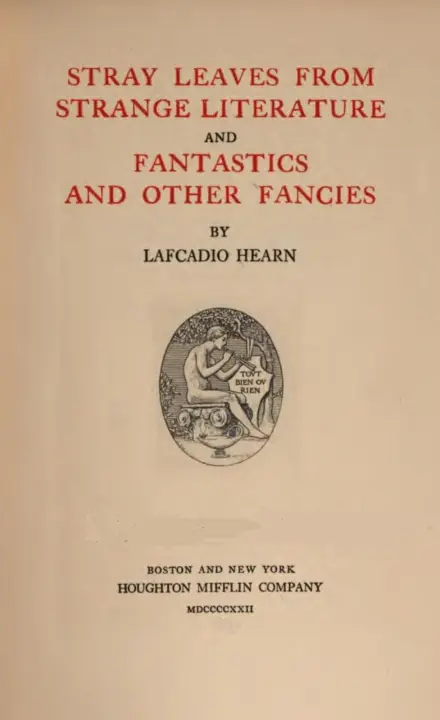
Lafcadio Hearn
BEHIND THE BOOK
This eBook is for the use of anyone anywhere in the United States and most other parts of the world at no cost and with almost no restrictions whatsoever. You may copy it, give it away or re-use it under the terms of the Project Gutenberg License included with this eBook or online at www.gutenberg.org. If you are not located in the United States, you will have to check the laws of the country where you are located before using this eBook. Read the source licence.
The original source file, including credits and licence, is retained by this library. Request an original-format copy at no charge. Please include the book title and Project Gutenberg identifier #55681.
KEEP YOUR CURIOSITY GOING
Wilfrid Scawen Blunt
Wilfrid Scawen Blunt

E. W. (Edgar Watson) Howe

David Patterson (Spirit) Hatch

David Patterson (Spirit) Hatch

David Patterson (Spirit) Hatch