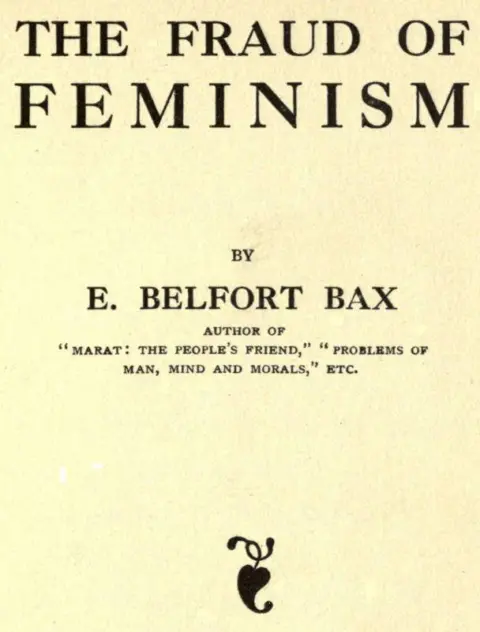
The Fraud of Feminism
Ernest Belfort Bax

THE CLASSIC COLLECTION · 1894
"German Society at the Close of the Middle Ages" by Ernest Belfort Bax is a historical account written in the late 19th century. The book aims to provide an overview of the social conditions and popular movements in Germany during the Reformation, with a particular focus on the revolutionary movements that foreshadowed the Peasants' War. The author delves into the intricate social hierarchies and economic tensions of the time, illustrating how they contributed to uprisings against prevailing feudal structures. The opening of the work outlines the historical context at the close of the 15th century, depicting a society seemingly stable but on the brink of significant change. It highlights the rigid feudal structure and emerging discontent, particularly among peasants and townspeople who were increasingly restless amid economic struggles and oppressive governance. Key events such as the rise of prophetic figures and early movements like the pilgrimage to Niklashausen serve as precursors to later widespread revolts. Bax sets the stage for exploring how the conditions of this era fostered a burgeoning desire for equality and justice among the common people, illustrating the fusion of economic grievance and social ambition that characterized the lead-up to the Reformation.
Introduction adapted from the source catalogue; source summaries may be automatically generated.
Free to read · English · 56,416 words · No account needed
MAKE TIME FOR A GOOD BOOK
On by default. Untick to stop anonymous reading totals. Each page counts after 10 seconds in view. How this works.
Anonymous counting is on unless you have switched it off.
At last all was ready for the great coup. The Kirchweihe (or village festival, held every year on the name-day of the patron saint of a village church) was being held at a neighbouring village on the 19th of October. This was the date fixed for a final general meeting of the conspirators to determine the plan of attack and to decide whether Freiburg should be its object, or some smaller town in the neighbourhood. The confederates in Elsass were ordered, as soon as the standard of revolt was raised in Breisgau (Baden), to move across the Rhine to Burkheim, where the banner of the league would be flying. Special instructions were given to the beggars to spy round the towns and in all inns and alehouses, and to bring reports to Lehen. Arrangements were also made for securing at least one or two adherents in each of the guilds in Freiburg. All these orders were carried out in accordance with the directions made by Joss before his departure. But whilst he was away the members lost their heads. When too late they bethought themselves to win over an old experienced warrior who lived in Freiburg, a cousin of one of the chief conspirators at Lehen. Had they done so earlier it is likely enough that he would have been able to secure them possession of the city. As it happened, things were managed too hurriedly. Before matters were ripe the chief men grew careless of all precautions, so confident were they of success. One of the conspirators within the city set fire to a stable with a view to creating a panic, in the course of which the keys of the city gates might be stolen and the leaguers admitted. The attempt, however, was discovered before the fire gained any hold, and merely put the authorities on the alert. Again, three members of the league seized upon a peasant a short distance from the city, dragged him into a neighbouring wood, and made him swear allegiance. After he had done this under compulsion they exposed to him their intentions as to Freiburg. The peasant proving recalcitrant, even to the extent of expressing horror at the proposal, the three drew their knives upon him, and would have murdered him when the sound of horses was heard on the high road close by, and, struck with panic, they let him go and hid themselves in the recesses of the wood. The peasant, of course, revealed all to his confessor the same evening, and wanted to know whether the oath he had taken under compulsion was binding on him. The priest put himself at once in communication with the Imperial Commissary of Freiburg, who made the City Corporation acquainted with the facts. Two other traitors a few days after came to the assistance of the authorities, and revealed many important secrets. Count Philip of Baden, their over-lord, to whom these disclosures were made, was not long in placing them at the disposal of the Corporation of Freiburg and of the Austrian Government at Ensisheim. Late the following night, October 4, messengers were sent in all directions to warn the authorities of the neighbouring villages and towns to prepare themselves for the outbreak of the conspiracy. Double watches were placed at the gates of Freiburg and on all the towers of the walls. The guilds were called together, and their members instructed to wake each other up immediately on the sound of the storm-bell, when they were all to meet in the cathedral close. The moment that these preparations were known at Lehen, a meeting was called together on the Hardmatte at vespers; but in the absence of Joss Fritz, and, as ill-luck would have it, in that also of one or two of the best organisers who were away on business of the league, divided counsels prevailed. In the very midst of all this, two hundred citizens of Freiburg armed to the teeth appeared in Lehen, seized Hans Enderlin and his son, as also Elsa, the woman with whom Joss had been living, besides other leading men of the movement. Panic now reigned amongst all concerned. Well nigh every one took to flight, most of them succeeding in crossing the frontier to Switzerland. The news of the collapse of the movement apparently reached Joss before he arrived in Lehen, as there is no evidence of his having returned there. Many of the conspirators met together in Basel, amongst them being Joss Fritz with his banner. They decided to seek an asylum in Zürich. But they were fallen upon on the way, and two were made prisoners, the rest, among them Joss, escaping. Those of the conspirators who were taken prisoners behaved heroically; not the most severe tortures could induce them to reveal anything of importance. As a consequence, comparatively few of those compromised fell victims to the vengeance of their noble and clerical enemies. In Elsass they were not so fortunate as in Baden, many persons being executed on suspicion. The Imperial Councillor Rudolph was even sent into Switzerland to demand the surrender of the fugitives, and two were given up by Schaffhausen. Joss's mistress was liberated after three weeks, and she was suspected of having harboured him at different times afterwards. The last distinct traces of him are to be found in the Black Forest ten years later, during the great rising; but they are slight, and merely indicate his having taken a part in this movement. Thus this interesting personality disappears from human ken. Did the energetic and enthusiastic peasant leader fall a victim to noble vengeance in 1525, or did he withdraw from public life to a tranquil old age in some obscure village of Southern Germany? These are questions which we shall now, it is probable, never be able to answer.
Your reading position is saved on this browser. Take it to another device with a library code. Reading pages adapt to text, rather than matching a printed edition.
BEHIND THE BOOK
This eBook is for the use of anyone anywhere in the United States and most other parts of the world at no cost and with almost no restrictions whatsoever. You may copy it, give it away or re-use it under the terms of the Project Gutenberg License included with this eBook or online at www.gutenberg.org. If you are not located in the United States, you will have to check the laws of the country where you are located before using this eBook. Read the source licence.
The original source file, including credits and licence, is retained by this library. Request an original-format copy at no charge. Please include the book title and Project Gutenberg identifier #47868.
KEEP YOUR CURIOSITY GOING
Cécile Tormay

Moritz Busch
John L. Ransom
Frances Wright
Cécile Tormay

Mabel Potter Daggett