THE CLASSIC COLLECTION✦The school and societyCLASSIC FREE BOOKS
The school and society
John Dewey
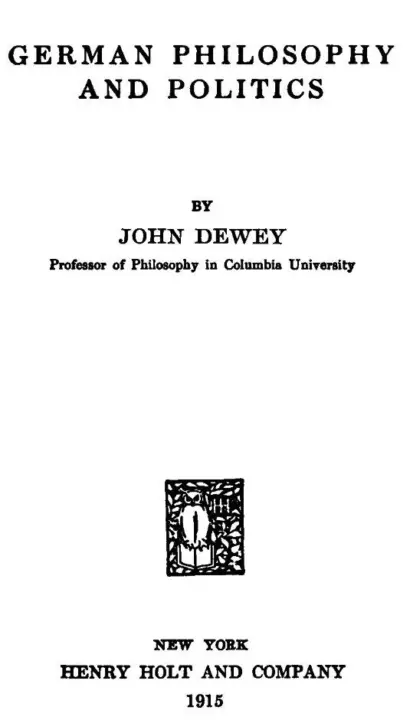
THE CLASSIC COLLECTION · 1915
"German Philosophy and Politics" by John Dewey is a collection of lectures written in the early 20th century. The work primarily examines the interplay between philosophical ideas, particularly those emanating from German thinkers, and their practical implications for politics and society. Dewey reflects on how these philosophical frameworks have influenced political thought and social structures in Germany, contributing to the understanding of modern European intellectual history. The opening of the text introduces Dewey's purpose of exploring the relationship between general ideas and practical affairs, questioning the assumption that philosophical concepts operate in a vacuum disconnected from real-world consequences. He critiques both historical and contemporary philosophies, emphasizing that ideas are often reactive to the socio-political context from which they arise. Dewey sets the stage for a discussion on how the evolution of German thought, from figures like Kant to Hegel, provides insight into the broader socio-political landscape of Germany, particularly in relation to state power and national identity. This complex interplay of philosophy and politics serves as a foundation for the lectures that follow.
Introduction adapted from the source catalogue; source summaries may be automatically generated.
Free to read · English · 26,300 words · No account needed
MAKE TIME FOR A GOOD BOOK
On by default. Untick to stop anonymous reading totals. Each page counts after 10 seconds in view. How this works.
Anonymous counting is on unless you have switched it off.
Bentham, 56
Bergson, 4
Bernhardi, 34-35, 52, 118
Bourdon, 107-108
Burke, 93-94
Chamberlain, 101 n.
Cosmopolitanism, 67, 75, 85, 99
Culture, 91
Descartes, 92
Despotism enlightened, 53
Dialectic, 70, 118
Duty, 24, 50-57
Education, 14, 72, 73
Empiricism, 41, 43, 126-129
Enlightenment, the, 37-39, 59, 92, 103
Eucken, 36, 55
Evolution, 112
Fichte, 68-80, 85-87
Formalism, 51
Freedom, 18, 25, 30, 33-35, 47, 51, 71, 115.
French Revolution, 57, 94, 103
French thought, 52, 91-94, 95, 100
Germania, 104
Germany, 14-16, 28, 29-31, 32-33, 36, 71, 78-81, 84-85, 88, 91-93,
94-98, 106-107
Haym, 107
Hegel, 94-95, 107-120, 125
Heine, 17, 18, 76, 83, 84-85
Herder, 112
History, 5-6, 59-67, 98-102, 107-119, 121
Hoffman, 81
Idealism, 28, 39, 70, 82, 107, 123, 130
Ideas and action, 3-15, 123-132
Individualism, 49, 72
Intelligence, 54-56, 126-128
Jena, 68
Kant, 19-40, 47-58, 59-67, 119-121
Kultur, 62-64
Lange, 78
Lasalle, 77
Law, 20-25, 116
Leibniz, 59, 112
Luther, 16, 27, 71, 87
Marx, 6, 110 n.
Militarism, 52
Napoleon, 67, 78-79
Nationalism, 67, 81, 86, 87, 115
Nietzsche, 28, 34, 58
Pantheism, 77, 82
Parliaments, 117
Personality, 48
Pfleiderer, 105
Philosophy, 7-18, 123-132
Property, 74
Psychology, Social, 82
Race, 100-101
Religion, 20-21, 26-27, 95
Rights, 52, 57
Romanticism, 81, 104, 122
Rousseau, 61, 91
Schelling, 82 n.
Scholar, 72
Science, 21-23, 28
Socialism, 74-75
Social motives, 60-61
Society, 64-65
State, 64-65, 66-67, 73-77, 110-118
Subjectivism, 49, 81
Supersensible, 23-25
Your reading position is saved on this browser. Take it to another device with a library code. Reading pages adapt to text, rather than matching a printed edition.
John Dewey
John Dewey
John Dewey
John Dewey
BEHIND THE BOOK
This eBook is for the use of anyone anywhere in the United States and most other parts of the world at no cost and with almost no restrictions whatsoever. You may copy it, give it away or re-use it under the terms of the Project Gutenberg License included with this eBook or online at www.gutenberg.org. If you are not located in the United States, you will have to check the laws of the country where you are located before using this eBook. Read the source licence.
The original source file, including credits and licence, is retained by this library. Request an original-format copy at no charge. Please include the book title and Project Gutenberg identifier #42208.
KEEP YOUR CURIOSITY GOING

David Patterson (Spirit) Hatch
Cécile Tormay

Moritz Busch
Coulson Kernahan
John L. Ransom

Ralph Waldo Emerson