THE CLASSIC COLLECTION✦An outlaw’s diary: the CommuneCLASSIC FREE BOOKS
An outlaw’s diary: the Commune
Cécile Tormay
THE CLASSIC COLLECTION · 1916
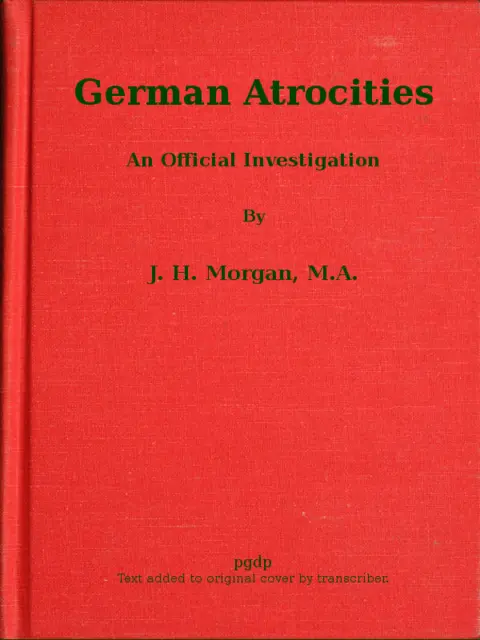
"German Atrocities: An Official Investigation" by J. H. Morgan is a historical account written in the early 20th century. This work investigates alleged atrocities committed by German forces during World War I, with an emphasis on a detailed analysis of the German White Book, which attempted to justify these actions. The book aims to compile evidence of war crimes and examine the credibility of claims made by both sides of the conflict. The opening portion of the text sets up the context for the investigation into German actions during the war, indicating that Morgan was commissioned to gather testimonies following allegations of breaches of international law by German troops. He details the methodology employed for collecting evidence, which involved direct inquiries with military personnel and analyzing reports by various diplomatic and military authorities. Morgan outlines a range of unique circumstances regarding the treatment of prisoners of war and the conduct of German soldiers in occupied areas, providing a critical framework for discussing the moral implications of these wartime actions. Through meticulous research, he aims to highlight the extent and systematic nature of the alleged atrocities.
Introduction adapted from the source catalogue; source summaries may be automatically generated.
Free to read · English · 46,828 words · No account needed
MAKE TIME FOR A GOOD BOOK
On by default. Untick to stop anonymous reading totals. Each page counts after 10 seconds in view. How this works.
Anonymous counting is on unless you have switched it off.
[60] Long ago--in 1870--Fustel de Coulanges pointed out that the crime which, to use the words of our law, “is not to be named among Christians,” flourished in Berlin as it flourished nowhere else, and the immorality of latter-day Germany was the subject of a mournful lamentation by Treitschke in his old age. An acute student of modern Germany, Dr. Arthur Shadwell, also remarks on the low commercial morality of German merchants (see the Nineteenth Century and After for August, 1915).
[61] It is a curious fact, attested by the evidence of a large number of British and French soldiers who have been in action, that the German soldier often exhibits the most abject fear when confronted individually with the bayonet, going down on his knees, and whining “Kamerad,” “Mercy,” and such like lachrymose appeals.
[62] Bryce Appendix, “Depositions taken by Professor Morgan,” page 195.
[63] Belgian Reports (Tenth Report), page 119. To the same effect the British and French Reports, passim.
[64] Admiralty Memorandum, August 21st. Commander’s report on the
stranding of E13.
[65] See Belgian Reports and Bryce Report.
[66] The writer has brought together a number of such passages in his preface to the German War Book. For others see Les Usages de la Guerre et la doctrine de l’Etat-Major Allemand, by Professor Charles Andler (Paris, 1915). Also Chapter I. of “Les Cruautés Allemandes, Requisitoire d’un neutre,” by Léon Maccas (Paris, 1915). And more especially the extremely valuable book published, at the moment of going to press, by an eminent French scholar, the Marquis de Dampierre, L’Allemagne et le Droit des Gens, a copy of which has just reached me.
[67] Sorel, Essais d’histoire et de critique, p. 271.
[68] German Proclamation of August 27th, 1914, at Wavre (Belgian Reports, No. 6, page 82). In the Proclamation at Namur of August 25th, 1914, the German commandant, von Bulow, warns the inhabitants against “the horrible crime” of compromising by their conduct the existence of the town and its inhabitants!
[69] Ibid., page 81.
[70] See p. 123.
[71] Holtzendorff, IV., 378.
[72] French Reports, Rapports et Proces-verbaux, p. 40.
[73] cf. the reply of the Roman Senate to the offer of a German chief to poison Arminius, “Responsum esse non fraude neque occultis, sed palam et armatum populum Romanum hostes suos ulcisci.” Tacit., Ann., II., p. 88.
[74] See the British White Paper of September 21st, 1915; “Austrian and German papers found in possession of James F. J. Archibald, Falmouth, August 30th, 1915.”
[75] Professor Salmond in the Law Quarterly Review.
[76] Mr. Justice Bailhache in the King v. the Superintendent of Vine Street Police Station. “The courts are entitled to take judicial notice of certain notorious facts. Spying has become the hall-mark of German Kultur.” September 7th, 1915.
Your reading position is saved on this browser. Take it to another device with a library code. Reading pages adapt to text, rather than matching a printed edition.
BEHIND THE BOOK
This eBook is for the use of anyone anywhere in the United States and most other parts of the world at no cost and with almost no restrictions whatsoever. You may copy it, give it away or re-use it under the terms of the Project Gutenberg License included with this eBook or online at www.gutenberg.org. If you are not located in the United States, you will have to check the laws of the country where you are located before using this eBook. Read the source licence.
The original source file, including credits and licence, is retained by this library. Request an original-format copy at no charge. Please include the book title and Project Gutenberg identifier #52679.
KEEP YOUR CURIOSITY GOING
Cécile Tormay

Moritz Busch
John L. Ransom
Frances Wright
Cécile Tormay

Mabel Potter Daggett