THE CLASSIC COLLECTION✦French life in town and countryCLASSIC FREE BOOKS
French life in town and country
Hannah Lynch
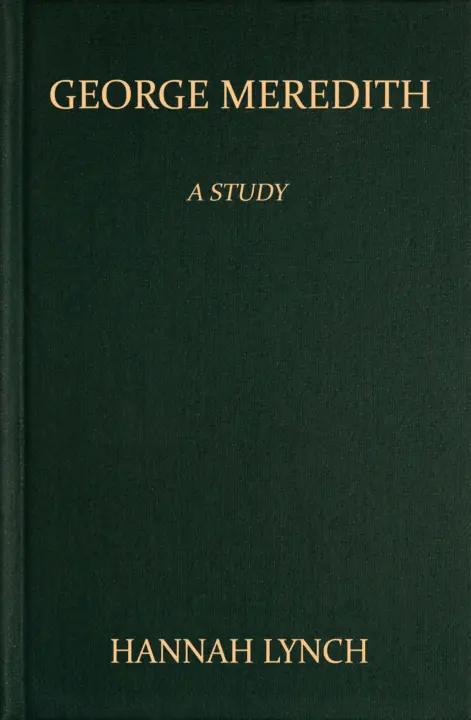
THE CLASSIC COLLECTION · 1891
"George Meredith: A Study" by Hannah Lynch is a critical literary analysis written in the late 19th century. The book examines the works and impact of George Meredith, a significant but often underappreciated English novelist and poet. Lynch delves into Meredith's themes, style, and the broader recognition he deserved in the literary world, highlighting his unique contributions to English literature. The opening of the text serves as an introduction to Lynch's exploration of Meredith's literary journey, beginning with her personal connection to him and the context for her study. She shares the anecdote of being prompted to lecture on Meredith, which led her to expand her thoughts into this book. The author discusses the general public's slow recognition of Meredith's talents, contrasting him with other prominent English writers. Lynch notes that while critics have often dismissed him, his work stands apart for its depth and complexity, suggesting that readers need to engage more thoughtfully with his challenging prose. The initial chapters outline how Meredith's novels reflect profound questions about human experiences, morality, and societal norms.
Introduction adapted from the source catalogue; source summaries may be automatically generated.
Free to read · English · 28,387 words · No account needed
MAKE TIME FOR A GOOD BOOK
On by default. Untick to stop anonymous reading totals. Each page counts after 10 seconds in view. How this works.
Anonymous counting is on unless you have switched it off.
It is a long time since I read this entrancing novel, and here in Paris, where I write, it is not attainable for reperusal. Hence many of the names of the characters have escaped my memory, though I can recall their personalities and actions vividly. I am still impressed with the acquaintance of a wonderful Greek--a Mr. Pericles, a wandering millionaire, ready upon hearsay to traverse Europe in the trail of undiscovered musical genius. Staying at the country house of one vulgar wealthy merchant, Mr. Pole, he unearths something like it in the voice of Emilia. The Pole family consists of three of those inimitable, ambitious, and diplomatic ladies that only Mr. Meredith hitherto has drawn us. I forget their names. There is a brother, Wilfred Pole, a cornet, one of those limp and flaccid jeunes premiers novelists and opera-composers are fond of selecting to sing the sweetest tenor in duet with the heroines. The hero of the novel, as of the opera, is usually the heroine’s foil, his unworthiness the shade against which her splendour and strength shine. There is a dreadful Irish widow, whose name I certainly remember--Mrs. Chumps. This awful creature is, like the Irishman of English comedy, purely the result of Saxon imagination dwelling upon our island without the illumination of personal knowledge of the race or the country. I have here in Paris met a Scotchwoman who gravely informed me that she was gathering materials for an Irish novel, though she admitted she had never been in Ireland, and her acquaintance of Irish people is exclusively confined to the few specimens of the race she had had the misfortune to meet with abroad. I shall be curious to see that novel when it appears, and fancy she is not the first Britisher to represent us to posterity upon materials for observation so slight and so misguiding. The only sympathy the lady mentioned appears to bring to her gigantic task is a partiality for a liquid as peculiar to the lowlands and highlands of Scotland as to the mountains and bogs of Ireland. May unlimited quantities of whisky enlighten her and enliven us! for she is bitten by a mighty hatred of the nameless Celt. Under such circumstances, barring the stimulus of mountain distillery, the widow Chumps seems to have been drawn. Her brogue savours more of the Thames than of the banks of the Suir. Such an Irish brogue is nowhere to be heard in Ireland. And there is something curiously alien to that country in her denseness and want of sensitiveness, for we know that pride and sensitiveness are the curses of the race. She is an old flame of Pole’s--‘me Pole’ she perpetually calls him, to the horror of the refined daughters and the elegant cornet; and as Mr. Pole has squandered her money entrusted to him, he is obliged to endure her overt tendernesses and force his children to bow to her. This contest produces several lively scenes, including the sequel when the widow finds she is betrayed and cheated and her Pole a bankrupt. Mr. Pericles adds to the liveliness, and also one Lady Something, who is almost in love with Wilfred, and plays an ugly trick on him and on Emilia by getting him to declare his passion for her and his indifference to Emilia within the latter’s hearing. The curtain drops on the degradation of the gallant cornet and the sorrowful enlightenment of Emilia. There is also a tragic figure of an organist and impoverished baronet, who loves one of the ladies of the Pole establishment, and commits suicide because she, loving him, must marry for her family, and several lively social youths and maidens and matrons, who act chorus, wittily, epigrammatically, and sprightlily, as Mr. Meredith’s chorus ever does. Then there are Italian politics--a favourite theme with the writer--an attractive Welsh brother and sister, and several unforgettable love-scenes; notably, one great passionate love-scene at Wilming Weir by moonlight, worthy to rank with those matchless chapters in ‘Richard Feverel.’ The lover himself is weaker and more pitiable than the average young gentleman elected by the novelist to pipe fluted sentimentalities to the sweet thrilling note of the heroine; a man--or a make-believe of man, which is by far the commoner article, for true and real men are rarer than true and real women, rare as these be--who could doubt the delicacy of Sandra’s passionate cry, ‘My lover!’ and who ‘could pledge himself to eternity, but shrank from being bound to eleven o’clock on the morrow morning.’ Writers are sometimes compunctious for the abasement to which they have submitted their heroines, and spare them the wedding-ring. Sandra does not marry Wilfred, and we hear of ‘the mellowed depth, the soft human warmth, which marriage had lent to her voice,’ afterwards in Italy. I forget whom she married, but I daresay it was her Welsh lover, the noble Italian enthusiast, blessed with a noble sister.
Your reading position is saved on this browser. Take it to another device with a library code. Reading pages adapt to text, rather than matching a printed edition.
Hannah Lynch
Hannah Lynch
Hannah Lynch
Hannah Lynch
BEHIND THE BOOK
This eBook is for the use of anyone anywhere in the United States and most other parts of the world at no cost and with almost no restrictions whatsoever. You may copy it, give it away or re-use it under the terms of the Project Gutenberg License included with this eBook or online at www.gutenberg.org. If you are not located in the United States, you will have to check the laws of the country where you are located before using this eBook. Read the source licence.
The original source file, including credits and licence, is retained by this library. Request an original-format copy at no charge. Please include the book title and Project Gutenberg identifier #67757.
KEEP YOUR CURIOSITY GOING

David Patterson (Spirit) Hatch

David Patterson (Spirit) Hatch

David Patterson (Spirit) Hatch

Ralph Waldo Emerson

Maurice Baring
Oscar Wilde & James McNeill Whistler