
Last letters from the living dead man
David Patterson (Spirit) Hatch
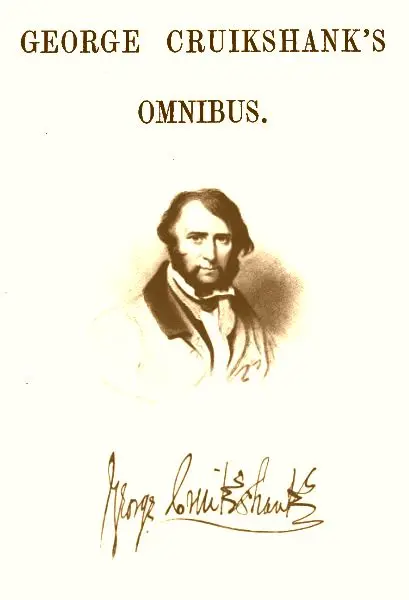
THE CLASSIC COLLECTION · 1842
"George Cruikshank's Omnibus" by George Cruikshank is a collection of illustrated works written in the early 19th century. This compilation showcases Cruikshank's artistic talent through a series of humorous and sometimes satirical essays, poems, and stories, featuring a variety of characters and themes reflective of Victorian society. The book promises to engage readers with its social commentary, whimsical illustrations, and the charm typical of Cruikshank’s style. The opening of this omnibus introduces readers to a preface that playfully addresses its younger audience, inviting them to explore a whimsical world of art, culture, and societal observations. Cruikshank describes his perspective as an artist navigating the curiosities and eccentricities of life, often employing humor to discuss serious subjects. Following the preface, we encounter a narrative focusing on “My Last Pair of Hessian Boots,” where the protagonist reminisces about his beloved boots, their mysterious disappearance, and the humorous misadventures that ensue as the boots seem to take on a life of their own. This sets the stage for Cruikshank’s engaging, illustrated storytelling that artfully blends humor with reflections on society.
Introduction adapted from the source catalogue; source summaries may be automatically generated.
Free to read · English · 167,330 words · No account needed
MAKE TIME FOR A GOOD BOOK
On by default. Untick to stop anonymous reading totals. Each page counts after 10 seconds in view. How this works.
Anonymous counting is on unless you have switched it off.
(10.) "And yet he can make himself exceedingly agreeable both in conversation and manners when he is in the humour so to do. I have met with persons who have been loaded with his civilities and attention. I know instances in which he has spent considerable time in showing strangers everything curious in the house; he is a collector of curiosities."
No single symp---- I was about to say that no single symptom of a curiosity, however insignificant, is visible in my dwelling, when by audible tokens I was (or rather am) rendered sensible of the existence of a pair of bellows. Well, in these it must be admitted that we do possess a curiosity. We call them "bellows," because, on a close inspection, they appear to bear a much stronger resemblance to "bellows" than to any other species of domestic implement; but what in reality they are, the next annual meeting of the great Scientific Association must determine; or the public may decide for themselves when admitted hereafter to view the precious deposit in the British Museum. In the mean time, I vainly essay to picture the unpicturable.
Eccentric, noseless, broken-winded, dilapidated, but immortal, these bellows have been condemned to be burnt a thousand times at least; but they are bellows of such an obstinate turn of mind that to destroy them is impossible. No matter how imperative the order--how immediate the hour of sacrifice, they are sure to escape. So much for old maxims; we may "sing old Rose," but we cannot "burn the bellows." As often as a family accident happens--such as the arrival of a new servant, or the sudden necessity for rekindling an expiring fire, out come the bellows, and forth go into the most secret and silent corners of the house such sounds of wheezing, squeaking, groaning, screaming, and sighing, as might be heard in a louder, but not more intolerable key, beneath the roaring fires of Etna. Then, rising above these mingled notes, issues the rapid ringing of two bells at once, succeeded by a stern injunction to the startled domestic "never on any account to use those bellows again," but, on the contrary, to burn, eject, and destroy them without reservation or remorse. One might as well issue orders to burn the east wind. A magic more powerful even than womanly tenderness preserves them; and six weeks afterwards forth rolls once more that world of wondrous noises. Let no one imagine that I have really sketched the bellows, unless I had sketched their multitudinous voice. What I have felt when drawing Punch is, that it was easy to represent his eyes, his nose, his mouth; but that the one essential was after all wanting--the squeak. The musician who undertook to convey by a single sound a sense of the peculiar smell of the shape of a drum, could alone picture to the eye the howlings and whisperings of the preternatural bellows. Now you hear a moaning as of one put to the torture, and may detect both the motion of the engine and the cracking of the joints; anon cometh a sound as of an old beldame half inebriated, coughing and chuckling. A sigh as from the depths of a woman's heart torn with love, or the "lover sighing like furnace," succeeds to this; and presently break out altogether--each separate note of the straining pack struggling to be foremost--the yelping of a cur, the bellowing of a schoolboy, the tones of a cracked flute played by a learner, the grinding of notched knives, the slow ringing of a muffled muffin-bell, the interrupted rush of water down a leaky pipe, the motion of a pendulum that does not know its own mind, the creaking of a prison-door, and the voice of one who crieth the last dying speech and confession; together with fifty thousand similar sounds, each as pleasant to the ear as "When am I to have the eighteen-pence" would be, to a man who never had a shilling since the day he was breeched. The origin of the bellows, I know not; but a suspicion has seized me that they might have been employed in the Ark had there been a kitchen-fire there; and they may have assisted in raising a flame under the first tea-kettle put on to celebrate the laying of the first stone of the great wall of China. They are ages upon ages older than the bellows of Simple Simon's mother; and were they by him to be ripped open, they could not possibly be deteriorated in quality. The bellows which yet bear the inscription,
Your reading position is saved on this browser. Take it to another device with a library code. Reading pages adapt to text, rather than matching a printed edition.
BEHIND THE BOOK
This eBook is for the use of anyone anywhere in the United States and most other parts of the world at no cost and with almost no restrictions whatsoever. You may copy it, give it away or re-use it under the terms of the Project Gutenberg License included with this eBook or online at www.gutenberg.org. If you are not located in the United States, you will have to check the laws of the country where you are located before using this eBook. Read the source licence.
The original source file, including credits and licence, is retained by this library. Request an original-format copy at no charge. Please include the book title and Project Gutenberg identifier #47400.
KEEP YOUR CURIOSITY GOING
David Patterson (Spirit) Hatch

David Patterson (Spirit) Hatch

David Patterson (Spirit) Hatch
Coulson Kernahan

Ralph Waldo Emerson

Maurice Baring