
Last letters from the living dead man
David Patterson (Spirit) Hatch
THE CLASSIC COLLECTION · 1842
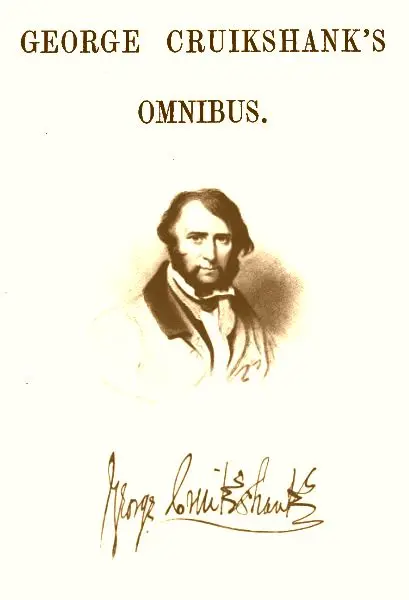
"George Cruikshank's Omnibus" by George Cruikshank is a collection of illustrated works written in the early 19th century. This compilation showcases Cruikshank's artistic talent through a series of humorous and sometimes satirical essays, poems, and stories, featuring a variety of characters and themes reflective of Victorian society. The book promises to engage readers with its social commentary, whimsical illustrations, and the charm typical of Cruikshank’s style. The opening of this omnibus introduces readers to a preface that playfully addresses its younger audience, inviting them to explore a whimsical world of art, culture, and societal observations. Cruikshank describes his perspective as an artist navigating the curiosities and eccentricities of life, often employing humor to discuss serious subjects. Following the preface, we encounter a narrative focusing on “My Last Pair of Hessian Boots,” where the protagonist reminisces about his beloved boots, their mysterious disappearance, and the humorous misadventures that ensue as the boots seem to take on a life of their own. This sets the stage for Cruikshank’s engaging, illustrated storytelling that artfully blends humor with reflections on society.
Introduction adapted from the source catalogue; source summaries may be automatically generated.
Free to read · English · 167,330 words · No account needed
MAKE TIME FOR A GOOD BOOK
On by default. Untick to stop anonymous reading totals. Each page counts after 10 seconds in view. How this works.
Anonymous counting is on unless you have switched it off.
He would rather inflict an injury on his friend, than act fairly himself.
He is disloyal, because he ought to grace his letter with the head of his Queen, and he declines doing so.
He prefers seeing his brother's two pockets picked, to having a hand thrust into one of his own.
He is an old fool, who wants to be thought young, and affects carelessness, because it is a youthful fault.
Rather than take a bottle of wine out of his own cellar, he would drink a couple at his neighbour's expense.
Sooner than experience a stamp on his toe, he would see his old father's
gouty feet trampled on.
He is ready to discharge a double-barrelled gun at anybody, to escape a
single shot at himself.
He would ride his friend's horse fifty miles, to save his own from a
journey of five-and-twenty.
To avoid an easy leap from the first-floor window, he would doom his nearest connexion to jump from the roof.
Rather than submit to the privation of half a meal, he would subject any human being to the misery of being dinnerless.
He is penny wise and twopence foolish. His penny saved is not a penny got, since the damage he occasions will recoil upon himself.
He is more mindful of the flourishing finances of the postmaster-general, than of the scanty funds of individuals who are dear to him.
He has no care for the revenue, for he shrinks from prompt payment.
He is dishonest, for rather than pay in advance he won't pay at all.
Above all, never listen to anything that may be urged in his defence. Never attach the slightest importance to such arguments as these:--
He is the best of patriots, because he raises a sinking revenue.
He is the best of friends, for he impels all whom he addresses to do good to the state at a slight cost to themselves.
He is the most loyal of men, for he cannot bear to part with his Queen's likeness, even upon a penny-piece.
He is a gentleman, and never has vulgar halfpence within reach.
He is kind to street-beggars, and gives away the penny in charity before he can get to the post-office.
He is well read in ancient literature, and knows that those who pay beforehand are the worst of paymasters.
He is delicate-minded, and feels that a pre-paid letter implies a supposition that the receiver would care about the postage.
His house is open to his acquaintances, who write so many notes there that he never has a stamp to use.
Your reading position is saved on this browser. Take it to another device with a library code. Reading pages adapt to text, rather than matching a printed edition.
BEHIND THE BOOK
This eBook is for the use of anyone anywhere in the United States and most other parts of the world at no cost and with almost no restrictions whatsoever. You may copy it, give it away or re-use it under the terms of the Project Gutenberg License included with this eBook or online at www.gutenberg.org. If you are not located in the United States, you will have to check the laws of the country where you are located before using this eBook. Read the source licence.
The original source file, including credits and licence, is retained by this library. Request an original-format copy at no charge. Please include the book title and Project Gutenberg identifier #47400.
KEEP YOUR CURIOSITY GOING
David Patterson (Spirit) Hatch

David Patterson (Spirit) Hatch

David Patterson (Spirit) Hatch
Coulson Kernahan

Ralph Waldo Emerson

Maurice Baring