THE CLASSIC COLLECTION✦The Catholic Church and conversionCLASSIC FREE BOOKS
The Catholic Church and conversion
G. K. (Gilbert Keith) Chesterton
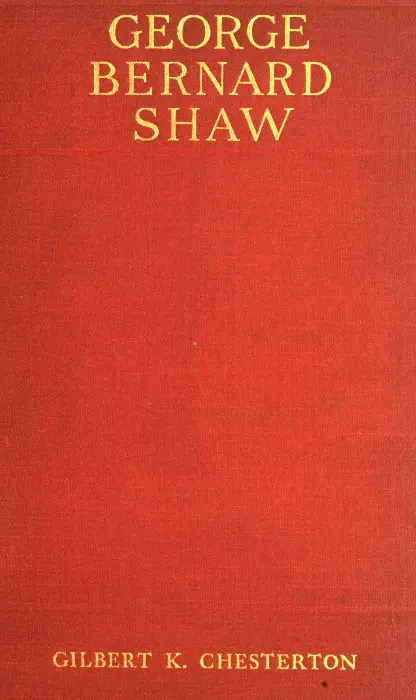
THE CLASSIC COLLECTION · 1909
"George Bernard Shaw" by G. K. Chesterton is a biographical study written in the early 20th century. The book delves into the complex personality and influences of the renowned playwright and critic George Bernard Shaw, exploring themes of Irish identity, Puritan values, and progressivism. The narrative sets the stage for a broader examination of Shaw's impact on theatre and society while highlighting his unique blend of intellect and audacity. The opening of the book introduces the challenge of encapsulating Bernard Shaw's multifaceted nature. Chesterton prompts the reader to understand Shaw not just as a figure of his time but as a product of three distinct influences: his Irish heritage, Puritan upbringing, and a spirit of progressivism. He reflects on common misconceptions about Shaw, particularly the idea that he is understood by only a few or that his long-windedness is indicative of vagueness rather than depth. The text serves as an insightful prelude to a deeper exploration of Shaw's life, summarizing the key influences that shaped his thoughts and works, setting the tone for a rich analysis of one of literature's most provocative figures.
Introduction adapted from the source catalogue; source summaries may be automatically generated.
Free to read · English · 52,508 words · No account needed
MAKE TIME FOR A GOOD BOOK
On by default. Untick to stop anonymous reading totals. Each page counts after 10 seconds in view. How this works.
Anonymous counting is on unless you have switched it off.
This blindness to paradox everywhere perplexes his outlook. He cannot understand marriage because he will not understand the paradox of marriage; that the woman is all the more the house for not being the head of it. He cannot understand patriotism, because he will not understand the paradox of patriotism; that one is all the more human for not merely loving humanity. He does not understand Christianity because he will not understand the paradox of Christianity; that we can only really understand all myths when we know that one of them is true. I do not under-rate him for this anti-paradoxical temper; I concede that much of his finest and keenest work in the way of intellectual purification would have been difficult or impossible without it. But I say that here lies the limitation of that lucid and compelling mind; he cannot quite understand life, because he will not accept its contradictions.
Nor is it by any means descriptive of Shaw to call him a Socialist; in so far as that word can be extended to cover an ethical attitude. He is the least social of all Socialists; and I pity the Socialist state that tries to manage him. This anarchism of his is not a question of thinking for himself; every decent man thinks for himself; it would be highly immodest to think for anybody else. Nor is it any instinctive licence or egoism; as I have said before, he is a man of peculiarly acute public conscience. The unmanageable part of him, the fact that he cannot be conceived as part of a crowd or as really and invisibly helping a movement, has reference to another thing in him, or rather to another thing not in him.
The great defect of that fine intelligence is a failure to grasp and enjoy the things commonly called convention and tradition; which are foods upon which all human creatures must feed frequently if they are to live. Very few modern people of course have any idea of what they are. "Convention" is very nearly the same word as "democracy." It has again and again in history been used as an alternative word to Parliament. So far from suggesting anything stale or sober, the word convention rather conveys a hubbub; it is the coming together of men; every mob is a convention. In its secondary sense it means the common soul of such a crowd, its instinctive anger at the traitor or its instinctive salutation of the flag. Conventions may be cruel, they may be unsuitable, they may even be grossly superstitious or obscene; but there is one thing that they never are. Conventions are never dead. They are always full of accumulated emotions, the piled-up and passionate experiences of many generations asserting what they could not explain. To be inside any true convention, as the Chinese respect for parents or the European respect for children, is to be surrounded by something which whatever else it is is not leaden, lifeless or automatic, something which is taut and tingling with vitality at a hundred points, which is sensitive almost to madness and which is so much alive that it can kill. Now Bernard Shaw has always made this one immense mistake (arising out of that bad progressive education of his), the mistake of treating convention as a dead thing; treating it as if it were a mere physical environment like the pavement or the rain. Whereas it is a result of will; a rain of blessings and a pavement of good intentions. Let it be remembered that I am not discussing in what degree one should allow for tradition; I am saying that men like Shaw do not allow for it at all. If Shaw had found in early life that he was contradicted by Bradshaw's Railway Guide or even by the Encyclopaedia Britannica, he would have felt at least that he might be wrong. But if he had found himself contradicted by his father and mother, he would have thought it all the more probable that he was right. If the issue of the last evening paper contradicted him he might be troubled to investigate or explain. That the human tradition of two thousand years contradicted him did not trouble him for an instant. That Marx was not with him was important. That Man was not with him was an irrelevant prehistoric joke. People have talked far too much about the paradoxes of Bernard Shaw. Perhaps his only pure paradox is this almost unconscious one; that he has tended to think that because something has satisfied generations of men it must be untrue.
Your reading position is saved on this browser. Take it to another device with a library code. Reading pages adapt to text, rather than matching a printed edition.
G. K. (Gilbert Keith) Chesterton
G. K. (Gilbert Keith) Chesterton
G. K. (Gilbert Keith) Chesterton
G. K. (Gilbert Keith) Chesterton
BEHIND THE BOOK
This eBook is for the use of anyone anywhere in the United States and most other parts of the world at no cost and with almost no restrictions whatsoever. You may copy it, give it away or re-use it under the terms of the Project Gutenberg License included with this eBook or online at www.gutenberg.org. If you are not located in the United States, you will have to check the laws of the country where you are located before using this eBook. Read the source licence.
The original source file, including credits and licence, is retained by this library. Request an original-format copy at no charge. Please include the book title and Project Gutenberg identifier #19535.
KEEP YOUR CURIOSITY GOING

Charles G. (Charles Griffith) Ross
Hannah Webster Foster

Emily Lawless
Edwin Hamlin Carr

Charles De Lano Hine
Andrew Ure