THE CLASSIC COLLECTION✦The Catholic Church and conversionCLASSIC FREE BOOKS
The Catholic Church and conversion
G. K. (Gilbert Keith) Chesterton
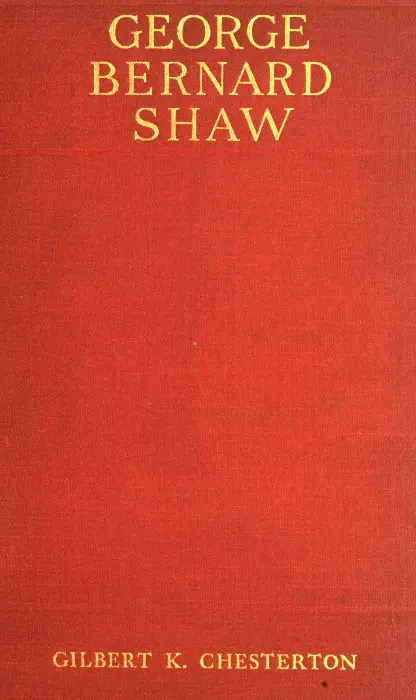
THE CLASSIC COLLECTION · 1909
"George Bernard Shaw" by G. K. Chesterton is a biographical study written in the early 20th century. The book delves into the complex personality and influences of the renowned playwright and critic George Bernard Shaw, exploring themes of Irish identity, Puritan values, and progressivism. The narrative sets the stage for a broader examination of Shaw's impact on theatre and society while highlighting his unique blend of intellect and audacity. The opening of the book introduces the challenge of encapsulating Bernard Shaw's multifaceted nature. Chesterton prompts the reader to understand Shaw not just as a figure of his time but as a product of three distinct influences: his Irish heritage, Puritan upbringing, and a spirit of progressivism. He reflects on common misconceptions about Shaw, particularly the idea that he is understood by only a few or that his long-windedness is indicative of vagueness rather than depth. The text serves as an insightful prelude to a deeper exploration of Shaw's life, summarizing the key influences that shaped his thoughts and works, setting the tone for a rich analysis of one of literature's most provocative figures.
Introduction adapted from the source catalogue; source summaries may be automatically generated.
Free to read · English · 52,508 words · No account needed
MAKE TIME FOR A GOOD BOOK
On by default. Untick to stop anonymous reading totals. Each page counts after 10 seconds in view. How this works.
Anonymous counting is on unless you have switched it off.
This quite vague and varied discontent probably did lead to the revelation of many incidental wrongs and to much humane hard work in certain holes and corners. It also gave birth to a great deal of quite futile and frantic speculation, which seemed destined to take away babies from women, or to give votes to tom-cats. But it had an evil in it much deeper and more psychologically poisonous than any superficial absurdities. There was in this thirst to be "progressive" a subtle sort of double-mindedness and falsity. A man was so eager to be in advance of his age that he pretended to be in advance of himself. Institutions that his wholesome nature and habit fully accepted he had to sneer at as old-fashioned, out of a servile and snobbish fear of the future. Out of the primal forests, through all the real progress of history, man had picked his way obeying his human instinct, or (in the excellent phrase) following his nose. But now he was trying, by violent athletic exertions, to get in front of his nose.
Into this riot of all imaginary innovations Shaw brought the sharp edge of the Irishman and the concentration of the Puritan, and thoroughly thrashed all competitors in the difficult art of being at once modern and intelligent. In twenty twopenny controversies he took the revolutionary side, I fear in most cases because it was called revolutionary. But the other revolutionists were abruptly startled by the presentation of quite rational and ingenious arguments on their own side. The dreary thing about most new causes is that they are praised in such very old terms. Every new religion bores us with the same stale rhetoric about closer fellowship and the higher life. No one ever approximately equalled Bernard Shaw in the power of finding really fresh and personal arguments for these recent schemes and creeds. No one ever came within a mile of him in the knack of actually producing a new argument for a new philosophy. I give two instances to cover the kind of thing I mean. Bernard Shaw (being honestly eager to put himself on the modern side in everything) put himself on the side of what is called the feminist movement; the proposal to give the two sexes not merely equal social privileges, but identical. To this it is often answered that women cannot be soldiers; and to this again the sensible feminists answer that women run their own kind of physical risk, while the silly feminists answer that war is an outworn barbaric thing which women would abolish. But Bernard Shaw took the line of saying that women had been soldiers, in all occasions of natural and unofficial war, as in the French Revolution. That has the great fighting value of being an unexpected argument; it takes the other pugilist's breath away for one important instant. To take the other case, Mr. Shaw has found himself, led by the same mad imp of modernity, on the side of the people who want to have phonetic spelling. The people who want phonetic spelling generally depress the world with tireless and tasteless explanations of how much easier it would be for children or foreign bagmen if "height" were spelt "hite." Now children would curse spelling whatever it was, and we are not going to permit foreign bagmen to improve Shakespeare. Bernard Shaw charged along quite a different line; he urged that Shakespeare himself believed in phonetic spelling, since he spelt his own name in six different ways. According to Shaw, phonetic spelling is merely a return to the freedom and flexibility of Elizabethan literature. That, again, is exactly the kind of blow the old speller does not expect. As a matter of fact there is an answer to both the ingenuities I have quoted. When women have fought in revolutions they have generally shown that it was not natural to them, by their hysterical cruelty and insolence; it was the men who fought in the Revolution; it was the women who tortured the prisoners and mutilated the dead. And because Shakespeare could sing better than he could spell, it does not follow that his spelling and ours ought to be abruptly altered by a race that has lost all instinct for singing. But I do not wish to discuss these points; I only quote them as examples of the startling ability which really brought Shaw to the front; the ability to brighten even our modern movements with original and suggestive thoughts.
Your reading position is saved on this browser. Take it to another device with a library code. Reading pages adapt to text, rather than matching a printed edition.
G. K. (Gilbert Keith) Chesterton
G. K. (Gilbert Keith) Chesterton
G. K. (Gilbert Keith) Chesterton
G. K. (Gilbert Keith) Chesterton
BEHIND THE BOOK
This eBook is for the use of anyone anywhere in the United States and most other parts of the world at no cost and with almost no restrictions whatsoever. You may copy it, give it away or re-use it under the terms of the Project Gutenberg License included with this eBook or online at www.gutenberg.org. If you are not located in the United States, you will have to check the laws of the country where you are located before using this eBook. Read the source licence.
The original source file, including credits and licence, is retained by this library. Request an original-format copy at no charge. Please include the book title and Project Gutenberg identifier #19535.
KEEP YOUR CURIOSITY GOING

Charles G. (Charles Griffith) Ross
Hannah Webster Foster

Emily Lawless
Edwin Hamlin Carr

Charles De Lano Hine
Andrew Ure