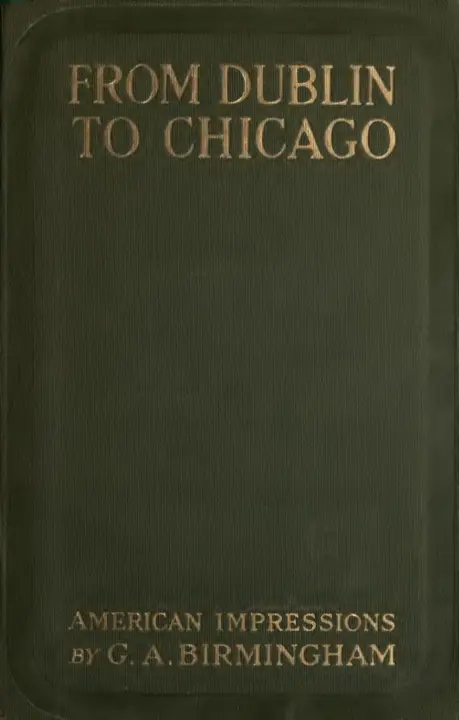
From Dublin to Chicago: Some Notes on a Tour in America
George A. Birmingham
THE CLASSIC COLLECTION · 1913
"General John Regan" by George A. Birmingham is a novel written in the early 20th century. The book is set in a small Irish town called Ballymoy and revolves around a quirky ensemble of characters including Constable Moriarty, Sergeant Colgan, and an American named Mr. Billing, who arrives in town to write a biography of General John Regan, a figure of some historical significance. The narrative weaves themes of local politics, community quirks, and a burgeoning plan to erect a statue in honor of this mysterious general. The opening of the story introduces readers to the austere environment of the Irish police barrack where Constable Moriarty finds himself grappling with boredom on a sweltering day. As he daydreams and interacts with the local peasant girl Mary Ellen, an opulent motor car arrives, attracting the attention of Moriarty and the townsfolk. Mr. Billing exits the car, revealing his intent to pay homage to General Regan, which catalyzes a series of comedic misunderstandings among the town's residents about the general's identity and the feasibility of erecting a statue in his name. Gallagher, the local newspaper editor, finds himself caught in a web of deception and local lore as they sidestep questions regarding the statue and the true history of General Regan, setting the stage for further intrigue and humor in the unfolding narrative.
Introduction adapted from the source catalogue; source summaries may be automatically generated.
Free to read · English · 77,154 words · No account needed
MAKE TIME FOR A GOOD BOOK
On by default. Untick to stop anonymous reading totals. Each page counts after 10 seconds in view. How this works.
Anonymous counting is on unless you have switched it off.
“It’s more than a hundred,” said Doyle. “What do you make it, Thady?”
“Counting 4s. 2d. to the dollar,” said Gallagher, “it comes to———”
“There’s a halfpenny along with that,” said Doyle, “as often as not.”
“Anyway,” said Gallagher, “it won’t be less than £104 3s. 4d.”
“The Urban District Council,” said Doyle, “will take a delight in passing that vote of thanks to Mr. Billing at its next meeting, and it’ll be a good strong vote, won’t it, Thady?”
“As strong as ever any one that was passed about the landlords,” said Gallagher, “only different, of course, mighty different.”
“Look here, O’Grady,” said Major Kent. “What do you mean by saying that I’m going to subscribe £5? Who is this General you’re all talking about?”
“Do shut up, Major,” said Dr. O’Grady. “Everything’s all right if you’ll only keep quiet. As you’ve got a camera with you, Mr. Billing,” he went on, “you might like to take a photograph of that house opposite you. It was there that the great General——”
“Glory be to God,” said Gallagher, “it’s the police barrack!”
“The birthplace of the great General?” said Mr. Billing, taking off his
hat.
“Not exactly,” said Dr. O’Grady. “Thady Gallagher will show you his birthplace this afternoon. This is the house in which he spent his early youth, up to the age of eleven years.”
“Excuse me,” said Mr. Billing. “I’ll just get my camera. A view of that house will be most interesting. I certainly ought to have it for my biography.”
He crossed the road to the hotel and picked up his camera. He carried it to the middle of the square and set up the tripod legs. Then he screwed the camera into its place.
“O’Grady,” said Major Kent, angrily. “I don’t want to make a public exposure of you before a total stranger, but if you don’t stop trying to make fools of us all———”
“I don’t know what you’re talking about, Major,” said the doctor. “I’m not making a fool of anyone. I’m helping to persuade Mr. Billing to erect a statue in this town. You can’t deny that a statue would be an improvement to the place.”
“A statue!” said the Major. “Who to?”
“Good Heavens!” said Dr. O’Grady, “haven’t you grasped that yet? To General John Regan.”
Mr. Billing had his head under a black cloth. He was screwing the lens of his camera backwards and forwards and appeared to be entirely absorbed in his photography.
Your reading position is saved on this browser. Take it to another device with a library code. Reading pages adapt to text, rather than matching a printed edition.
George A. Birmingham
George A. Birmingham
George A. Birmingham
George A. Birmingham
BEHIND THE BOOK
This eBook is for the use of anyone anywhere in the United States and most other parts of the world at no cost and with almost no restrictions whatsoever. You may copy it, give it away or re-use it under the terms of the Project Gutenberg License included with this eBook or online at www.gutenberg.org. If you are not located in the United States, you will have to check the laws of the country where you are located before using this eBook. Read the source licence.
The original source file, including credits and licence, is retained by this library. Request an original-format copy at no charge. Please include the book title and Project Gutenberg identifier #24073.
KEEP YOUR CURIOSITY GOING
Coulson Kernahan

Maurice Baring
Frances Wright
Cécile Tormay

Frederic Jesup Stimson

W. H. P. (William Henry Pope) Jarvis