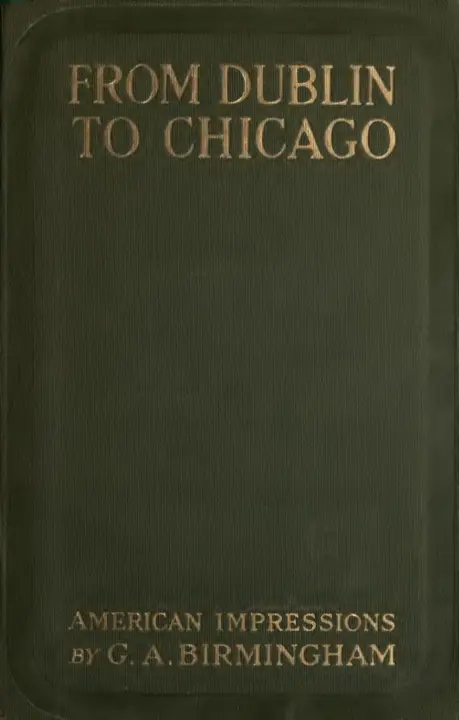
From Dublin to Chicago: Some Notes on a Tour in America
George A. Birmingham
THE CLASSIC COLLECTION · 1913
"General John Regan" by George A. Birmingham is a novel written in the early 20th century. The book is set in a small Irish town called Ballymoy and revolves around a quirky ensemble of characters including Constable Moriarty, Sergeant Colgan, and an American named Mr. Billing, who arrives in town to write a biography of General John Regan, a figure of some historical significance. The narrative weaves themes of local politics, community quirks, and a burgeoning plan to erect a statue in honor of this mysterious general. The opening of the story introduces readers to the austere environment of the Irish police barrack where Constable Moriarty finds himself grappling with boredom on a sweltering day. As he daydreams and interacts with the local peasant girl Mary Ellen, an opulent motor car arrives, attracting the attention of Moriarty and the townsfolk. Mr. Billing exits the car, revealing his intent to pay homage to General Regan, which catalyzes a series of comedic misunderstandings among the town's residents about the general's identity and the feasibility of erecting a statue in his name. Gallagher, the local newspaper editor, finds himself caught in a web of deception and local lore as they sidestep questions regarding the statue and the true history of General Regan, setting the stage for further intrigue and humor in the unfolding narrative.
Introduction adapted from the source catalogue; source summaries may be automatically generated.
Free to read · English · 77,154 words · No account needed
MAKE TIME FOR A GOOD BOOK
On by default. Untick to stop anonymous reading totals. Each page counts after 10 seconds in view. How this works.
Anonymous counting is on unless you have switched it off.
“My friend Mr. Doyle,” said Dr. O’Grady, “has a proposal to lay before the meeting. Where’s that card, Doyle, that you showed me last week?”
Doyle drew a bundle of grimy papers from his breast pocket and went through them slowly. One, which appeared to be a letter written on business paper, he laid on the table in front of him. At the bottom of the bundle he came on a large card. He handed this to Father McCormack. The printing on it was done in Curiously shaped letters, evidently artistic in intention, with a tendency towards the ecclesiastical. Round the outside of the card was a deep border of black, as if the owner of it were in mourning for a near relative.
Father McCormack looked at it dubiously.
“Read it out,” said Dr. O’Grady. “I’d like the Major to hear exactly what’s on it.”
“‘Mr. Aloysius Doyle,’” read Father McCormack.
“He’s a nephew of my own,” said Doyle.
“He would be,” said Gallagher. “If he wasn’t we’d hear nothing about
him.”
He was still feeling sore about the “Battle March of King Malachi the Brave,” and was anxious to make himself disagreeable to someone. It struck him that it would be easy to annoy Doyle by suggesting that he was trying to do a good turn to his nephew at the expense of the statue fund.
“I needn’t tell you, gentlemen,” said Doyle, with great dignity, “that it’s not on account of his being a nephew of my own that I’m recommending him to the notice of this committee. If he was fifty times my nephew I wouldn’t mention his name without I was sure that he was as good a man as any other for the job we have on hand.”
No one, of course, believed this, but no one wanted to argue with Doyle about it. Father McCormack went on reading from the black-edged card which he held in his hand.
“‘Mortuary Sculptor,’”
“Sculptor!” said Dr. O’Grady. “You hear that, Major, don’t you? Sculptors are people who make statues.”
“Mortuary sculptors, I suppose,” said the Major viciously, “make statues
of dead men.”
“The General’s dead anyway,” said Doyle, “so that’s suitable enough.”
“‘Address—The Monumental Studio, Michael Angelo House, Great Brunswick. Street, Dublin,’” read Father McCormack. “That’ll be where your nephew lives, Mr. Doyle?”
“It’s where he has his works,” said Doyle. “He lives down near
Sandymount.”
“‘Celtic Crosses, Obelisks and every kind of Monument supplied at the shortest notice,’” said Father McCormack, still reading from the card. “‘Family Vaults decorated. Inscriptions Cut. Estimates Free. Low Prices’.”
Your reading position is saved on this browser. Take it to another device with a library code. Reading pages adapt to text, rather than matching a printed edition.
George A. Birmingham

George A. Birmingham
George A. Birmingham
George A. Birmingham
BEHIND THE BOOK
This eBook is for the use of anyone anywhere in the United States and most other parts of the world at no cost and with almost no restrictions whatsoever. You may copy it, give it away or re-use it under the terms of the Project Gutenberg License included with this eBook or online at www.gutenberg.org. If you are not located in the United States, you will have to check the laws of the country where you are located before using this eBook. Read the source licence.
The original source file, including credits and licence, is retained by this library. Request an original-format copy at no charge. Please include the book title and Project Gutenberg identifier #24073.
KEEP YOUR CURIOSITY GOING
Coulson Kernahan

Maurice Baring
Frances Wright
Cécile Tormay

Frederic Jesup Stimson

W. H. P. (William Henry Pope) Jarvis