THE CLASSIC COLLECTION✦My diaries, being a personal narrative of events 1888-1914, Part 2 (1900-1914)CLASSIC FREE BOOKS
My diaries, being a personal narrative of events 1888-1914, Part 2 (1900-1914)
Wilfrid Scawen Blunt
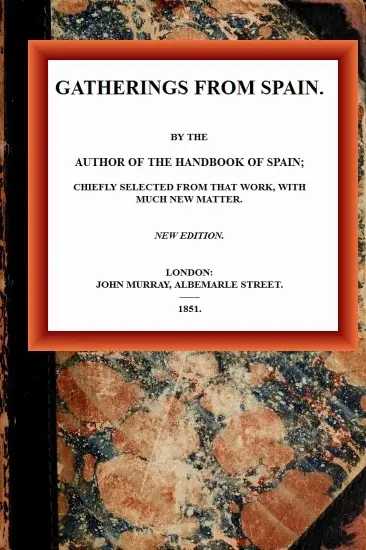
THE CLASSIC COLLECTION · 1846
"Gatherings from Spain" by Richard Ford is a travelogue and cultural commentary written in the mid-19th century. The work is primarily a compilation of observations and analyses about Spain’s regions, characteristics, and customs, tailored especially for individuals contemplating a visit. The author delves into the complex sociopolitical landscape of Spain, highlighting regional distinctions and the nation's rich heritage and contemporary shifts. The opening of the book introduces the reader to Spain's geographical and cultural diversity, emphasizing its composition of distinct provinces that were once independent kingdoms. Ford discusses the isolation created by mountains and rivers, which perpetuates localism among the Spanish people. He critiques the notion of a unified Spain, illustrating how each province retains its unique identity and characteristics that differ significantly from one another. Through anecdotes and historical references, Ford sets the stage for a deeper exploration of Spanish society, geography, and the nuances of travel within this captivating yet fragmented nation.
Introduction adapted from the source catalogue; source summaries may be automatically generated.
Free to read · English · 136,429 words · No account needed
MAKE TIME FOR A GOOD BOOK
On by default. Untick to stop anonymous reading totals. Each page counts after 10 seconds in view. How this works.
Anonymous counting is on unless you have switched it off.
Another mode of travelling is by riding post, accompanied by a mounted postilion, who is changed with the cattle at each relay. It is an expeditious but fatiguing plan; yet one which, like the Tartar courier of the East, has long prevailed in Spain. Thus our Charles I. rode to Madrid under the name of John Smith, by which he was not likely to be identified. The delight of Philip II., who boasted that he governed the world from the Escorial, was to receive frequent and early intelligence; and this desire to hear something new is still characteristic of the Spanish government. The cabinet-couriers have the preference of horses at every relay. The particular distances they have to perform are all timed, and so many leagues are required to be done in a fixed time; and, in order to encourage despatch, for every hour gained on the allowed time, an additional sum was paid to them: hence the common expression “ganando horas” gaining hours--equivalent to our old “post haste--haste for your life.”
[Sidenote: DILIGENCES.]
[Sidenote: EXPENSES ON THE ROAD.]
The usual mode of travelling for the affluent is in the public conveyances, which are the fashion from being novelties and only introduced under Ferdinand VII.; previously to their being allowed at all, serious objections were started, similar to those raised by his late Holiness to the introduction of railways into the papal states; it was said that these tramontane facilities would bring in foreigners, and with them philosophy, heresy, and innovations, by which the wisdom of Spain’s ancestors might be upset. These scruples were ingeniously got over by bribing the monarch with a large share of the profits. Now that the royal monopoly is broken down, many new and competing companies have sprung up; this mode of travelling is the cheapest and safest, nor is it thought at all beneath the dignity of “the best set,” nay royalty itself goes by the coach. Thus the Infante Don Francisco de Paula constantly hires the whole of the diligence to convey himself and his family from Madrid to the sea-coast; and one reason gravely given for Don Enrique’s not coming to marry the Queen, was that his Royal Highness could not get a place, as the dilly was booked full. The public carriages of Spain are quite as good as those of France, and the company who travel in them generally more respectable and better bred. This is partly accounted for by the expense: the fares are not very high, yet still form a serious item to the bulk of Spaniards; consequently those who travel in the public carriages in Spain are the class who would in other countries travel per post. It must, however, be admitted that all travelling in the public conveyances of the Continent necessarily implies great discomfort to those accustomed to their own carriages; and with every possible precaution the long journeys in Spain, of three to five hundred miles at a stretch, are such as few English ladies can undergo, and are, even with men, undertakings rather of necessity than of pleasure. The mail is organized on the plan of the French malle-poste, and offers, to those who can stand the bumping, shaking, and churning of continued and rapid travelling without halting, a means of locomotion which leaves nothing to be desired. The diligences also are imitations of the lumbering French model. It will be in vain to expect in them the neatness, the well-appointed turn-out, the quiet, time-keeping, and infinite facilities of the English original. These matters when passed across the water are modified to the heroic Continental contempt for doing things in style; cheapness, which is their great principle, prefers rope-traces to those of leather, and a carter to a regular coachman; the usual foreign drags also exist, which render their slow coaches and bureaucratic absurdities so hateful to free Britons; but when one is once booked and handed over to the conductor, you arrive in due time at the journey’s end. The “guards” are realities; they consist of stout, armed, most picturesque, robber-like men and no mistake, since many, before they were pardoned and pensioned, have frequently taken a purse on the Queen’s highway; for the foreground of your first sketch, they are splendid fellows, and worth a score of marshals. They are provided with a complete arsenal of swords and blunderbusses, so that the cumbrous machine rolling over the sea of plains looks like a man-of-war, and has been compared to a marching citadel. Again in suspicious localities a mounted escort of equally suspicious look gallops alongside, nor is the primitive practice of black mail altogether neglected: the consequence of these admirable precautions is, that the diligences are seldom or never robbed; the thing, however, is possible.
Your reading position is saved on this browser. Take it to another device with a library code. Reading pages adapt to text, rather than matching a printed edition.
BEHIND THE BOOK
This eBook is for the use of anyone anywhere in the United States and most other parts of the world at no cost and with almost no restrictions whatsoever. You may copy it, give it away or re-use it under the terms of the Project Gutenberg License included with this eBook or online at www.gutenberg.org. If you are not located in the United States, you will have to check the laws of the country where you are located before using this eBook. Read the source licence.
The original source file, including credits and licence, is retained by this library. Request an original-format copy at no charge. Please include the book title and Project Gutenberg identifier #41611.
KEEP YOUR CURIOSITY GOING
Wilfrid Scawen Blunt
Wilfrid Scawen Blunt

E. W. (Edgar Watson) Howe
Cécile Tormay

Moritz Busch
John L. Ransom