THE CLASSIC COLLECTION✦My diaries, being a personal narrative of events 1888-1914, Part 2 (1900-1914)CLASSIC FREE BOOKS
My diaries, being a personal narrative of events 1888-1914, Part 2 (1900-1914)
Wilfrid Scawen Blunt
THE CLASSIC COLLECTION · 1846
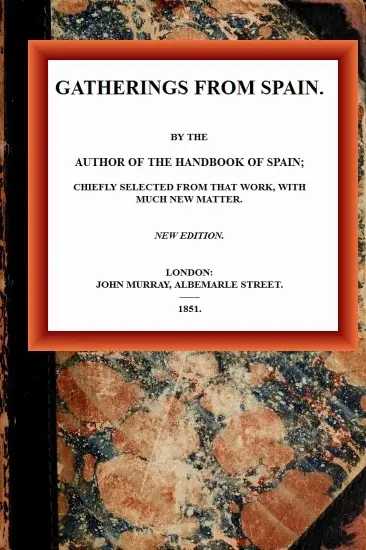
"Gatherings from Spain" by Richard Ford is a travelogue and cultural commentary written in the mid-19th century. The work is primarily a compilation of observations and analyses about Spain’s regions, characteristics, and customs, tailored especially for individuals contemplating a visit. The author delves into the complex sociopolitical landscape of Spain, highlighting regional distinctions and the nation's rich heritage and contemporary shifts. The opening of the book introduces the reader to Spain's geographical and cultural diversity, emphasizing its composition of distinct provinces that were once independent kingdoms. Ford discusses the isolation created by mountains and rivers, which perpetuates localism among the Spanish people. He critiques the notion of a unified Spain, illustrating how each province retains its unique identity and characteristics that differ significantly from one another. Through anecdotes and historical references, Ford sets the stage for a deeper exploration of Spanish society, geography, and the nuances of travel within this captivating yet fragmented nation.
Introduction adapted from the source catalogue; source summaries may be automatically generated.
Free to read · English · 136,429 words · No account needed
MAKE TIME FOR A GOOD BOOK
On by default. Untick to stop anonymous reading totals. Each page counts after 10 seconds in view. How this works.
Anonymous counting is on unless you have switched it off.
[Sidenote: MUSIC IN VENTAS.]
The real opera of Spain is in the shop of the Barbero or in the court-yard of the Venta; in truth, good music, whether harmonious or scientific, vocal or instrumental, is seldom heard in this land, notwithstanding the eternal strumming and singing that is going on there. The very masses, as performed in the cathedrals, from the introduction of the pianoforte and the violin, have very little impressive or devotional character. The fiddle disenchants. Even Murillo, when he clapped catgut under a cherub chin in the clouds, thereby damaged the angelic sentiment. Let none despise the genuine songs and instruments of the Peninsula, as excellence in music is multiform, and much of it, both in name and substance, is conventional. Witness a whining ballad sung by a chorus out of work, to encoring crowds in the streets of merry old England, or a bagpipe-tune played in Ross-shire, which enchants the Highlanders, who cry that strain again, but scares away the gleds. Let therefore the Spaniards enjoy also what they call music, although fastidious foreigners condemn it as Iberian and Oriental. They love to have it so, and will have their own way, in their own time and tune, Rossini and Paganini to the contrary notwithstanding. They--not the Italians--are listened to by a delighted semi-Moro audience, with a most profound Oriental and melancholy attention. Like their love, their music, which is its food, is a serious affair; yet the sad song, the guitar, and dance, at this moment, form the joy of careless poverty, the repose of sunburnt labour. The poor forget their toils, sans six sous et sans souci; nay, even their meals, like Pliny’s friend Claro, who lost his supper, Bætican olives and gazpacho, to run after a Gaditanian dancing-girl.
[Sidenote: THE GUITAR.]
In venta and court-yard, in spite of a long day’s work and scanty fare, at the sound of the guitar and click of the castanet, a new life is breathed into their veins. So far from feeling past fatigue, the very fatigue of the dance seems refreshing, and many a weary traveller will rue the midnight frolics of his noisy and saltatory fellow-lodgers. Supper is no sooner over than “après la panse la danse,”--some muscular masculine performer, the very antithesis of Farinelli, screams forth his couplets, “screechin’ out his prosaic verse,” either at the top of his voice, or drawls out his ballad, melancholy as the drone of a Lincolnshire bagpipe, and both alike to the imminent danger of his own trachea, and of all un-Spanish acoustic organs. For verily, to repeat Gray’s unhandsome critique of the grand Opéra Français, it consists of “des miaulemens et des hurlemens effroyables, mêlés avec un tintamare du diable.” As, however, in Paris, so in Spain, the audience are in raptures; all men’s ears grow to the tunes as if they had eaten ballads; all join in chorus at the end of each verse; this “private band,” as among the sangre su, supplies the want of conversation, and converts a stupid silence into scientific attention,--ainsi les extrêmes se touchent. There is always in every company of Spaniards, whether soldiers, civilians, muleteers, or ministers, some one who can play the guitar more or less, like Louis XIV., who, according to Voltaire, was taught nothing but that and dancing. Godoy, the Prince of the Peace, one of the most worthless of the multitude of worthless ministers by whom Spain has been misgoverned, first captivated the royal Messalina by his talent of strumming on the guitar; so Gonzales Bravo, editor of the Madrid Satirist, rose to be premier, and conciliated the virtuous Christina, who, soothed by the sweet sounds of this pepper-and-salted Amphion, forgot his libels on herself and Señor Muñoz. It may be predicted of the Spains, that when this strumming is mute, the game will be up, as the Hebrew expression for the ne plus ultra desolation of an Oriental city is “the ceasing of the mirth of the guitar and tambourine.”
Your reading position is saved on this browser. Take it to another device with a library code. Reading pages adapt to text, rather than matching a printed edition.
BEHIND THE BOOK
This eBook is for the use of anyone anywhere in the United States and most other parts of the world at no cost and with almost no restrictions whatsoever. You may copy it, give it away or re-use it under the terms of the Project Gutenberg License included with this eBook or online at www.gutenberg.org. If you are not located in the United States, you will have to check the laws of the country where you are located before using this eBook. Read the source licence.
The original source file, including credits and licence, is retained by this library. Request an original-format copy at no charge. Please include the book title and Project Gutenberg identifier #41611.
KEEP YOUR CURIOSITY GOING
Wilfrid Scawen Blunt
Wilfrid Scawen Blunt

E. W. (Edgar Watson) Howe
Cécile Tormay

Moritz Busch
John L. Ransom