THE CLASSIC COLLECTION✦My diaries, being a personal narrative of events 1888-1914, Part 2 (1900-1914)CLASSIC FREE BOOKS
My diaries, being a personal narrative of events 1888-1914, Part 2 (1900-1914)
Wilfrid Scawen Blunt
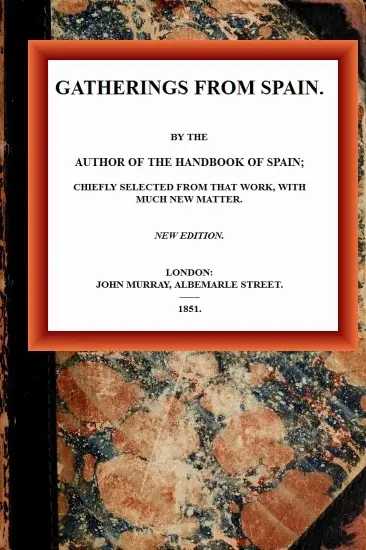
THE CLASSIC COLLECTION · 1846
"Gatherings from Spain" by Richard Ford is a travelogue and cultural commentary written in the mid-19th century. The work is primarily a compilation of observations and analyses about Spain’s regions, characteristics, and customs, tailored especially for individuals contemplating a visit. The author delves into the complex sociopolitical landscape of Spain, highlighting regional distinctions and the nation's rich heritage and contemporary shifts. The opening of the book introduces the reader to Spain's geographical and cultural diversity, emphasizing its composition of distinct provinces that were once independent kingdoms. Ford discusses the isolation created by mountains and rivers, which perpetuates localism among the Spanish people. He critiques the notion of a unified Spain, illustrating how each province retains its unique identity and characteristics that differ significantly from one another. Through anecdotes and historical references, Ford sets the stage for a deeper exploration of Spanish society, geography, and the nuances of travel within this captivating yet fragmented nation.
Introduction adapted from the source catalogue; source summaries may be automatically generated.
Free to read · English · 136,429 words · No account needed
MAKE TIME FOR A GOOD BOOK
On by default. Untick to stop anonymous reading totals. Each page counts after 10 seconds in view. How this works.
Anonymous counting is on unless you have switched it off.
[Sidenote: A QUESTION OF DAYS.]
To return, however, to sight-seeing in Spain. Lucky was the traveller prepared even to bribe and pay, who ever in our time chanced to fall in with a librarian who knew what books he had, or with a priest who could tell what pictures were in his chapel; ask him for the painting by Murillo--a shoulder-shrug was his reply, or a curt “no hay,” “there is none;” had you inquired for the “blessed Saint Thomas,” then he might have pointed it out; the subject, not the artist, being all that was required for the service of the church. An incurious bliss of ignorance is no less grateful to the Spanish mind, than the dolce far niente or sweet indolent doing nothing is to the body. All that gives trouble, or “fashes,” destroys the supreme height of felicity, which consists in avoiding exertion. A chapter might be filled with instances, which, had they not occurred to our humble selves, would seem caricature inventions. The not to be able to answer the commonest question, or to give any information as to matters of the most ordinary daily occurrence, is so prevalent, that we at first thought it must proceed from some fear of committal, some remnant of inquisitorial engendered reserve, rather than from bonâ fide careless and contented ignorance. The result, however, of much intercourse and experience arrived at, was, that few people are more communicative than the lower classes of Spaniards, especially to an Englishman, to whom they reveal private and family secrets: their want of knowledge applies rather to things than to persons.
[Sidenote: UNCERTAINTY OF SPANISH THINGS.]
If you called on a Spanish gentleman, and, finding him out, wished afterwards to write him a note, and inquired of his man or maid servant the number of the house;--“I do not know, my lord,” was the invariable answer, “I never was asked it before, I have never looked for it: let us go out and see. Ah! it is number 36.” Wishing once to send a parcel by the wagon from Merida to Madrid, “On what day, my lord,” said I to the potbellied, black-whiskered ventero, “does your galera start for the Court?” “Every Wednesday,” answered he; “and let not your grace be anxious”--“Disparate--nonsense,” exclaimed his copper-skinned, bright-eyed wife, “why do you tell the English knight such lies? the wagon, my lord, sets out on Fridays.” During the logomachy, or the few words which ensued between the well-matched pair, our good luck willed, that the mayoral or driver of the vehicle should come in, who forthwith informed us that the days of departure were Thursdays; and he was right. This occurred in the provinces; take, therefore, a parallel passage in the capital, the heart and brain of the Castiles. “Señor, tenga Usted la bondad--My lord,” said I to a portly, pompous bureaucrat, who booked places in the dilly to Toledo,--“have the goodness, your grace, to secure me one for Monday, the 7th.”--“I fear,” replied he, politely, for the negocio had been prudently opened by my offering him a real Havannah, “that your lordship has made a mistake in the date. Monday is the 8th of the current month”--which it was not. Thinking to settle the matter, we handed to him, with a bow, the almanack of the year, which chanced to be in our pocket-book. “Señor,” said he, gravely, when he had duly examined it, “I knew that I was right; this one was printed at Seville,”--which it was--“and we are here at Madrid, which is otra cosa, that is, altogether another affair.” In this solar difference and pre-eminence of the Court, it must be remembered, that the sun, at its creation, first shone over the neighbouring city, to which the dilly ran; and that even in the last century, it was held to be heresy at Salamanca, to say that it did not move round Spain. In sad truth, it has there stood still longer than in astronomical lectures or metaphors. Spain is no paradise for calculators; here, what ought to happen, and what would happen elsewhere according to Cocker and the doctrine probabilities, is exactly the event which is the least likely to come to pass. One arithmetical fact only can be reckoned upon with tolerable certainty: let given events be represented by numbers; then two and two may at one time make three, or possibly five at another; but the odds are four to one against two and two ever making four; another safe rule in Spanish official numbers; e. g. “five thousand men killed and wounded”--“five thousand dollars will be given,” and so forth, is to deduct two noughts, and sometimes even three, and read fifty or five instead.
Your reading position is saved on this browser. Take it to another device with a library code. Reading pages adapt to text, rather than matching a printed edition.
BEHIND THE BOOK
This eBook is for the use of anyone anywhere in the United States and most other parts of the world at no cost and with almost no restrictions whatsoever. You may copy it, give it away or re-use it under the terms of the Project Gutenberg License included with this eBook or online at www.gutenberg.org. If you are not located in the United States, you will have to check the laws of the country where you are located before using this eBook. Read the source licence.
The original source file, including credits and licence, is retained by this library. Request an original-format copy at no charge. Please include the book title and Project Gutenberg identifier #41611.
KEEP YOUR CURIOSITY GOING
Wilfrid Scawen Blunt
Wilfrid Scawen Blunt

E. W. (Edgar Watson) Howe
Cécile Tormay

Moritz Busch
John L. Ransom