THE CLASSIC COLLECTION✦My diaries, being a personal narrative of events 1888-1914, Part 2 (1900-1914)CLASSIC FREE BOOKS
My diaries, being a personal narrative of events 1888-1914, Part 2 (1900-1914)
Wilfrid Scawen Blunt
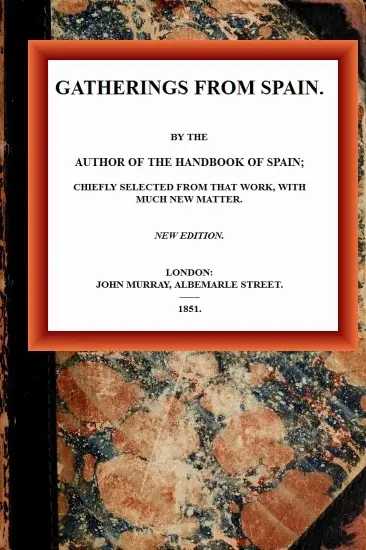
THE CLASSIC COLLECTION · 1846
"Gatherings from Spain" by Richard Ford is a travelogue and cultural commentary written in the mid-19th century. The work is primarily a compilation of observations and analyses about Spain’s regions, characteristics, and customs, tailored especially for individuals contemplating a visit. The author delves into the complex sociopolitical landscape of Spain, highlighting regional distinctions and the nation's rich heritage and contemporary shifts. The opening of the book introduces the reader to Spain's geographical and cultural diversity, emphasizing its composition of distinct provinces that were once independent kingdoms. Ford discusses the isolation created by mountains and rivers, which perpetuates localism among the Spanish people. He critiques the notion of a unified Spain, illustrating how each province retains its unique identity and characteristics that differ significantly from one another. Through anecdotes and historical references, Ford sets the stage for a deeper exploration of Spanish society, geography, and the nuances of travel within this captivating yet fragmented nation.
Introduction adapted from the source catalogue; source summaries may be automatically generated.
Free to read · English · 136,429 words · No account needed
MAKE TIME FOR A GOOD BOOK
On by default. Untick to stop anonymous reading totals. Each page counts after 10 seconds in view. How this works.
Anonymous counting is on unless you have switched it off.
Various as are the objects worth observing in Spain, many of which are to be seen there only, it may be as well to mention what is not to be seen, for there is no such loss of time as finding this out oneself, after weary chace and wasted hour. Those who expect to meet with well-garnished arsenals, libraries, restaurants, charitable or literary institutions, canals, railroads, tunnels, suspension-bridges, steam-engines, omnibuses, manufactories, polytechnic galleries, pale-ale breweries, and similar appliances and appurtenances of a high state of political, social, and commercial civilization, had better stay at home. In Spain there are no turnpike-trust meetings, no quarter-sessions, no courts of justice, according to the real meaning of that word, no treadmills, no boards of guardians, no chairmen, directors, masters-extraordinary of the court of chancery, no assistant poor-law commissioners. There are no anti-tobacco-teetotal-temperance-meetings, no auxiliary-missionary-propagating societies, nothing in the blanket and lying-in asylum line, nothing, in short, worth a revising-barrister of three years’ standing’s notice, unless he be partial to the study of the laws of bankruptcy. Spain is no country for the political economist, beyond affording an example of the decline of the wealth of nations, and offering a wide topic on errors to be avoided, as well as for experimental theories, plans of reform and amelioration. In Spain, Nature reigns; she has there lavished her utmost prodigality of soil and climate, which Spaniards have for the last four centuries been endeavouring to counteract by a culpable neglect of agricultural speeches and dinners, and a non-distribution of prizes for the biggest boars, asses, and labourers with largest families.
[Sidenote: WHAT TO OBSERVE.]
The landed proprietor of the Peninsula is little better than a weed of the soil; he has never observed, nor scarcely permitted others to observe, the vast capabilities which might and ought to be called into action. He seems to have put Spain into Chancery, such is the general dilapidation. The country is little better than a terra incognita, to naturalists, geologists, and all other branches of ists and ologists. Everywhere there, the material is as superabundant as native labourers and operatives are deficient. All these interesting branches of inquiry, healthful and agreeable, as being out-of-door pursuits, and bringing the amateur in close contact with nature, offer to embryo authors who are ambitious to book something new, a more worthy subject than the old story of dangers of bull-fights, bandits, and black eyes. Those who aspire to the romantic, the poetical, the sentimental, the artistical, the antiquarian, the classical, in short, to any of the sublime and beautiful lines, will find both in the past and present state of Spain, subjects enough in wandering with lead-pencil and note-book through this singular country, which hovers between Europe and Africa, between civilization and barbarism; this land of the green valley and barren mountain, of the boundless plain and the broken sierra; those Elysian gardens of the vine, the olive, the orange, and the aloe; those trackless, vast, silent, uncultivated wastes, the heritage of the wild bee;--in flying from the dull uniformity, the polished monotony of Europe, to the racy freshness of that original, unchanged country, where antiquity treads on the heels of to-day, where Paganism disputes the very altar with Christianity, where indulgence and luxury contend with privation and poverty, where a want of all that is generous or merciful is blended with the most devoted heroic virtues, where the most cold-blooded cruelty is linked with the fiery passions of Africa, where ignorance and erudition stand in violent and striking contrast.
Your reading position is saved on this browser. Take it to another device with a library code. Reading pages adapt to text, rather than matching a printed edition.
BEHIND THE BOOK
This eBook is for the use of anyone anywhere in the United States and most other parts of the world at no cost and with almost no restrictions whatsoever. You may copy it, give it away or re-use it under the terms of the Project Gutenberg License included with this eBook or online at www.gutenberg.org. If you are not located in the United States, you will have to check the laws of the country where you are located before using this eBook. Read the source licence.
The original source file, including credits and licence, is retained by this library. Request an original-format copy at no charge. Please include the book title and Project Gutenberg identifier #41611.
KEEP YOUR CURIOSITY GOING
Wilfrid Scawen Blunt
Wilfrid Scawen Blunt

E. W. (Edgar Watson) Howe
Cécile Tormay

Moritz Busch
John L. Ransom