THE CLASSIC COLLECTION✦My diaries, being a personal narrative of events 1888-1914, Part 2 (1900-1914)CLASSIC FREE BOOKS
My diaries, being a personal narrative of events 1888-1914, Part 2 (1900-1914)
Wilfrid Scawen Blunt
THE CLASSIC COLLECTION · 1846
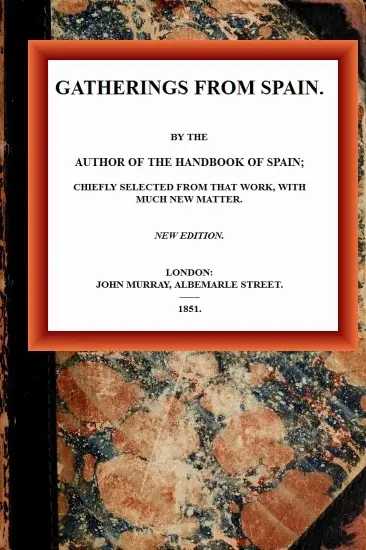
"Gatherings from Spain" by Richard Ford is a travelogue and cultural commentary written in the mid-19th century. The work is primarily a compilation of observations and analyses about Spain’s regions, characteristics, and customs, tailored especially for individuals contemplating a visit. The author delves into the complex sociopolitical landscape of Spain, highlighting regional distinctions and the nation's rich heritage and contemporary shifts. The opening of the book introduces the reader to Spain's geographical and cultural diversity, emphasizing its composition of distinct provinces that were once independent kingdoms. Ford discusses the isolation created by mountains and rivers, which perpetuates localism among the Spanish people. He critiques the notion of a unified Spain, illustrating how each province retains its unique identity and characteristics that differ significantly from one another. Through anecdotes and historical references, Ford sets the stage for a deeper exploration of Spanish society, geography, and the nuances of travel within this captivating yet fragmented nation.
Introduction adapted from the source catalogue; source summaries may be automatically generated.
Free to read · English · 136,429 words · No account needed
MAKE TIME FOR A GOOD BOOK
On by default. Untick to stop anonymous reading totals. Each page counts after 10 seconds in view. How this works.
Anonymous counting is on unless you have switched it off.
Alas for poor Protestants, who, by non-payment of St. Peter’s pence, have added an additional act of heresy, and the worst of all, the one which Rome never pardons. These defaulters can only hope to be saved by faith, and its fruits, good works; they must repent, must quit their long-cherished sins, and lead a new life; for them there is no rope of St. Francis to pull them out, if once in the pit; no rosary of St. Domenick to remove them, quick, presto, begone, from torment to happiness. Outside the pale of the Vatican, their souls have no chance, and inside the frontiers of Spain their bodies have scarcely a better prospect, should they die in that orthodox land. There the greatest liberal barely tolerates any burial at all of their black-blooded heretical carcasses, as no corn will grow near them. Until within a very few years at seaport towns, their bodies used to be put in a hole in the sands, and beyond low water mark; nay, even this concession to the infidel offended the semi-Moro fishermen, who true believers and persecutors feared that their soles might be poisoned: not that either sailor or priest ever exhibited any fear of taking British current coin, all cash that comes into their nets being most Catholic, so says the proverb, El dinero es muy Catolico.
[Sidenote: LUTHERAN BURIAL.]
[Sidenote: CEMETERY AT MALAGA.]
Matters connected with the grave have been placed, as regards Protestants, on a much more pleasant footing within these last few years; and it may be a consolation to invalids, who are sent to Spain for change of climate, and who are particular, to know, in case of accidents, that Protestant burial-grounds are now permitted at Cadiz, Malaga, and in a few other places. The history of the permission is curious, and has never, to the best of our belief, been told. In the days of Philip II. Lutherans were counted in many degrees worse than dogs; when caught alive, they were burnt by the holy tribunal; and when dead, were cast out on the dunghill. Even when our poltroon James I. sent, in 1622, his ill-judged olive-bearing mission, by which Spain was saved from utter humiliation, Mr. Hole, the secretary of the ambassador, Lord Digby, having died at Santander, the body was not allowed to be buried at all; it was put into a shell, and sunk in the sea; but no sooner was his lordship gone, than “the fishermen,” we quote from Somers’ tracts, “fearing that they should catch no fish as long as the coffin of a heretic lay in their waters,” fished it up, “and the corpse of our countryman and brother was thrown above ground, to be devoured by the fowls of the air.” In the treaty of 1630, the 31st Article provided for the disposal of the goods of those Englishmen who might die in Spain, but not for their bodies. “These,” says a commentator of Rymer, “must be left stinking above ground, to the end that the dogs may be sure to find them.” When Mr. Washington, page to Charles I., died at Madrid, at the time his master was there, Howell, who was present, relates that it was only as an especial favour to the suitor of the Spanish Infanta that the body was allowed to be interred in the garden of the embassy, under a fig-tree. A few years afterwards, 1650, Ascham, the envoy of Cromwell, was assassinated, and his corpse put, without any rites, into a hole; but the Protector was not a man to be trifled with, and knew well how to deal with a Spanish government, always a craven and bully, from whom nothing ever is to be obtained by concession and gentleness, which is considered as weakness, while everything is to be extorted from its fears. He that very year commanded a treaty to be prepared for the proper burial of his subjects, to which the blustering Spaniard immediately assented. This provision was stipulated into the treaty of Charles II. in 1664, and was conceded and ratified again in 1667 to Sir Richard Fanshawe.
Your reading position is saved on this browser. Take it to another device with a library code. Reading pages adapt to text, rather than matching a printed edition.
BEHIND THE BOOK
This eBook is for the use of anyone anywhere in the United States and most other parts of the world at no cost and with almost no restrictions whatsoever. You may copy it, give it away or re-use it under the terms of the Project Gutenberg License included with this eBook or online at www.gutenberg.org. If you are not located in the United States, you will have to check the laws of the country where you are located before using this eBook. Read the source licence.
The original source file, including credits and licence, is retained by this library. Request an original-format copy at no charge. Please include the book title and Project Gutenberg identifier #41611.
KEEP YOUR CURIOSITY GOING
Wilfrid Scawen Blunt
Wilfrid Scawen Blunt

E. W. (Edgar Watson) Howe
Cécile Tormay

Moritz Busch
John L. Ransom