THE CLASSIC COLLECTION✦My diaries, being a personal narrative of events 1888-1914, Part 2 (1900-1914)CLASSIC FREE BOOKS
My diaries, being a personal narrative of events 1888-1914, Part 2 (1900-1914)
Wilfrid Scawen Blunt
THE CLASSIC COLLECTION · 1846
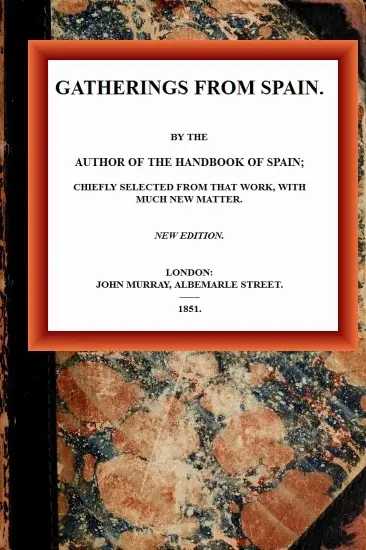
"Gatherings from Spain" by Richard Ford is a travelogue and cultural commentary written in the mid-19th century. The work is primarily a compilation of observations and analyses about Spain’s regions, characteristics, and customs, tailored especially for individuals contemplating a visit. The author delves into the complex sociopolitical landscape of Spain, highlighting regional distinctions and the nation's rich heritage and contemporary shifts. The opening of the book introduces the reader to Spain's geographical and cultural diversity, emphasizing its composition of distinct provinces that were once independent kingdoms. Ford discusses the isolation created by mountains and rivers, which perpetuates localism among the Spanish people. He critiques the notion of a unified Spain, illustrating how each province retains its unique identity and characteristics that differ significantly from one another. Through anecdotes and historical references, Ford sets the stage for a deeper exploration of Spanish society, geography, and the nuances of travel within this captivating yet fragmented nation.
Introduction adapted from the source catalogue; source summaries may be automatically generated.
Free to read · English · 136,429 words · No account needed
MAKE TIME FOR A GOOD BOOK
On by default. Untick to stop anonymous reading totals. Each page counts after 10 seconds in view. How this works.
Anonymous counting is on unless you have switched it off.
One Word on this wonderful Bull, that disarms death of its sting, and which, although few of our readers may ever have heard of it, plays a far more important part in the Peninsula than the quadruped does in the arena. Fastings are nowhere more strictly enjoined than here, where Lent represents the Ramadan of the Moslem. The denials have been mitigated to those faithful who have good appetites, by the paternal indulgence of their holy father at Rome, who, in consideration that it was necessary to keep the Spanish crusaders in fighting condition in order more effectually to crush the infidel, conceded to Saint Ferdinand the permission that his army might eat meat rations during Lent, provided there were any, for, to the credit of Spanish commissariats in general, few troops fast more regularly and religiously. The auspicious day on which the arrival is proclaimed of this welcome bull that announces dinner, is celebrated by bells merry as at a marriage feast; in the provincial cities mayors and corporations go to cathedral in what is called state, to the wonder of the mob and amusement of their betters at the resurrection of quiz coaches, the robes, maces, and obsolete trappings, by which these shadows of a former power and dignity hope to mark individual and collective insignificancy. A copy of this precious Bull cannot of course be had for nothing, and as it must be paid for, and in ready money, it forms one of the certain branches of public income. Although the proceeds ought to be expended on crusading purposes, Ferdinand VII., the Catholic King, and the only sovereign in possession of such a revenue, never contributed one mite towards the Christian Greeks in their recent struggle against the Turkish unbelievers.
[Sidenote: DEATH-BED IN SPAIN]
These bulls, or rather paper-money notes, are prepared with the greatest precautions, and constituted one of the most profitable articles of Spanish manufacture; a maritime war with England was dreaded, not so much from regard to the fasting transatlantic souls, as from the fear of losing, as Dr. Robertson has shown, the sundry millions of dollars and silver dross remitted from America in exchange for these spiritual treasures. They were printed at Seville, at the Dominican convent, the Porta cœli; but Soult, who now it appears is turning devotee, burnt down this gate of heaven, with its passports, and the presses. The bulls are only good for the year during which they are issued; after twelve months they become stale and unprofitable. There is then, says Blanco White, and truly, for we have often seen it, “a prodigious hurry to obtain new ones by all those who wish well to their souls, and do not overlook the ease and comfort of their stomachs.” A fresh one must be annually taken out, like a game-certificate, before Spaniards venture to sport with flesh or fowl, and they have reason to be thankful that it does not cost three pounds odd: for the sum of dos reales, or less than sixpence, man, woman, and child may obtain the benefit of clergy and cookery; but evil betides the uncertificated poacher, treadmills for life are a farce, perdition catches his soul. His certificate is demanded by the keeper of conscience when he is caught in the trap of sickness, and if without one, his conviction is certain; he cannot plead ignorance of the law, for a postscript and condition is affixed to all notices of jubilees, indulgences, and other purgatorial benefits, which are fixed on the church doors; and the language is as courteous and peremptory as in our popular assessed tax-paper--“Se ha de tener la bula:” you must have the bull; if you expect to derive any relief from these relaxations in purgatory, which all Spaniards most particularly do: hence the common phrase used by any one, when committing some little peccadillo in other matters, tengo mi bula para todo--I have got my bull, my licence to do any thing. The possession of this document acts on all fleshly comforts like soda on indigestion, indeed it neutralizes everything except heresy. As it is cheap, a Protestant resident, albeit he may not quite believe in its saving effects, will do well to purchase one for the sake of the peace of mind of his weaker brethren, for in this religion of forms and outer observances, more horror is felt by rigid Spaniards, at seeing an Englishman eating meat during a fast, than if he had broken all the ten commandments. The sums levied from the nation for these bulls is very large, although they are diminished before finally paid into the exchequer; some of the honey gathered by so many bees will stick to their wings, and the place of chief commissioner of the Bula is a better thing than that in the Excise or Customs of unbelieving countries.
Your reading position is saved on this browser. Take it to another device with a library code. Reading pages adapt to text, rather than matching a printed edition.
BEHIND THE BOOK
This eBook is for the use of anyone anywhere in the United States and most other parts of the world at no cost and with almost no restrictions whatsoever. You may copy it, give it away or re-use it under the terms of the Project Gutenberg License included with this eBook or online at www.gutenberg.org. If you are not located in the United States, you will have to check the laws of the country where you are located before using this eBook. Read the source licence.
The original source file, including credits and licence, is retained by this library. Request an original-format copy at no charge. Please include the book title and Project Gutenberg identifier #41611.
KEEP YOUR CURIOSITY GOING
Wilfrid Scawen Blunt
Wilfrid Scawen Blunt

E. W. (Edgar Watson) Howe
Cécile Tormay

Moritz Busch
John L. Ransom