READ · DISCOVER · ENJOYClassic literature · Always free
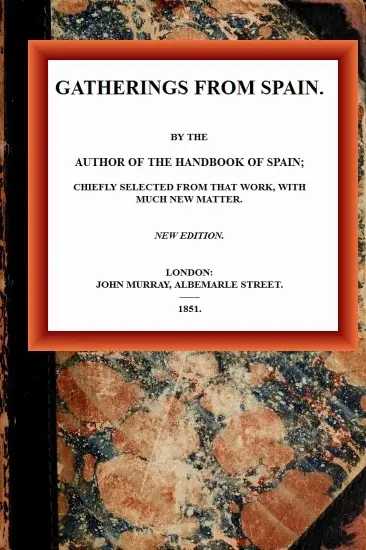
Gatherings from Spain — digital edition cover

THE CLASSIC COLLECTION · 1846

Gatherings from Spain

"Gatherings from Spain" by Richard Ford is a travelogue and cultural commentary written in the mid-19th century. The work is primarily a compilation of observations and analyses about Spain’s regions, characteristics, and customs, tailored especially for individuals contemplating a visit. The author delves into the complex sociopolitical landscape of Spain, highlighting regional distinctions and the nation's rich heritage and contemporary shifts. The opening of the book introduces the reader to Spain's geographical and cultural diversity, emphasizing its composition of distinct provinces that were once independent kingdoms. Ford discusses the isolation created by mountains and rivers, which perpetuates localism among the Spanish people. He critiques the notion of a unified Spain, illustrating how each province retains its unique identity and characteristics that differ significantly from one another. Through anecdotes and historical references, Ford sets the stage for a deeper exploration of Spanish society, geography, and the nuances of travel within this captivating yet fragmented nation.

Introduction adapted from the source catalogue; source summaries may be automatically generated.

Start reading ↓

Free to read · English · 136,429 words · No account needed

MAKE TIME FOR A GOOD BOOK

Gatherings from Spain

On by default. Untick to stop anonymous reading totals. Each page counts after 10 seconds in view. How this works.

Anonymous counting is on unless you have switched it off.

Gatherings from Spain

[Sidenote: EXECUTION OF A ROBBER.]

Next morning the triple tiers of the old balconies, roofs, and whole area of the Moorish and most picturesque square were crowded by the lower orders; the men wrapped up in their cloaks--(it was a December morning)--the women in their mantillas, many with young children in their arms, brought in the beginning of life to witness its conclusion. The better classes not only absent themselves from these executions, but avoid any allusion to the subject as derogatory to European civilization; the humbler ranks, who hold the conventions of society very cheap, give loose to their morbid curiosity to behold scenes of terror, which operates powerfully on the women, who seem impelled irresistibly to witness sights the most repugnant to their nature, and to behold sufferings which they would most dread to undergo; they, like children, are the great lovers of the horrible, whether in a tale or in dreadful reality; to the men it was as a tragedy, where the last scene is death--death which rivets the attention of all, who sooner or later must enact the same sad part.[10] They desire to see how the criminal will conduct himself; they sympathise with him if he displays coolness and courage, and despise him on the least symptom of unmanliness. An open square was then formed about the scaffold by lines of soldiers drawn up, into which the officers and clergy were admitted. As the fatal hour drew nigh, the increasing impatience of the multitude began to vent itself in complaints of how slowly the time passed--that time of no value to them, but of such precious import to him, whose very moments were numbered.

[Sidenote: EXECUTION OF A ROBBER.]

When at length the cathedral clock tolled out the fatal hour, a universal stir of tiptoe expectation took place, a pushing forward to get the best situations. Still ten minutes had to elapse, for the clock of the tribunal is purposely set so much later than that of the cathedral, in order to afford the utmost possible chance of a reprieve. When that clock too had rung out its knell, all eyes were turned to the prison-door, from whence the miserable man came forth, attended by some Franciscans. He had chosen that order to assist at his dying moments, a privilege always left to the criminal. He was clad in a coarse yellow baize gown, the colour which denotes the crime of murder, and is appropriated always to Judas Iscariot in Spanish paintings. He walked slowly on his last journey, half supported by those around him, and stopping often, ostensibly to kiss the crucifix held before him by a friar, but rather to prolong existence--sweet life!--even yet a moment. When he arrived reluctantly at the scaffold, he knelt down on the steps, the threshold of death;--the reverend attendants covered him over with their blue robes--his dying confession was listened to unseen. He then mounted the platform attended by a single friar; addressed the crowd in broken sentences, with a gasping breath--told them that he died repentant, that he was justly punished, and that he forgave his executioner. “Mi delito me mata, y no ese hombre,”--my offence puts me to death, and not this fellow; as “Ese hombre” is a contemptuous expression, and implies insult, the ruling feeling of the Spaniard was displayed in death against the degraded functionary. The criminal then exclaimed, “Viva la fé! viva la religion! viva el rey! viva el nombre de Jesus!” All of which met no echo from those who heard him. His dying cry was “Viva la Virgen Santisima!” at these words the devotion to the goddess of Spain burst forth in one general acclamation, “Viva la Santisima!” So strong is their feeling towards the Virgin, and so lukewarm their comparative indifference towards their king, their faith, and their Saviour! Meanwhile the executioner, a young man dressed in black, was busied in the preparations for death. The fatal instrument is simple: the culprit is placed on a rude seat; his back leans against a strong upright post, to which an iron collar is attached, enclosing his neck, and so contrived as to be drawn home to the post by turning a powerful screw. The executioner bound so tightly the naked legs and arms of Veneno, that they swelled and became black--a precaution not unwise, as the father of this functionary had been killed in the act of executing a struggling criminal. The priest who attended Veneno was a bloated, corpulent man, more occupied in shading the sun from his own face, than in his ghostly office; the robber sat with a writhing look of agony, grinding his clenched teeth. When all was ready, the executioner took the lever of the screw in both hands, gathered himself up for a strong muscular effort, and, at the moment of a preconcerted signal, drew the iron collar tight, while an attendant flung a black handkerchief over the face--a convulsive pressure of the hands and a heaving of the chest were the only visible signs of the passing of the robber’s spirit. After a pause of a few moments, the executioner cautiously peeped under the handkerchief, and after having given another turn to the screw, lifted it off, folded it up, carefully put it into his pocket, and then proceeded to light a cigar

Your reading position is saved on this browser. Take it to another device with a library code. Reading pages adapt to text, rather than matching a printed edition.

BEHIND THE WORDS

About Richard Ford

Richard Ford (1796–1858). Explore Gatherings from Spain in this collection. These books span history, travel & exploration.

Explore this author’s books →

THE READERS’ VERDICT

How did this story stay with you?

Not rated yet
Your rating for Gatherings from Spain

Be the first to share your verdict.

One rating per browser, which you can change or remove. A necessary browser identifier remembers your vote. How ratings work

A GOOD STORY DESERVES COMPANY

Pass this book along.

A great read is even better when it’s shared.

SEND A LITTLE INSPIRATION

Share this book

BEHIND THE BOOK

Edition & source details.

Title
Gatherings from Spain
Author
Richard Ford
First publication (Open Library catalogue match)
1846
Digital edition publisher
Project Gutenberg
Gutenberg release date
2012-12-12
Language
English
Source edition imprint
Not stated in source catalogue
Source identifier
Project Gutenberg #41611
Contributors
No additional named contributors in source metadata

Public-domain source & licence

This eBook is for the use of anyone anywhere in the United States and most other parts of the world at no cost and with almost no restrictions whatsoever. You may copy it, give it away or re-use it under the terms of the Project Gutenberg License included with this eBook or online at www.gutenberg.org. If you are not located in the United States, you will have to check the laws of the country where you are located before using this eBook. Read the source licence.

Full source licence and obtaining an original copy

The original source file, including credits and licence, is retained by this library. Request an original-format copy at no charge. Please include the book title and Project Gutenberg identifier #41611.

the full Project Gutenberg License must appear
prominently whenever any copy of a Project Gutenberg work (any work
on which the phrase “Project Gutenberg” appears, or with which the
phrase “Project Gutenberg” is associated) is accessed, displayed,
performed, viewed, copied or distributed:

This eBook is for the use of anyone anywhere in the United States and most
other parts of the world at no cost and with almost no restrictions
whatsoever. You may copy it, give it away or re-use it under the terms
of the Project Gutenberg™ License included with this eBook or online
at www.gutenberg.org. If you
are not located in the United States, you will have to check the laws
of the country where you are located before using this eBook.

1.E.2. If an individual Project Gutenberg electronic work is
derived from texts not protected by U.S. copyright law (does not
contain a notice indicating that it is posted with permission of the
copyright holder), the work can be copied and distributed to anyone in
the United States without paying any fees or charges. If you are
redistributing or providing access to a work with the phrase “Project
Gutenberg” associated with or appearing on the work, you must comply
either with the requirements of paragraphs 1.E.1 through 1.E.7 or
obtain permission for the use of the work and the Project Gutenberg
trademark as set forth in paragraphs 1.E.8 or 1.E.9.

1.E.3. If an individual Project Gutenberg electronic work is posted
with the permission of the copyright holder, your use and distribution
must comply with both paragraphs 1.E.1 through 1.E.7 and any
additional terms imposed by the copyright holder. Additional terms
will be linked to the Project Gutenberg License for all works
posted with the permission of the copyright holder found at the
beginning of this work.

1.E.4. Do not unlink or detach or remove the full Project Gutenberg
License terms from this work, or any files containing a part of this
work or any other work associated with Project Gutenberg.

1.E.5. Do not copy, display, perform, distribute or redistribute this
electronic work, or any part of this electronic work, without
prominently displaying the sentence set forth in paragraph 1.E.1 with
active links or immediate access to the full terms of the Project
Gutenberg License.

1.E.6. You may convert to and distribute this work in any binary,
compressed, marked up, nonproprietary or proprietary form, including
any word processing or hypertext form. However, if you provide access
to or distribute copies of a Project Gutenberg work in a format
other than “Plain Vanilla ASCII” or other format used in the official
version posted on the official Project Gutenberg website
(www.gutenberg.org), you must, at no additional cost, fee or expense
to the user, provide a copy, a means of exporting a copy, or a means
of obtaining a copy upon request, of the work in its original “Plain
Vanilla ASCII” or other form. Any alternate format must include the
full Project Gutenberg License as specified in paragraph 1.E.1.

1.E.7. Do not charge a fee for access to, viewing, displaying,
performing, copying or distributing any Project Gutenberg works
unless you comply with paragraph 1.E.8 or 1.E.9.

1.E.8. You may charge a reasonable fee for copies of or providing
access to or distributing Project Gutenberg electronic works
provided that:

• You pay a royalty fee of 20% of the gross profits you derive from
the use of Project Gutenberg works calculated using the method
you already use to calculate your applicable taxes. The fee is owed
to the owner of the Project Gutenberg trademark, but he has
agreed to donate royalties under this paragraph to the Project
Gutenberg Literary Archive Foundation. Royalty payments must be paid
within 60 days following each date on which you prepare (or are
legally required to prepare) your periodic tax returns. Royalty
payments should be clearly marked as such and sent to the Project
Gutenberg Literary Archive Foundation at the address specified in
Section 4, “Information about donations to the Project Gutenberg
Literary Archive Foundation.”

• You provide a full refund of any money paid by a user who notifies
you in writing (or by e-mail) within 30 days of receipt that s/he
does not agree to the terms of the full Project Gutenberg™
License. You must require such a user to return or destroy all
copies of the works possessed in a physical medium and discontinue
all use of and all access to other copies of Project Gutenberg™
works.

• You provide, in accordance with paragraph 1.F.3, a full refund of
any money paid for a work or a replacement copy, if a defect in the
electronic work is discovered and reported to you within 90 days of
receipt of the work.

• You comply with all other terms of this agreement for free
distribution of Project Gutenberg™ works.


1.E.9. If you wish to charge a fee or distribute a Project
Gutenberg™ electronic work or group of works on different terms than
are set forth in this agreement, you must obtain permission in writing
from the Project Gutenberg Literary Archive Foundation, the manager of
the Project Gutenberg™ trademark. Contact the Foundation as set
forth in Section 3 below.

1.F.

1.F.1. Project Gutenberg volunteers and employees expend considerable
effort to identify, do copyright research on, transcribe and proofread
works not protected by U.S. copyright law in creating the Project
Gutenberg™ collection. Despite these efforts, Project Gutenberg™
electronic works, and the medium on which they may be stored, may
contain “Defects,” such as, but not limited to, incomplete, inaccurate
or corrupt data, transcription errors, a copyright or other
intellectual property infringement, a defective or damaged disk or
other medium, a computer virus, or computer codes that damage or
cannot be read by your equipment.

1.F.2. LIMITED WARRANTY, DISCLAIMER OF DAMAGES - Except for the “Right
of Replacement or Refund” described in paragraph 1.F.3, the Project
Gutenberg Literary Archive Foundation, the owner of the Project
Gutenberg™ trademark, and any other party distributing a Project
Gutenberg™ electronic work under this agreement, disclaim all
liability to you for damages, costs and expenses, including legal
fees. YOU AGREE THAT YOU HAVE NO REMEDIES FOR NEGLIGENCE, STRICT
LIABILITY, BREACH OF WARRANTY OR BREACH OF CONTRACT EXCEPT THOSE
PROVIDED IN PARAGRAPH 1.F.3. YOU AGREE THAT THE FOUNDATION, THE
TRADEMARK OWNER, AND ANY DISTRIBUTOR UNDER THIS AGREEMENT WILL NOT BE
LIABLE TO YOU FOR ACTUAL, DIRECT, INDIRECT, CONSEQUENTIAL, PUNITIVE OR
INCIDENTAL DAMAGES EVEN IF YOU GIVE NOTICE OF THE POSSIBILITY OF SUCH
DAMAGE.

1.F.3. LIMITED RIGHT OF REPLACEMENT OR REFUND - If you discover a
defect in this electronic work within 90 days of receiving it, you can
receive a refund of the money (if any) you paid for it by sending a
written explanation to the person you received the work from. If you
received the work on a physical medium, you must return the medium
with your written explanation. The person or entity that provided you
with the defective work may elect to provide a replacement copy in
lieu of a refund. If you received the work electronically, the person
or entity providing it to you may choose to give you a second
opportunity to receive the work electronically in lieu of a refund. If
the second copy is also defective, you may demand a refund in writing
without further opportunities to fix the problem.

1.F.4. Except for the limited right of replacement or refund set forth
in paragraph 1.F.3, this work is provided to you ‘AS-IS’, WITH NO
OTHER WARRANTIES OF ANY KIND, EXPRESS OR IMPLIED, INCLUDING BUT NOT
LIMITED TO WARRANTIES OF MERCHANTABILITY OR FITNESS FOR ANY PURPOSE.

1.F.5. Some states do not allow disclaimers of certain implied
warranties or the exclusion or limitation of certain types of
damages. If any disclaimer or limitation set forth in this agreement
violates the law of the state applicable to this agreement, the
agreement shall be interpreted to make the maximum disclaimer or
limitation permitted by the applicable state law. The invalidity or
unenforceability of any provision of this agreement shall not void the
remaining provisions.

1.F.6. INDEMNITY - You agree to indemnify and hold the Foundation, the
trademark owner, any agent or employee of the Foundation, anyone
providing copies of Project Gutenberg™ electronic works in
accordance with this agreement, and any volunteers associated with the
production, promotion and distribution of Project Gutenberg™
electronic works, harmless from all liability, costs and expenses,
including legal fees, that arise directly or indirectly from any of
the following which you do or cause to occur: (a) distribution of this
or any Project Gutenberg work, (b) alteration, modification, or
additions or deletions to any Project Gutenberg work, and (c) any
Defect you cause.

Section 2. Information about the Mission of Project Gutenberg

Project Gutenberg is synonymous with the free distribution of
electronic works in formats readable by the widest variety of
computers including obsolete, old, middle-aged and new computers. It
exists because of the efforts of hundreds of volunteers and donations
from people in all walks of life.

Volunteers and financial support to provide volunteers with the
assistance they need are critical to reaching Project Gutenberg’s
goals and ensuring that the Project Gutenberg collection will
remain freely available for generations to come. In 2001, the Project
Gutenberg Literary Archive Foundation was created to provide a secure
and permanent future for Project Gutenberg and future
generations. To learn more about the Project Gutenberg Literary
Archive Foundation and how your efforts and donations can help, see
Sections 3 and 4 and the Foundation information page at www.gutenberg.org.

Section 3. Information about the Project Gutenberg Literary Archive Foundation

The Project Gutenberg Literary Archive Foundation is a non-profit
501(c)(3) educational corporation organized under the laws of the
state of Mississippi and granted tax exempt status by the Internal
Revenue Service. The Foundation’s EIN or federal tax identification
number is 64-6221541. Contributions to the Project Gutenberg Literary
Archive Foundation are tax deductible to the full extent permitted by
U.S. federal laws and your state’s laws.

The Foundation’s business office is located at 41 Watchung Plaza #516,
Montclair NJ 07042, USA, +1 (862) 621-9288. Email contact links and up
to date contact information can be found at the Foundation’s website
and official page at www.gutenberg.org/contact

Section 4. Information about Donations to the Project Gutenberg
Literary Archive Foundation

Project Gutenberg™ depends upon and cannot survive without widespread
public support and donations to carry out its mission of
increasing the number of public domain and licensed works that can be
freely distributed in machine-readable form accessible by the widest
array of equipment including outdated equipment. Many small donations
($1 to $5,000) are particularly important to maintaining tax exempt
status with the IRS.

The Foundation is committed to complying with the laws regulating
charities and charitable donations in all 50 states of the United
States. Compliance requirements are not uniform and it takes a
considerable effort, much paperwork and many fees to meet and keep up
with these requirements. We do not solicit donations in locations
where we have not received written confirmation of compliance. To SEND
DONATIONS or determine the status of compliance for any particular state
visit www.gutenberg.org/donate.

While we cannot and do not solicit contributions from states where we
have not met the solicitation requirements, we know of no prohibition
against accepting unsolicited donations from donors in such states who
approach us with offers to donate.

International donations are gratefully accepted, but we cannot make
any statements concerning tax treatment of donations received from
outside the United States. U.S. laws alone swamp our small staff.

Please check the Project Gutenberg web pages for current donation
methods and addresses. Donations are accepted in a number of other
ways including checks, online payments and credit card donations. To
donate, please visit: www.gutenberg.org/donate.

Section 5. General Information About Project Gutenberg electronic works

Professor Michael S. Hart was the originator of the Project
Gutenberg concept of a library of electronic works that could be
freely shared with anyone. For forty years, he produced and
distributed Project Gutenberg eBooks with only a loose network of
volunteer support.

Project Gutenberg eBooks are often created from several printed
editions, all of which are confirmed as not protected by copyright in
the U.S. unless a copyright notice is included. Thus, we do not
necessarily keep eBooks in compliance with any particular paper
edition.

Most people start at our website which has the main PG search
facility: www.gutenberg.org.

This website includes information about Project Gutenberg,
including how to make donations to the Project Gutenberg Literary
Archive Foundation, how to help produce our new eBooks, and how to
subscribe to our email newsletter to hear about new eBooks.


KEEP YOUR CURIOSITY GOING

Your next chapter awaits.