THE CLASSIC COLLECTION✦My diaries, being a personal narrative of events 1888-1914, Part 2 (1900-1914)CLASSIC FREE BOOKS
My diaries, being a personal narrative of events 1888-1914, Part 2 (1900-1914)
Wilfrid Scawen Blunt
THE CLASSIC COLLECTION · 1846
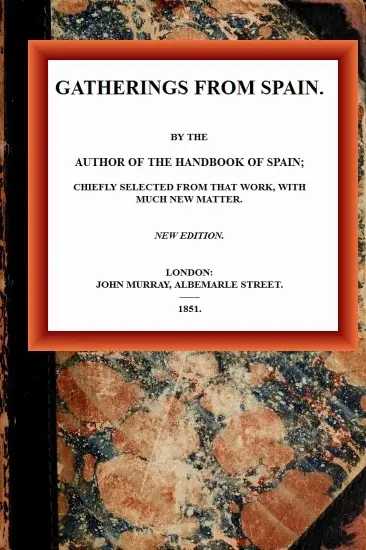
"Gatherings from Spain" by Richard Ford is a travelogue and cultural commentary written in the mid-19th century. The work is primarily a compilation of observations and analyses about Spain’s regions, characteristics, and customs, tailored especially for individuals contemplating a visit. The author delves into the complex sociopolitical landscape of Spain, highlighting regional distinctions and the nation's rich heritage and contemporary shifts. The opening of the book introduces the reader to Spain's geographical and cultural diversity, emphasizing its composition of distinct provinces that were once independent kingdoms. Ford discusses the isolation created by mountains and rivers, which perpetuates localism among the Spanish people. He critiques the notion of a unified Spain, illustrating how each province retains its unique identity and characteristics that differ significantly from one another. Through anecdotes and historical references, Ford sets the stage for a deeper exploration of Spanish society, geography, and the nuances of travel within this captivating yet fragmented nation.
Introduction adapted from the source catalogue; source summaries may be automatically generated.
Free to read · English · 136,429 words · No account needed
MAKE TIME FOR A GOOD BOOK
On by default. Untick to stop anonymous reading totals. Each page counts after 10 seconds in view. How this works.
Anonymous counting is on unless you have switched it off.
What can’t be cured must be endured. To resume, therefore, the character of these Spanish servants; they are very loquacious, and highly credulous, as often is the case with those given to romancing, which they, and especially the Andalucians, are to a large degree; and, in fact, it is the only remaining romance in Spain, as far as the natives are concerned. As they have an especial good opinion of themselves, they are touchy, sensitive, jealous, and thin-skinned, and easily affronted whenever their imperfections are pointed out; their disposition is very sanguine and inflammable; they are always hoping that what they eagerly desire will come to pass without any great exertion on their parts; they love to stand still with their arms folded, while other men put their shoulders to the wheel. Their lively imagination is very apt to carry them away into extremes for good or evil, when they act on the moment like children, and having gratified the humour of the impulse relapse into their ordinary tranquillity, which is that of a slumbering volcano. On the other hand, they are full of excellent and redeeming good qualities; they are free from caprice, are hardy, patient, cheerful, good-humoured, sharp-witted, and intelligent: they are honest, faithful, and trustworthy; sober, and unaddicted to mean, vulgar vices; they have a bold, manly bearing, and will follow well wherever they are well led, being the raw material of as good soldiers as are in the world; they are loyal and religious at heart, and full of natural tact, mother-wit, and innate good manners. In general, a firm, quiet, courteous, and somewhat reserved manner is the most effective. Whenever duties are to be performed, let them see that you are not to be trifled with. The coolness of a determined Englishman’s manner, when in earnest, is what few foreigners can withstand. Grimace and gesticulation, sound and fury, bluster, petulance, and impertinence fume and fret in vain against it, as the sprays and foam of the “French lake” do against the unmoved and immoveable rock of Gibraltar. An Englishman, without being over-familiar, may venture on a far greater degree of unbending in his intercourse with his Spanish dependants than he can dare to do with those he has in England. It is the custom of the country; they are used to it, and their heads are not turned by it, nor do they ever forget their relative positions. The Spaniards treat their servants very much like the ancient Romans or the modern Moors; they are more their vernæ, their domestic slaves: it is the absolute authority of the father combined with the kindness. Servants do not often change their masters in Spain: their relation and duties are so clearly defined, that the latter runs no risk of compromising himself or his dignity by his familiarity, which can be laid down or taken up at his own pleasure; whereas the scorn, contempt, and distance with which the said courteous Don would treat a roturier who presumed to be intimate, baffle description. In England no man dares to be intimate with his footman; for supposing even such absurd fancy entered his brain, his footman is his equal in the eye of man-made law, God having created them utterly unequal in all his gifts, whether of rank, wealth, form, or intellect. Conventional barriers accordingly must be erected in self-defence: and social barriers are more difficult to be passed than walls of brass, more impossible to be repealed than the whole statutes at large. No master in Spain, and still less a foreigner, should ever descend to personal abuse, sneers, or violence. A blow is never to be washed out except in blood, and Spanish revenge descends to the third and fourth generation; and whatever these backward Spaniards have to learn from foreigners, it is not the duty of revenge, nor how to perform it. There should be no threatenings in vain, but whenever the opportunity occurs for punishment, let it be done quietly and effectively, and the fault once punished should not be needlessly ripped up again; Spaniards are sufficiently unforgiving, and hoarders-up of unrevenged grievances require to be reminded. A kind and uniform behaviour, a showing consideration to them, in a manner which implies that you are accustomed to it, and expect it to be shown to you, keeps most things in their right places. Temper and patience are the great requisites in the master, especially when he speaks the language imperfectly. He must not think Spaniards stupid because they cannot guess the meaning of his unknown tongue. Nothing again is gained by fidgeting and overdoing, and however early you may get up, daybreak will not take place the sooner: no por mucho madrugar, amanece mas temprano. Let well alone: be not zealous overmuch: be occasionally both blind and deaf: shut the door, and the devil passes by: keep honey in mouth and an eye to your cash: miel en boca y guarda la bolsa. Still how much less expenditure is necessary in Spain than in performing the commonest excursion in England!--and yet many who submit to their own countrymen’s extortions are furious at what they imagine is an especial cheating of them, quasi Englishmen, abroad: this outrageous economy, with which some are afflicted, is penny wise and pound foolish: pay, pay therefore with both hands. The traveller must remember that he gains caste, gets brevet rank in Spain--that he is taken for a grandee incog., and ranks with their nobility; he must pay for these luxuries: how small after all will be the additional per centage on his general expenditure, and how well bestowed is the excess, in keeping the temper good, and the capability of enjoying unruffled a tour, which only is performed once in a life! No wise man who goes into Spain for amusement will plunge into this guerrilla, this constant petty warfare, about sixpences. Let the traveller be true to himself; hold his tongue; avoid bad company, quien hace su cama con perros, se levanta con pulgas, those who sleep with dogs get up with fleas; and make room for bulls and fools, al loco y toro da le corro, and he may see Spain agreeably, and, as Catullus said to Veranius, who made the tour many centuries ago, may on his return amuse his friends and “old mother:”--
Your reading position is saved on this browser. Take it to another device with a library code. Reading pages adapt to text, rather than matching a printed edition.
BEHIND THE BOOK
This eBook is for the use of anyone anywhere in the United States and most other parts of the world at no cost and with almost no restrictions whatsoever. You may copy it, give it away or re-use it under the terms of the Project Gutenberg License included with this eBook or online at www.gutenberg.org. If you are not located in the United States, you will have to check the laws of the country where you are located before using this eBook. Read the source licence.
The original source file, including credits and licence, is retained by this library. Request an original-format copy at no charge. Please include the book title and Project Gutenberg identifier #41611.
KEEP YOUR CURIOSITY GOING
Wilfrid Scawen Blunt
Wilfrid Scawen Blunt

E. W. (Edgar Watson) Howe
Cécile Tormay

Moritz Busch
John L. Ransom