THE CLASSIC COLLECTION✦Atoms and electronsCLASSIC FREE BOOKS
Atoms and electrons
J. W. N. (John William Navin) Sullivan
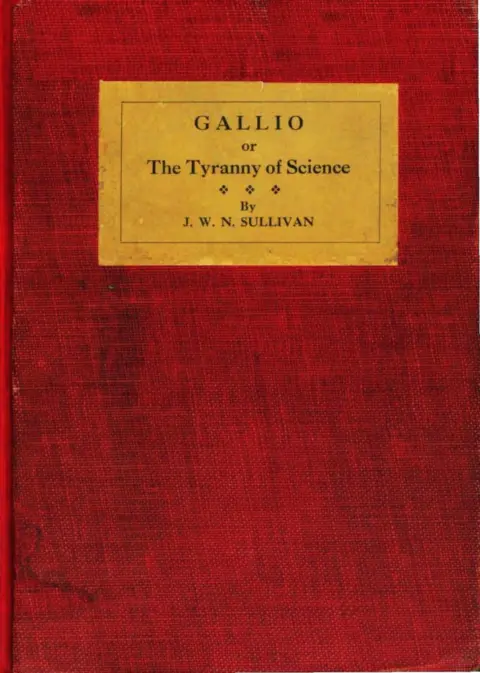
THE CLASSIC COLLECTION · 1928
"Gallio : or, The tyranny of science by J. W. N. Sullivan" is a philosophical essay of cultural criticism written in the early 20th century. The book examines the growing prestige of science and challenges its claim to define reality, especially where it sidelines art, morals, and spiritual experience. Its likely topic is the limits of scientific method and the need to recognize values, purpose, and imagination as central to human knowledge. The essay opens with the rise of scientific authority from Darwin to Einstein, noting how artists first resisted and then, after the War, often embraced a bleak materialism. It argues that modern physics—especially relativity—undermines the old “iron laws,” showing that scientific laws are mind-shaped selections from a world of “point-events,” and that science offers only partial, abstract descriptions of reality. Sullivan criticizes the fetish of measurement and the misuse of scientific prestige in fields like eugenics, crude psychoanalysis, and behaviourism, as well as the fallacy of “explaining by origins.” He urges humility before quantum mysteries and calls for richer abstractions, drawing on thinkers like Eddington and Whitehead to replace “substance” with “organism” and to reconnect space, time, memory, and expectation. Art—especially music—is presented as a mode of genuine knowledge that reveals possibilities of the spirit and anticipates human growth. The book closes by denying that science should tyrannize culture: its scope is limited, its laws are provisional and self-referential, and it is largely irrelevant to the deepest moral and spiritual concerns.
Introduction adapted from the source catalogue; source summaries may be automatically generated.
Free to read · English · 9,555 words · No account needed
MAKE TIME FOR A GOOD BOOK
On by default. Untick to stop anonymous reading totals. Each page counts after 10 seconds in view. How this works.
Anonymous counting is on unless you have switched it off.
The notion that we live in a purposeless universe is so opposed to the mental habits we have inherited that it is a matter of the greatest difficulty to bear it constantly in mind. Most of the people who hold this belief to-day would not do so but for three reasons: the disillusionment caused by the War, their respect for science, and their belief that science preaches materialism. As for the War, that is an experience to which we must accommodate ourselves as best we may. It is consistent with the belief that man is a developing spirit, but it is certainly a proof that he is not very far developed. The respect for science is, I believe, on the whole rather overdone. The respect is a little excessive even when it relates to mathematical physics, but it becomes almost absurd when it relates to some other branches of science. I believe, for instance, that Freud’s form of psycho-analysis, some forms of behaviourism, and many of the statements of the eugenists really are as silly as they look. All that they have in common with such first-class mental activities as physics and chemistry is the name “science.” It is this name that secures for them such attention as they get from intelligent people who are not cranks. But even physics is a more provisional and more human thing than some romantic references to it would lead one to suppose. Even the tower of the mathematician, which Mr Bernard Shaw imagines to have been always unshaken, has been seriously disturbed on more than one occasion. The student of the history of science will not be too confident even of the “indubitable certainties” of physics when he reflects on the universal passion of belief that attached to the notion of a mechanical ether, for whose present absence from the universe some men of science are still inconsolable, and when he reflects on the fate that has overtaken that “most perfect and perfectly established law”, Newton’s law of gravitation. There are no indubitable certainties in science, a fact that we who are contemporary with the destruction of the Newtonian system are not likely to forget. There are only provisional hypotheses. It may even be, as Mr J. B. S. Haldane prophesies, that physiology will one day invade and destroy mathematical physics, by which somewhat dark saying I suppose phenomena mathematically may be given up. Whether he means that or not, it is a possibility, as Professor Eddington has hinted. The scientific practitioner usually treats his hypotheses as tools, but to the layman they become dogmas. One is led to believe this by seeing that many of those who accept materialism on what they suppose to be scientific evidence are rendered acutely unhappy by their belief. A truer knowledge of the status of scientific theories would render this agony unnecessary. There are people with a natural leaning towards materialism, and science, preferably somewhat old-fashioned science, will give them quite sufficient grounds to indulge their propensity with complete intellectual honesty. But science does not, and never has, brought forward sufficient evidence to justify a man turning materialist against his will. And perhaps no man has ever done so. Perhaps one can take the agonies of modern poets too seriously. Many artists, not only small ones, have no real indwelling force such as a man like Beethoven obviously possessed. They are merely very impressionable and adopt an attitude towards life, and this attitude is accepted and maintained, not because they really think it is true, but because they derive strength from it. It gives them a centre from which they can work; it gives them a feeling of strength and completeness. The maintenance of their attitude towards life may become the condition that they exist and function as artists at all. Nevertheless, the attitude is maintained only by a constant effort of will, although, since the motive is self-preservation, the artist will nearly always think himself perfectly sincere. But I shall, without going into these refinements, take the unhappiness of our modern literary men at its face-value, those, that is, who believe that the universe is purposeless and think this belief is founded on scientific evidence.
Your reading position is saved on this browser. Take it to another device with a library code. Reading pages adapt to text, rather than matching a printed edition.
J. W. N. (John William Navin) Sullivan
J. W. N. (John William Navin) Sullivan
BEHIND THE BOOK
This eBook is for the use of anyone anywhere in the United States and most other parts of the world at no cost and with almost no restrictions whatsoever. You may copy it, give it away or re-use it under the terms of the Project Gutenberg License included with this eBook or online at www.gutenberg.org. If you are not located in the United States, you will have to check the laws of the country where you are located before using this eBook. Read the source licence.
The original source file, including credits and licence, is retained by this library. Request an original-format copy at no charge. Please include the book title and Project Gutenberg identifier #76629.
KEEP YOUR CURIOSITY GOING

David Patterson (Spirit) Hatch

David Patterson (Spirit) Hatch

David Patterson (Spirit) Hatch
Coulson Kernahan

Ralph Waldo Emerson

Maurice Baring