
Letters to a Friend, Written to Mrs. Ezra S. Carr, 1866-1879
John Muir
THE CLASSIC COLLECTION · 1906
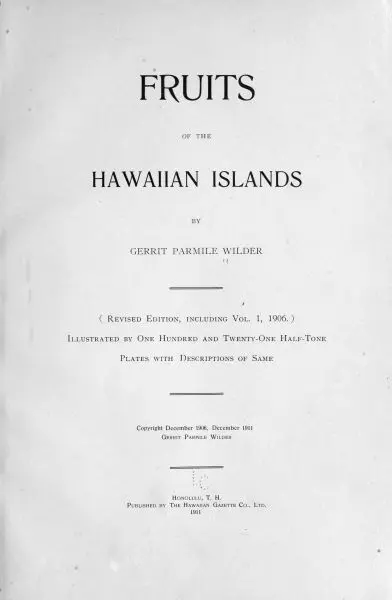
"Fruits of the Hawaiian Islands" by Gerrit Parmile Wilder is a scientific publication written in the early 20th century. It provides a comprehensive account of both indigenous and naturalized fruits found in the Hawaiian Islands, aiming to deepen the understanding of their characteristics, cultivation, and significance. The opening of the text introduces the author's prefatory notes and intent, explaining that this revised edition integrates data from an earlier publication initially intended as a multi-volume work. It acknowledges the contributions of various horticultural works and friends who aided in the research. The section also suggests a variety of fruits, such as the avocado and pomegranate, which are discussed in detail, emphasizing their taxonomy, growth habits, and peculiarities. Each fruit is accompanied by illustrations that enhance the reader's familiarity with these tropical fruits.
Introduction adapted from the source catalogue; source summaries may be automatically generated.
Free to read · English · 18,556 words · No account needed
MAKE TIME FOR A GOOD BOOK
On by default. Untick to stop anonymous reading totals. Each page counts after 10 seconds in view. How this works.
Anonymous counting is on unless you have switched it off.
The Guava is an extensive genus of low-growing evergreen trees, found chiefly in the West Indies, South America, and China. They have become naturalized in Hawaii, and may be found growing wild on waste lands and by the roadside. In some localities growing so rank as to become troublesome. The leaves are oval to oblong, usually acuminate, glabrous above and pubescent beneath, and have prominent veins. The fragrant, white, solitary flowers are axillary.
The somewhat rough skin of the globose fruit is a brownish-yellow, and the firm, dark-pink pulp, in which is embedded numerous seeds, is generally acid and aromatic. This guava is the source of the famous guava jelly of commerce.
G. P. W. Collection. PLATE LVIII
Psidium Guayava.
(Sweet red guava.)
This guava has the same general characteristics as the preceding variety. It is more frequently found in valleys and gulches than in the open. Its red pulp is firm and sweet.
G. P. W. Collection. PLATE LIX
Psidium Guayava.
(White lemon guava.)
The lemon guava tree grows taller and somewhat more erect than the others. The pear-shaped fruit is large, often 3 inches in length. It has a rough, greenish-white skin, and the white pulp is sweet. This is a cultivated variety, and is found growing in a few gardens in these Islands.
G. P. W. Collection. PLATE LX
Psidium Guayava pyriferum.
This handsome evergreen tree was an early introduced species, and now is very common about the islands. Grows very symmetrically, and attains the height of 20 to 25 feet. Leaves, small, lanceolate, shiny, the trunk and branches smooth. Flowers white and very fragrant; fruit small, pear-shaped, pulp yellow and containing many seeds; this species is very prolific, but the fruit is inferior.
G. P. W. Collection. PLATE LXI
Psidium Cattleyanum.
One of the hardiest of the guavas, and said to be a native of Brazil. The date of its introduction to Hawaii is not recorded, and as Hillebrand makes no mention of it, it is probably of recent importation. A shrubby tree 15 to 20 feet high. Leaves opposite, obovate, small, leathery, dark-green, shiny. Flowers white, fragrant. Fruit spherical, about one inch in diameter, purple-reddish when ripe, soft, juicy pulp, which has an agreeable flavor, and containing many small seeds. This fruit is used for making jams and jellies, and bears a crop more or less during all the months of the year.
G. P. W. Collection. PLATE LXII
Psidium Cattleyanum.
(var. lucidum.)
This low-growing shrub is occasionally cultivated in these Islands. It has opposite obovate leaves, and fragrant white flowers. The round fruit, which has a sweet, yellow pulp, is larger than the strawberry guava, and has a more delicate flavor.
Your reading position is saved on this browser. Take it to another device with a library code. Reading pages adapt to text, rather than matching a printed edition.
BEHIND THE BOOK
This eBook is for the use of anyone anywhere in the United States and most other parts of the world at no cost and with almost no restrictions whatsoever. You may copy it, give it away or re-use it under the terms of the Project Gutenberg License included with this eBook or online at www.gutenberg.org. If you are not located in the United States, you will have to check the laws of the country where you are located before using this eBook. Read the source licence.
The original source file, including credits and licence, is retained by this library. Request an original-format copy at no charge. Please include the book title and Project Gutenberg identifier #43581.
KEEP YOUR CURIOSITY GOING
John Muir

Asa Gray
Asa Gray

Florence Nightingale
Elizabeth Robins Pennell
Denison Olmsted