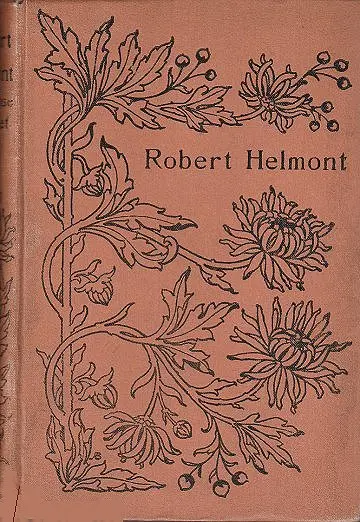
Robert Helmont: Diary of a Recluse, 1870-1871
Alphonse Daudet
THE CLASSIC COLLECTION · 1898
"Fromont and Risler — Complete" by Alphonse Daudet is a novel written during the late 19th century, specifically in the context of the Naturalism movement in literature. The narrative centers around the lives of characters intertwined in the world of Parisian bourgeoisie, particularly focusing on Risler, a self-made and honest man, and Sidonie, his young and charming bride. The story explores themes of ambition, social class, and the complexities of human relationships as it unfolds against the backdrop of their wedding festivities and the societal structures that influence their lives. The opening of the novel introduces readers to the joyful yet emotionally charged scenes at Risler's wedding. As Risler celebrates his newfound happiness amidst friends and family at a lavish cafe, he reflects on the day’s events with overwhelming joy, particularly the presence of his bride Sidonie and her mother. However, hints of underlying tensions and unspoken concerns emerge when he interacts with various guests, including his partner Georges Fromont, who seems to have a complicated connection with Sidonie. Through a vivid depiction of characters' emotions and the dynamics of social hierarchy, Daudet sets the stage for the complex interplay of love, ambition, and societal expectations that will shape Risler's and Sidonie's lives moving forward.
Introduction adapted from the source catalogue; source summaries may be automatically generated.
Free to read · English · 85,163 words · No account needed
MAKE TIME FOR A GOOD BOOK
On by default. Untick to stop anonymous reading totals. Each page counts after 10 seconds in view. How this works.
Anonymous counting is on unless you have switched it off.
"Look, surgeon," said one of them. "His hand is closed, as if he were
holding something in it."
"That is true," the surgeon replied, drawing nearer. "That sometimes happens in the last convulsions.
"You remember at Solferino, Commandant Bordy held his little daughter's miniature in his hand like that? We had much difficulty in taking it from him."
As he spoke he tried to open the poor, tightly-closed dead hand.
"Look!" said he, "it is a letter that he is holding so tight."
He was about to read it; but one of the officers took it from his hands and passed it to Sigismond, who was still kneeling.
"Here, Monsieur. Perhaps you will find in this some last wish to be
carried out."
Sigismond Planus rose. As the light in the room was dim, he walked with faltering step to the window, and read, his eyes filled with tears:
"Well, yes, I love you, I love you, more than ever and forever! What is the use of struggling and fighting against fate? Our sin is stronger than we..."
It was the letter which Frantz had written to his sister-in-law a year before, and which Sidonie had sent to her husband on the day following their terrible scene, to revenge herself on him and his brother at the same time.
Risler could have survived his wife's treachery, but that of his brother
had killed him.
When Sigismond understood, he was petrified with horror. He stood there, with the letter in his hand, gazing mechanically through the open window.
The clock struck six.
Yonder, over Paris, whose dull roar they could hear although they could not see the city, a cloud of smoke arose, heavy and hot, moving slowly upward, with a fringe of red and black around its edges, like the powder-smoke on a field of battle. Little by little, steeples, white buildings, a gilded cupola, emerged from the mist, and burst forth in a splendid awakening.
Then the thousands of tall factory chimneys, towering above that sea of clustered roofs, began with one accord to exhale their quivering vapor, with the energy of a steamer about to sail. Life was beginning anew. Forward, ye wheels of time! And so much the worse for him who lags behind!
Thereupon old Planus gave way to a terrible outburst of wrath.
"Ah! harlot-harlot!" he cried, shaking his fist; and no one could say whether he was addressing the woman or the city of Paris.
Your reading position is saved on this browser. Take it to another device with a library code. Reading pages adapt to text, rather than matching a printed edition.
Alphonse Daudet
Alphonse Daudet
Alphonse Daudet
Alphonse Daudet
BEHIND THE BOOK
This eBook is for the use of anyone anywhere in the United States and most other parts of the world at no cost and with almost no restrictions whatsoever. You may copy it, give it away or re-use it under the terms of the Project Gutenberg License included with this eBook or online at www.gutenberg.org. If you are not located in the United States, you will have to check the laws of the country where you are located before using this eBook. Read the source licence.
The original source file, including credits and licence, is retained by this library. Request an original-format copy at no charge. Please include the book title and Project Gutenberg identifier #3980.
KEEP YOUR CURIOSITY GOING
Coulson Kernahan

Maurice Baring
Frances Wright
Cécile Tormay

Frederic Jesup Stimson

W. H. P. (William Henry Pope) Jarvis