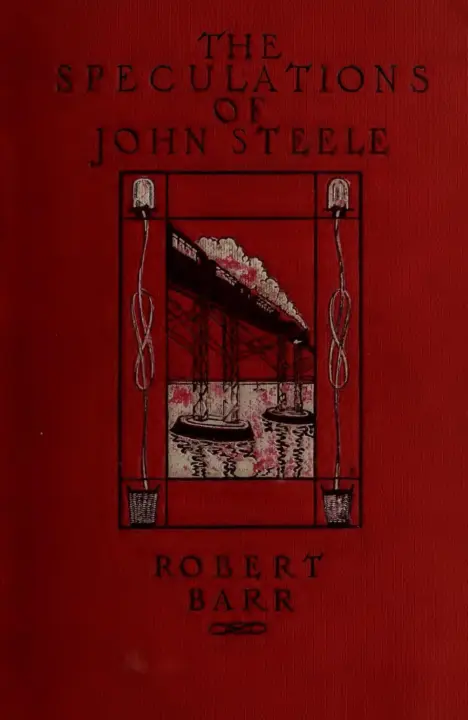
The Speculations of John Steele
Robert Barr
THE CLASSIC COLLECTION · 1896
"From Whose Bourne" by Robert Barr is a fictional narrative written in the late 19th century. The story centers around William Brenton, who unexpectedly finds himself deceased after a seemingly normal Christmas Eve dinner with his wife, Alice, and friends. The narrative explores themes of life after death as Brenton grapples with his new existence in the spirit world and his attempts to understand the circumstances surrounding his untimely demise while navigating the emotional turmoil of seeing his wife accused of his murder. The opening of the story introduces William Brenton as he excuses himself from the gathering and goes upstairs, where he soon falls into a dreamlike state. This unsettling dream transitions into a surreal experience where he observes his own lifeless body and learns from a mysterious figure that he is dead. As Brenton comes to terms with his new reality, he is drawn back to the events leading to his death and is horrified to discover that his wife has been arrested for his murder. The initial chapters establish a captivating premise of the afterlife intertwined with mystery, engaging the reader in Brenton's journey as he seeks both clarity and resolution for the chaos left behind.
Introduction adapted from the source catalogue; source summaries may be automatically generated.
Free to read · English · 29,755 words · No account needed
MAKE TIME FOR A GOOD BOOK
On by default. Untick to stop anonymous reading totals. Each page counts after 10 seconds in view. How this works.
Anonymous counting is on unless you have switched it off.
"I am not afraid," said Mrs. Brenton, "that the truth will injure or
prejudice my case."
"I am sure of that," answered the newspaper man; and then, knowing that she would not sit down if he asked her to, he continued diplomatically, "Madam, will you permit me to sit down? I wish to write out my notes as carefully as possible. Accuracy is my strong point."
"Certainly," said Mrs. Brenton; and, seeing that it was not probable the interview would be a short one, she seated herself by the window, while the sheriff took a chair in the corner, and drew a newspaper from his pocket.
"Now, madam," said the special, "a great number of the questions I ask you may seem trivial, but as I said to the sheriff a moment ago, some word of yours that appears to you entirely unconnected with the case may give me a clue which will be exceedingly valuable. You will, therefore, I am sure, pardon me if some of the questions I ask you appear irrelevant."
Mrs. Brenton bowed her head, but said nothing.
"Were your husband's business affairs in good condition at the time of
his death?"
"As far as I know they were."
"Did you ever see anything in your husband's actions that would lead you to think him a man who might have contemplated suicide?"
Mrs. Brenton looked up with wide-open eyes.
"Certainly not," she said.
"Had he ever spoken to you on the subject of suicide?"
"I do not remember that he ever did."
"Was he ever queer in his actions? In short, did you ever notice anything about him that would lead you to doubt his sanity? I am sorry if questions I ask you seem painful, but I have reasons for wishing to be certain on this point."
"No," said Mrs. Brenton; "he was perfectly sane. No man could have been more so. I am certain that he never thought of committing suicide."
"Why are you so certain on that point?"
"I do not know why. I only know I am positive of it."
"Do you know if he had any enemy who might wish his death?"
"I doubt if he had an enemy in the world. I do not know of any."
"Have you ever heard him speak of anybody in a spirit of enmity?"
"Never. He was not a man who bore enmity against people. Persons whom he did not like he avoided."
"The poison, it is said, was put into his cup of coffee. Do you happen to know," said Stratton, turning to the sheriff, "how they came to that conclusion?"
Your reading position is saved on this browser. Take it to another device with a library code. Reading pages adapt to text, rather than matching a printed edition.
Robert Barr
Robert Barr
Robert Barr
Robert Barr
BEHIND THE BOOK
This eBook is for the use of anyone anywhere in the United States and most other parts of the world at no cost and with almost no restrictions whatsoever. You may copy it, give it away or re-use it under the terms of the Project Gutenberg License included with this eBook or online at www.gutenberg.org. If you are not located in the United States, you will have to check the laws of the country where you are located before using this eBook. Read the source licence.
The original source file, including credits and licence, is retained by this library. Request an original-format copy at no charge. Please include the book title and Project Gutenberg identifier #9312.
KEEP YOUR CURIOSITY GOING
Coulson Kernahan

Maurice Baring
Frances Wright
Cécile Tormay
Francis Greenleaf Allinson & Anne C. E. (Anne Crosby Emery) Allinson

Frederic Jesup Stimson