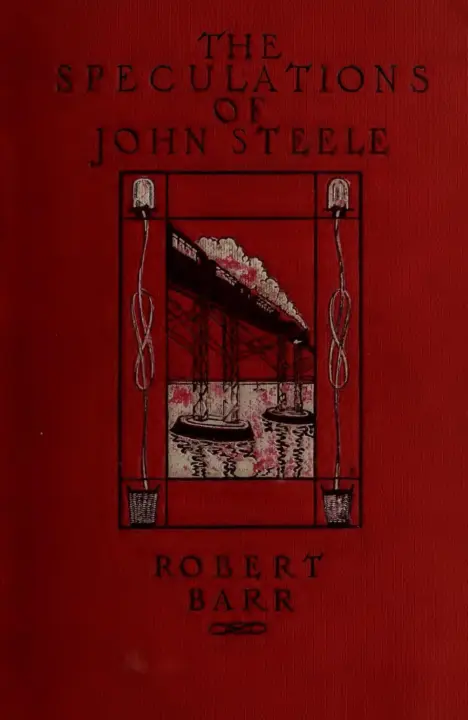
The Speculations of John Steele
Robert Barr
THE CLASSIC COLLECTION · 1896
"From Whose Bourne" by Robert Barr is a fictional narrative written in the late 19th century. The story centers around William Brenton, who unexpectedly finds himself deceased after a seemingly normal Christmas Eve dinner with his wife, Alice, and friends. The narrative explores themes of life after death as Brenton grapples with his new existence in the spirit world and his attempts to understand the circumstances surrounding his untimely demise while navigating the emotional turmoil of seeing his wife accused of his murder. The opening of the story introduces William Brenton as he excuses himself from the gathering and goes upstairs, where he soon falls into a dreamlike state. This unsettling dream transitions into a surreal experience where he observes his own lifeless body and learns from a mysterious figure that he is dead. As Brenton comes to terms with his new reality, he is drawn back to the events leading to his death and is horrified to discover that his wife has been arrested for his murder. The initial chapters establish a captivating premise of the afterlife intertwined with mystery, engaging the reader in Brenton's journey as he seeks both clarity and resolution for the chaos left behind.
Introduction adapted from the source catalogue; source summaries may be automatically generated.
Free to read · English · 29,755 words · No account needed
MAKE TIME FOR A GOOD BOOK
On by default. Untick to stop anonymous reading totals. Each page counts after 10 seconds in view. How this works.
Anonymous counting is on unless you have switched it off.
"Well, I will soon show you how we manage all that. Just wish to accompany me, and I will take you the rest of the way."
"How would Venice do?" said Brenton. "I didn't see half as much of that
city as I wanted to."
"Very well," replied his companion, "Venice it is;" and the American city in which they stood faded away from them, and before Brenton could make up his mind exactly what was happening, he found himself walking with his comrade in St. Mark's Square.
"Well, for rapid transit," said Brenton, "this beats anything I've ever had any idea of; but it increases the feeling that I am in a dream."
"You'll soon get used to it," answered Ferris; "and, when you do, the cumbersome methods of travel in the world itself will show themselves in their right light. Hello!" he cried, "here's a man whom I should like you to meet. By the way, I either don't know your name or I have forgotten it."
"William Brenton," answered the other.
"Mr. Speed, I want to introduce you to Mr. Brenton."
"Ah," said Speed, cordially, "a new-comer. One of your victims, Ferris?"
"Say one of his pupils, rather," answered Brenton.
"Well, it is pretty much the same thing," said Speed. "How long have you been with us, and how do you like the country?"
"You see, Mr. Brenton," interrupted Ferris, "John Speed was a newspaper man, and he must ask strangers how they like the country. He has inquired so often while interviewing foreigners for his paper that now he cannot abandon his old phrase. Mr. Brenton has been with us but a short time," continued Ferris, "and so you know, Speed, you can hardly expect him to answer your inevitable question."
"What part of the country are you from?" asked Speed.
"Cincinnati," answered Brenton, feeling almost as if he were an American tourist doing the continent of Europe.
"Cincinnati, eh? Well, I congratulate you. I do not know any place in America that I would sooner die in, as they call it, than Cincinnati. You see, I am a Chicago man myself."
Brenton did not like the jocular familiarity of the newspaper man, and found himself rather astonished to learn that in the spirit-world there were likes and dislikes, just as on earth.
"Chicago is a very enterprising city," he said, in a non-committal way.
"Chicago, my dear sir," said Speed, earnestly, "is the city. You will see that Chicago is going to be the great city of the world before you are a hundred years older. By the way, Ferris," said the Chicago man, suddenly recollecting something, "I have got Sommers over here with me."
Your reading position is saved on this browser. Take it to another device with a library code. Reading pages adapt to text, rather than matching a printed edition.
Robert Barr
Robert Barr
Robert Barr
Robert Barr
BEHIND THE BOOK
This eBook is for the use of anyone anywhere in the United States and most other parts of the world at no cost and with almost no restrictions whatsoever. You may copy it, give it away or re-use it under the terms of the Project Gutenberg License included with this eBook or online at www.gutenberg.org. If you are not located in the United States, you will have to check the laws of the country where you are located before using this eBook. Read the source licence.
The original source file, including credits and licence, is retained by this library. Request an original-format copy at no charge. Please include the book title and Project Gutenberg identifier #9312.
KEEP YOUR CURIOSITY GOING
Coulson Kernahan

Maurice Baring
Frances Wright
Cécile Tormay
Francis Greenleaf Allinson & Anne C. E. (Anne Crosby Emery) Allinson

Frederic Jesup Stimson