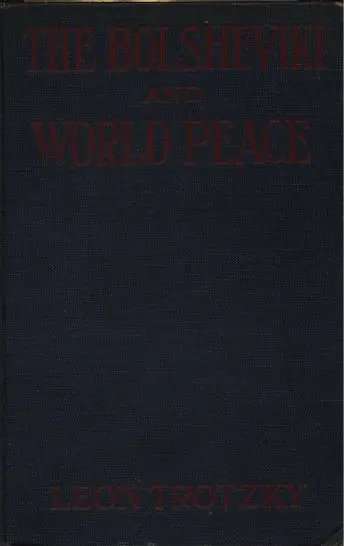
The Bolsheviki and World Peace
Leon Trotsky
THE CLASSIC COLLECTION · 1919
"From October to Brest-Litovsk" by Leon Trotsky is a historical account written in the early 20th century during a tumultuous period marked by the Russian Revolution and World War I. This work recounts the events leading up to the signing of the Treaty of Brest-Litovsk, focusing on the dynamics between various political factions, including the Bolsheviks, Social-Revolutionists, and Mensheviks, as well as the struggles within the Russian army and the impact of the war on the revolution itself. The opening of the book sets the stage for a detailed examination of the October Revolution, emphasizing the rapid developments and confusion surrounding the political landscape at the time. Trotsky discusses the relationship between the working class, peasantry, and the emerging power of middle-class intellectuals, highlighting how the war reshaped these groups' roles in the revolutionary movement. He reflects on the challenges of maintaining order in a chaotic environment while advocating for a more radical approach to peace negotiations amid the global conflict. The initial chapters indicate Trotsky's intentions to provide an authentic account of the revolution's complexities, meriting attention from readers interested in revolutionary history and political theory.
Introduction adapted from the source catalogue; source summaries may be automatically generated.
Free to read · English · 32,347 words · No account needed
MAKE TIME FOR A GOOD BOOK
On by default. Untick to stop anonymous reading totals. Each page counts after 10 seconds in view. How this works.
Anonymous counting is on unless you have switched it off.
The question was put by history far more concretely and sharply. The Constituent Assembly, owing to the character of its majority, was bound to turn over the government to the Chernov, Kerensky and Tseretelli group. Could this group have guided the destinies of the Revolution? Could it have found support in that class which constitutes the backbone of the Revolution? No. The real kernel of the class revolution has come into irreconcilable conflict with its democratic shell. By this situation the fate of the Constituent Assembly had been sealed. Its dissolution became the only possible surgical remedy for the contradiction, which had been created, not by us, but by all the preceding course of events.
At the historic night session of the Second All-Russian Congress of the Soviets the decree on peace was adopted. (The full text is printed in the Appendix.) At that moment the Soviet government was only becoming established in the important centers of the country and there was very little confidence abroad in its power. The Soviet adopted the decree unanimously. But this seemed to many no more than a political demonstration. Those who were for a compromise preached at every opportunity that our resolution would bring no results; for, on the one hand, the German imperialists would not recognize and would not deal with us; on the other hand, our Allies would declare war upon us as soon as we should start negotiating a separate peace. Under the shadow of these predictions we took our first steps to secure a general democratic peace. The decree was adopted on the 26th of October, when Kerensky and Krassnov were at the gates of Petrograd. On the 7th of November, we addressed by wireless an invitation to our Allies and enemies to conclude a general peace. In reply the Allied Governments addressed to General Dukhonin, then commander-in-chief, through their military attaches, a communication stating that further steps to separate peace negotiations would lead to the gravest consequences. To this protest we answered the 11th of November by appealing to all the workers, soldiers and peasants. In this appeal we declared that under no circumstances would we permit our army to shed its blood under the club of the foreign bourgeoisie. We swept aside the threat of the Western imperialists and took upon ourselves the responsibility for our peace policy before the international working class. First of all, we published, in accordance with our promises, made as a matter of principle, the secret treaties and declared that we would relinquish everything in these treaties that was against the interests of the masses of the people in all countries. The capitalist governments made an attempt to make use of our disclosures against one another, but the masses of the people understood and recognized us. Not a single social patriotic publication, as far as we know, dared to protest against having all the methods of diplomacy radically changed by a government of peasants and workers; they dared not protest against us for denouncing the dishonest cunning, chicanery and cheating of the old diplomacy. We made it the task of our diplomacy to enlighten the masses of the peoples, to open their eyes to the real meaning of the policy of their governments, in order to weld them together in a common struggle and a common hatred against the bourgeois capitalist order. The German bourgeois press accused us of "dragging on" the peace negotiations; but all nations anxiously followed the discussions at Brest-Litovsk, and in this way we rendered, during the two months and a half of peace negotiations, a service to the cause of peace which was recognized even by the more honest of our enemies. The question of peace was first put before the world in a shape which made it impossible to side-track it any longer by machinations behind the scenes. On the 22nd of November a truce was signed to discontinue military activities on the entire front from the Baltic to the Black Sea. Once more we requested our Allies to join us and to conduct together with us the peace negotiations. There was no reply, though this time the Allies did not again attempt to frighten us by threats. The peace negotiations were started December 9th, a month and a half after the peace decree was adopted. The accusations of the purchased press and of the social-traitor press that we had made no attempt to agree with our Allies on a common policy was therefore entirely false. For a month and a half we kept our Allies informed about every step we made and always called upon them to become a party to the peace negotiations. Our conscience is clear before the peoples of France, Italy and Great Britain.... We did all in our power to get all the belligerents to join the peace negotiations. If we were compelled to start separate peace negotiations, it was not because of any fault of ours, but because of the Western imperialists, as well as those of the Russian parties, which continued predicting the approaching destruction of the workmen's and peasants' government of Russia and who persuaded the Allies not to pay serious attention to our peace initiative. But be that as it may, on the 9th of December the peace conversations were started. Our delegation made a statement of principles which set forth the basis of a general democratic peace in the exact expressions of the decree of the 26th of October (8th of November). The other side demanded that the session be broken off, and the reopening of the sessions was later, at the suggestion of Kuehlmann, repeatedly delayed. It was clear that the delegation of the Teuton Allies experienced no small difficulty in the formulation of its reply to our delegation. On the 25th of December this reply was given. The diplomats of the Teuton Allies expressed agreement with our democratic formula of peace without annexations and indemnities, on the basis of self-determination of peoples. We saw clearly that this was but pretense; but we had not expected even that they would try to pretend; because, as the French writer has said, hypocrisy is the tribute that vice pays to virtue. The fact that the German imperialists found it necessary to make this tribute to the principles of democracy, was, in our eyes, evidence that the situation of affairs within Germany was serious enough.... But if we, generally speaking, had no illusions concerning the love for democracy of Messrs. Kuehlmann and Czernin--we know well enough the nature of the German and Austro-Hungarian dominating classes--it must nevertheless be admitted that we had not the slightest idea of the chasm which separated the real intentions of German imperialism from those principles which were put forth on the 25th of December by Mr. von Kuehlmann as a parody on the Russian revolution--a chasm which was revealed so strikingly a few days later. Such audacity we had never expected.
Your reading position is saved on this browser. Take it to another device with a library code. Reading pages adapt to text, rather than matching a printed edition.
BEHIND THE BOOK
This eBook is for the use of anyone anywhere in the United States and most other parts of the world at no cost and with almost no restrictions whatsoever. You may copy it, give it away or re-use it under the terms of the Project Gutenberg License included with this eBook or online at www.gutenberg.org. If you are not located in the United States, you will have to check the laws of the country where you are located before using this eBook. Read the source licence.
The original source file, including credits and licence, is retained by this library. Request an original-format copy at no charge. Please include the book title and Project Gutenberg identifier #6413.
KEEP YOUR CURIOSITY GOING
Cécile Tormay

Moritz Busch
John L. Ransom
Frances Wright
Cécile Tormay

Mabel Potter Daggett