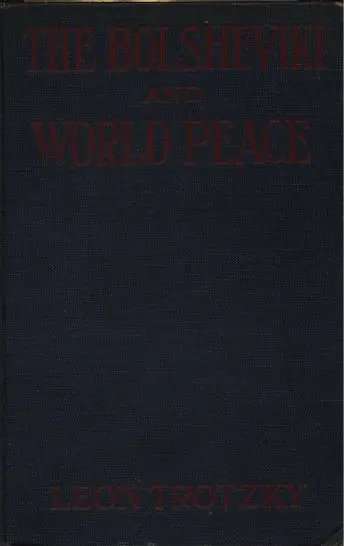
The Bolsheviki and World Peace
Leon Trotsky
THE CLASSIC COLLECTION · 1919
"From October to Brest-Litovsk" by Leon Trotsky is a historical account written in the early 20th century during a tumultuous period marked by the Russian Revolution and World War I. This work recounts the events leading up to the signing of the Treaty of Brest-Litovsk, focusing on the dynamics between various political factions, including the Bolsheviks, Social-Revolutionists, and Mensheviks, as well as the struggles within the Russian army and the impact of the war on the revolution itself. The opening of the book sets the stage for a detailed examination of the October Revolution, emphasizing the rapid developments and confusion surrounding the political landscape at the time. Trotsky discusses the relationship between the working class, peasantry, and the emerging power of middle-class intellectuals, highlighting how the war reshaped these groups' roles in the revolutionary movement. He reflects on the challenges of maintaining order in a chaotic environment while advocating for a more radical approach to peace negotiations amid the global conflict. The initial chapters indicate Trotsky's intentions to provide an authentic account of the revolution's complexities, meriting attention from readers interested in revolutionary history and political theory.
Introduction adapted from the source catalogue; source summaries may be automatically generated.
Free to read · English · 32,347 words · No account needed
MAKE TIME FOR A GOOD BOOK
On by default. Untick to stop anonymous reading totals. Each page counts after 10 seconds in view. How this works.
Anonymous counting is on unless you have switched it off.
All power to the Soviets! demanded our party. Translated into party language, this had meant, in the preceding period, the power of the S. R.'s and Mensheviks, as opposed to a coalition with the liberal bourgeoisie. Now, in October 1917, the same motto meant handing over all power to the revolutionary proletariat, at the head of which, at this period, stood the Bolshevik party. It was a question of the dictatorship of the working class, which was leading, or, more correctly, was capable of leading the many millions of the poorest peasantry. This was the historical significance of the October uprising.
Everything led the party to this path. Since the first days of the Revolution, we had been preaching the necessity and inevitability of the power passing to the Soviets. After a great internal struggle, the majority of the Soviets made this demand their own, having accepted our point of view. We were preparing the Second All-Russian Congress of Soviets at which we: expected our party's complete victory. Under Dan's leadership (the cautious Cheidze had departed for the Caucasus), the Central Executive Committee attempted to block in every way the calling of the Congress of the Soviets. After great exertions, supported by the Soviet fraction of the Democratic Assembly, we finally secured the setting of the date of the Congress for October 25th. This date was destined to become the greatest day in the history of Russia. As a preliminary, we called in Petrograd a Congress of Soviets of the Northern regions, including the Baltic fleet and Moscow. At this Congress, we had a solid majority, and obtained a certain support on the right in the persons of the left S. R. faction, besides laying important organizational premises for the October uprising.
But even earlier, previous to the Congress of Northern Soviets, there occurred an event which was destined to play a most important role in the subsequent political struggle. Early in October there came to a meeting of the Petrograd Executive Committee, the Soviet's representative in the staff of the Petrograd Military District and announced that Headquarters demanded that two-thirds of the Petrograd garrison should be sent to the front. For what purpose? To defend Petrograd. They were not to be sent to the front at once, but still it was necessary to make ready immediately. The Staff recommended that the Petrograd Soviet approve this plan. We were on our guard. At the end of August, also, five revolutionary regiments, complete or in parts, had been taken out of Petrograd. This had been done at the request of the then Supreme Commander Korniloff, who at that very time was preparing to hurl a Caucasian division against Petrograd, with the intention of once for all settling with the revolutionary capital. Thus we had already the experience of purely political transfer of regiments under the pretext of military operations. Anticipating events. I shall say, that from documents brought to light after the October Revolution it became clear beyond any doubt that the proposed removal of the Petrograd garrison actually had nothing to do with military purposes, but was forced upon Commander-in-Chief Dukhonin, against his will, by none else but Kerensky, who was striving to clear the capital of the most revolutionary soldiers, i.e., those most hostile to him. But at that time, early in October, our suspicions evoked at first a storm of patriotic indignation. The Staff people were pressing us, Kerensky was impatient, for the ground under his feet had grown too hot. We, on the other hand, delayed answering. Danger undoubtedly threatened Petrograd and the question of defending the capital loomed before us in all its terrible significance. But after the Korniloff experience, after Rodzyanko's words concerning the desirability of the German occupation, whence should we take the assurance that Petrograd would not be maliciously given up to the Germans in punishment for its seditious spirit? The Executive Committee refused to affix its seal blindly to the order to transfer two-thirds of the garrison. It was necessary to verify, we said, whether there really were military considerations back of this order, and therefore it was necessary to create an organization for this verification. Thus was born the idea of creating--by the side of the Soldiers' section of the Soviet, i. e., the garrison's political representation--a purely military organization, in the form of a Military Revolutionary Committee, which subsequently acquired enormous power and became the real tool of the October Revolution. Undoubtedly, even in those hours, when putting forth the idea of creating an organization in whose hands would be concentrated the threads for guiding the Petrograd garrison on the purely military side, we clearly realized that this very organization might become an irreplaceable revolutionary tool. At that time we were already openly heading for the uprising, and were preparing for it in an organized way.
Your reading position is saved on this browser. Take it to another device with a library code. Reading pages adapt to text, rather than matching a printed edition.
BEHIND THE BOOK
This eBook is for the use of anyone anywhere in the United States and most other parts of the world at no cost and with almost no restrictions whatsoever. You may copy it, give it away or re-use it under the terms of the Project Gutenberg License included with this eBook or online at www.gutenberg.org. If you are not located in the United States, you will have to check the laws of the country where you are located before using this eBook. Read the source licence.
The original source file, including credits and licence, is retained by this library. Request an original-format copy at no charge. Please include the book title and Project Gutenberg identifier #6413.
KEEP YOUR CURIOSITY GOING
Cécile Tormay

Moritz Busch
John L. Ransom
Frances Wright
Cécile Tormay

Mabel Potter Daggett