THE CLASSIC COLLECTION✦“America for Americans!” The Typical American, Thanksgiving SermonCLASSIC FREE BOOKS
“America for Americans!” The Typical American, Thanksgiving Sermon
John Philip Newman
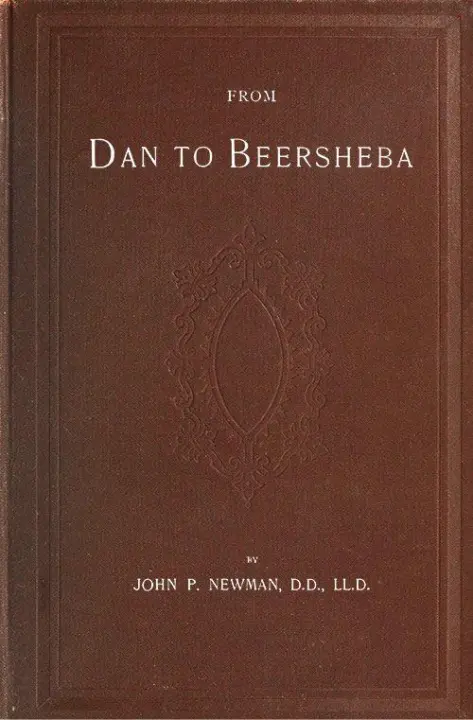
THE CLASSIC COLLECTION · 1892
"From Dan to Beersheba" by John Philip Newman is a descriptive account of the Holy Land written in the late 19th century. The work focuses on exploring the rich history, geography, and culture of Palestine, chronicling its significance in biblical narratives. It serves as both a travelogue and an insightful examination of the landscapes and customs of the area, aiming to connect the present-day aspects of the land with its historic and scriptural references. The opening of the book introduces the geographical structure of Palestine, detailing its mountainous terrain and fertile plains, while also assessing the transformations that have occurred over the centuries. Newman describes the boundaries of the region and reflects on the biblical significance of locations from Dan to Beersheba, providing context for the significance of these sites. He emphasizes the stark contrast between the land's ancient bountifulness, as described in scriptural texts, and its current state of barrenness, attributing these changes to both natural factors and historical events. The thorough details presented lay the foundation for a deeper exploration of the ensuing chapters, inviting readers into the transformative historical tapestry of the Holy Land.
Introduction adapted from the source catalogue; source summaries may be automatically generated.
Free to read · English · 158,898 words · No account needed
MAKE TIME FOR A GOOD BOOK
On by default. Untick to stop anonymous reading totals. Each page counts after 10 seconds in view. How this works.
Anonymous counting is on unless you have switched it off.
Had the dinner Abraham prepared for the three angels on the plains of Mamre been dramatized, the correspondence could hardly have been more exact. The tent-life; this distant field; the pressing invitation to dine; the water for the ablution of our hands and feet; the going to the field for a kid; handing it to a servant to dress it; the meal itself; the sheikh standing up while we ate; the seclusion of the females gave a lifelike reality to the sacred story.
Like the patriarchs of old, these Bedouin sheikhs lead a predatory life, moving their tents from place to place, according to the climate, and the demands of their herds and flocks. But in wealth, in hospitality, in reputation, in purity of character, in devotion, in intellect, in nobility of nature, the modern Arab chief holds no comparison with the exalted nature, the high-toned character, and the Christian-like piety of the prince of the patriarchs.
As in the days of the Hebrew spies, the Vale of Hebron is still famous for the delicious grapes of Eshcol.[368] Extending up the valley for more than a mile, and covering the sloping hills on either side, these celebrated vineyards are cultivated with care, and are a source of considerable revenue to the proprietors. Unlike our vineyards, those of Eshcol have no arbors. The vines are planted in rows, from eight to ten feet apart in each direction. When they attain a height of six feet they are attached to a stake, placed in a sloping position, and the shoots extending from vine to vine form a long and graceful festoon. Occasionally two opposite rows are purposely inclined toward each other, forming with their branches a natural arbor. After vintage, in late autumn, all the shoots are pruned off, and the stocks are cut down within a few feet of the ground, leaving an ungainly and apparently dead trunk; but the returning spring brings forth again the tender leaf, and the coming summer matures the luscious grape for the autumnal vintage. In each vineyard there is a lodge, or stone tower, from which the watchman keeps guard against the depredations of beasts and the incursions of robbers. During the vintage season the town is deserted; the people retire to these towers, each one sitting beneath his own vine and fig-tree,[369] and dividing the time between the gathering of the fruitage and the enjoyments of the annual festival. As the Moslems, who are the principal proprietors, are not allowed by their Koran to make wine, the grapes are either dried into raisins, or they are first pressed, and the juice is then boiled down into a sirup called dîbs, not unlike molasses, but of a more delightful flavor and delicious taste. It was to these vineyards the spies came, and from them they carried bunches of the grapes to Moses and their brethren as evidence of the fruitfulness of the Promised Land. Their journey was long, fatiguing, and perilous. Leaving Kadesh Barnea, in the Desert of Paran, they entered the Jordan Valley, and followed the river northward to Lake Tiberias, and, winding round its northern shore, entered the upper valley of the Jordan, pursuing their journey as far as Rehob, near Dan, as men come to Hamath; thence returning through the midst of the land by Tabor, across the great plain of Esdraelon, over the hills of Samaria, through the vale of Shechem, by Jacob’s well, over the heights of Benjamin and Judah, by Shiloh, Bethel, Jerusalem, and Bethlehem, to Hebron. Here flows the brook Eshcol, from which they drank, and from the vines along its banks they cut down a branch with one cluster of grapes, “and they bare it between two upon a staff.” To those who live in more northern climates, this story of the enormous size and great weight of a single bunch of grapes must seem incredible; but, whatever may be the degeneracy of the Syrian grape, through centuries of neglect, the proof is abundant that in southern latitudes grapes grow to an enormous size. According to Pliny, a bunch of African grapes was larger than an infant. Paul Lucas mentions bunches which he saw in Damascus weighing forty-five pounds each, and in Naples I have eaten grapes each one as large as a plum. The mode, however, adopted by the spies to carry the bunch from Eshcol to Kadesh Barnea was probably not rendered necessary by the size of the cluster so much as by the desire to preserve it entire for the benefit of their brethren.[370] Watched by the keen eye of the vine-dresser, we entered the vineyard, and were impressed with the exact correspondence between the one before us and the one described by our Lord: There was a certain householder, which planted a vineyard, hedged it round about, digged a wine-press in it, built a tower, and let it out to husbandmen.[371] There were the vines; around them was the hedge; within it was the press; yonder stood the tower, and by my side toiled the husbandman. Within the same vale are groves of olives, and orchards of figs, and apricots, and quinces, and pomegranates. The latter fruit, so frequently referred to in the Bible, is as sweet to the taste as it is pleasant to the eye. In form and size it is not unlike an orange, and in color inclines to a pale yellow, tinged with a red blush. They grow upon a thorny bush, with a tulip-shaped flower of a brilliant red color, and form one of the luxuries of the East both to the native and to the stranger. But the noblest of all the trees of Hebron is the remarkable oak of Abraham. It stands in the midst of the vineyards, in a clean, smooth spot, covered with soft, fresh grass, and near a well of cool water. It is an oak of the evergreen species, measuring twenty-three feet in girth, and its magnificent branches spread out over a circle ninety feet in diameter. Six feet from the ground the trunk separates into four huge branches, and, higher up, these in turn spread out into many more. Standing alone, it appears to greater advantage, and its lengthened arms, loaded with exquisite foliage, affords delightful shade to the weary traveler. Here, on their festive days, the Jewish maidens and the young men of Hebron assemble beneath this ancestral tree to enjoy the rural pleasure of the song and dance. Though of great age, it is still sound and majestic, and with it tradition associates many thrilling memories. Standing on the Plain of Mamre, it probably marks the spot where Abraham pitched his tent and entertained the angels. Though hardly credible that this terebinth should have remained green and vigorous during the lapse of nearly forty centuries, yet it may be cherished as the last representative of the sacred forest of Mamre. Fond of contrasts, and never happier than when the extremes of fortune and the ends of time meet in the same scene, the Oriental legendaries point to this noble oak as the slave-mart where the descendants of Abraham were sold by their Roman masters into captivity.
Your reading position is saved on this browser. Take it to another device with a library code. Reading pages adapt to text, rather than matching a printed edition.
BEHIND THE BOOK
This eBook is for the use of anyone anywhere in the United States and most other parts of the world at no cost and with almost no restrictions whatsoever. You may copy it, give it away or re-use it under the terms of the Project Gutenberg License included with this eBook or online at www.gutenberg.org. If you are not located in the United States, you will have to check the laws of the country where you are located before using this eBook. Read the source licence.
The original source file, including credits and licence, is retained by this library. Request an original-format copy at no charge. Please include the book title and Project Gutenberg identifier #55824.
KEEP YOUR CURIOSITY GOING
Wilfrid Scawen Blunt
Wilfrid Scawen Blunt

E. W. (Edgar Watson) Howe

David Patterson (Spirit) Hatch

David Patterson (Spirit) Hatch

David Patterson (Spirit) Hatch