THE CLASSIC COLLECTION✦“America for Americans!” The Typical American, Thanksgiving SermonCLASSIC FREE BOOKS
“America for Americans!” The Typical American, Thanksgiving Sermon
John Philip Newman
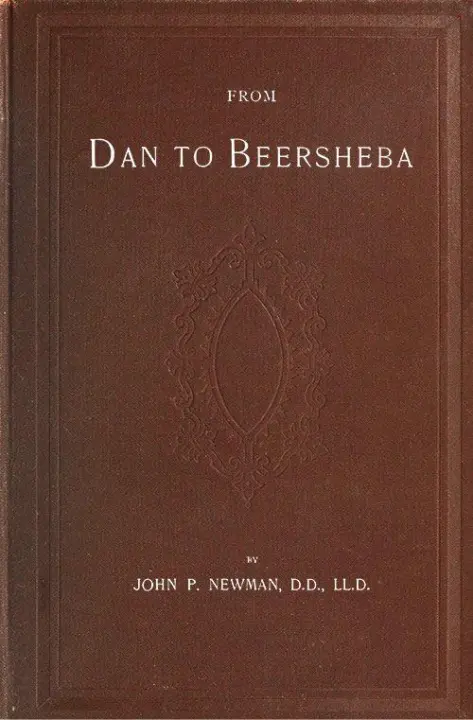
THE CLASSIC COLLECTION · 1892
"From Dan to Beersheba" by John Philip Newman is a descriptive account of the Holy Land written in the late 19th century. The work focuses on exploring the rich history, geography, and culture of Palestine, chronicling its significance in biblical narratives. It serves as both a travelogue and an insightful examination of the landscapes and customs of the area, aiming to connect the present-day aspects of the land with its historic and scriptural references. The opening of the book introduces the geographical structure of Palestine, detailing its mountainous terrain and fertile plains, while also assessing the transformations that have occurred over the centuries. Newman describes the boundaries of the region and reflects on the biblical significance of locations from Dan to Beersheba, providing context for the significance of these sites. He emphasizes the stark contrast between the land's ancient bountifulness, as described in scriptural texts, and its current state of barrenness, attributing these changes to both natural factors and historical events. The thorough details presented lay the foundation for a deeper exploration of the ensuing chapters, inviting readers into the transformative historical tapestry of the Holy Land.
Introduction adapted from the source catalogue; source summaries may be automatically generated.
Free to read · English · 158,898 words · No account needed
MAKE TIME FOR A GOOD BOOK
On by default. Untick to stop anonymous reading totals. Each page counts after 10 seconds in view. How this works.
Anonymous counting is on unless you have switched it off.
As in the days of Christ, the Jews are divided into rival sects――the Sephardim and the Askenazim. The former are of Spanish origin, and are the descendants of those whom Ferdinand and Isabella banished in 1497 A.D., presenting the rare instance of persons having been exiled to their native land. Their language is a mixture of Spanish and Arabic; and, though subjects of the Sultan, they are suffered to maintain a distinct community, governed by their Rabbinical laws. Numbering about four thousand, they have four synagogues, and are subject to a council of seven rabbis, and a high-priest called “the Head in Zion.” Their poverty is the most abject, their filth the most indescribable, their wretchedness the most complete imaginable. Their brethren of the Askenazim order are principally of German and Polish extraction, and number in all less than four thousand souls. Having been readmitted to Palestine in the beginning of the present century, they remain subject to the consuls of their respective countries. Being mostly paupers, they are allowed six dollars per annum for support, which is the amount per capita drawn from the contributions remitted to them from the rich Jews in other lands. Hoping to enlighten their minds and preserve a knowledge of their religion, thirty-six reading-rooms have been opened for their instruction, in which teachers are employed to instruct them in the Talmud and other religious works. With becoming regularity they keep the feast of the Passover, observe their Sabbath, and assemble on Friday in their “place of reading” to recite the lamentations of their prophets.
On the Monday night succeeding Palm Sunday was celebrated the Jewish Passover, which I was invited to witness by a Christian merchant of Jerusalem, whose reputation among the Jews made him a welcome guest. The paschal moon shone softly as we threaded the narrow streets winding up the steep acclivities of Zion. Calling first on a family of moderate circumstances, we found them already seated around the table, engaged in the preliminary devotions of the feast. Since the loss of their nationality the Jews celebrate this festival at their homes, and in an unpretending manner observe as far as possible the requisitions of their law. In obedience to the command, all the members of the household were present, including parents, sons and daughters, and daughters-in-law. The dwelling had been carefully cleansed of old leaven by the father of the family; and, that his search into every nook and cranny might not seem fruitless, the busy housewife had purposely placed bits of old bread in such parts of the building where they would certainly meet his eye, and which he destroyed with much ado. The apartment in which the family were enjoying their annual feast was a large square room with vaulted ceiling. The table had been prepared with great neatness and care. On each plate was a bit of lamb, a piece of unleavened bread, a few bitter herbs, and for each person there was a glass of wine. Three lamps were burning on the table, and as many were suspended from the ceiling directly above――symbols of the Trinity. Observing a vacant chair and a well-filled plate, with a goblet of wine before it, I was informed the vacant place was for the Prophet Elias, whom they expected would come, and for whom they wished to be prepared at any moment. To represent the hasty departure of their fathers from Egypt, and in obedience to the paschal law, each person was attired as for a journey: “With your loins girded, your shoes on your feet, and your staff in your hand; ye shall eat it in haste: it is the Lord’s passover.” To illustrate how their ancestors had spoiled the Egyptians in borrowing “jewels of silver and jewels of gold, and raiment,” they had attired themselves in their best apparel, adorned their persons with their most costly ornaments, and decorated the table with whatever silver and gold ware they possessed. The father, who was a man in the prime of life, sat at the head of the table, the mother, a neat-looking woman, sat at the opposite end, the three daughters were arranged on one side, and the two sons on the other. In a chanting tone the eldest son read from the book of Exodus the story and deliverance of the Israelites, while the whole family recited portions of their history in concert. Alternately they were jubilant and indignant: when Moses triumphed they shouted; when Pharaoh was cruel they cursed him, and in their rage they dipped their finger in the wine, and, allowing it to drop upon the floor, they enumerated therewith the plagues of Egypt, declaring Pharaoh should not have a drop of wine to cool his parched tongue. The Scripture recitation over, they began to eat, exclaiming, as they tasted the herb, “Bitter, bitter!”[242]
Your reading position is saved on this browser. Take it to another device with a library code. Reading pages adapt to text, rather than matching a printed edition.
BEHIND THE BOOK
This eBook is for the use of anyone anywhere in the United States and most other parts of the world at no cost and with almost no restrictions whatsoever. You may copy it, give it away or re-use it under the terms of the Project Gutenberg License included with this eBook or online at www.gutenberg.org. If you are not located in the United States, you will have to check the laws of the country where you are located before using this eBook. Read the source licence.
The original source file, including credits and licence, is retained by this library. Request an original-format copy at no charge. Please include the book title and Project Gutenberg identifier #55824.
KEEP YOUR CURIOSITY GOING
Wilfrid Scawen Blunt
Wilfrid Scawen Blunt

E. W. (Edgar Watson) Howe

David Patterson (Spirit) Hatch

David Patterson (Spirit) Hatch

David Patterson (Spirit) Hatch