THE CLASSIC COLLECTION✦Towards democracyCLASSIC FREE BOOKS
Towards democracy
Edward Carpenter
THE CLASSIC COLLECTION · 1892
"From Adam's Peak to Elephanta: Sketches in Ceylon and India" by Edward Carpenter is a travel narrative written in the late 19th century. This work captures the author's reflections and observations during his travels through Ceylon (modern-day Sri Lanka) and India, exploring the cultural, social, and natural landscapes of these regions. As a blend of personal memoir and social commentary, the book delves into the complexities of local life, interactions with native peoples, and the contrast between Western and Eastern philosophies. The opening of the narrative establishes Carpenter's intention to document his first impressions rather than rely on generalizations that could misrepresent the richness and diversity of the regions he visits. He begins his journey on a steamship through the Suez Canal, setting the stage for his exploration of Ceylon and India. Descriptions of the changing landscape, the vibrancy of Colombo, and the uniqueness of its inhabitants, including the rich tapestry of cultural identities among the Cinghalese and Tamils, provide a vivid backdrop. The author reflects on the social dynamics he observes, emphasizing the poignant contrasts between colonial power structures and the lived experiences of local populations, hinting at the complex tapestry of human interactions that will characterize his travels throughout the book.
Introduction adapted from the source catalogue; source summaries may be automatically generated.
Free to read · English · 90,601 words · No account needed
MAKE TIME FOR A GOOD BOOK
On by default. Untick to stop anonymous reading totals. Each page counts after 10 seconds in view. How this works.
Anonymous counting is on unless you have switched it off.
There was a native king and kingdom of Kandy till about eighty years ago (1814), when the British overthrew it; and it is curious that the old Kandian law--which was recognised for some time by the British--contains very evident traces of the old group-marriage which is found among so many races in their pre-civilisation period. There were two kinds of marriage treated of in the Kandian law--the Deega marriage, in which the wife went (as with us) to the house of her husband, and became more or less his property; and the Beena marriage, in which he came to live with her among her own people, but was liable to expulsion at any time! The latter form is generally supposed to be the more primitive, and belongs to the time when heredity is traced through the woman, and when also polygamous and polyandrous practices prevail. And this is confirmed by a paragraph of the Kandian law, or custom, which forbade intermarriage between the children of two brothers, or between the children of two sisters, but allowed it between the children of a brother and a sister--the meaning of course being that two brothers might have the same wife, or two sisters the same husband, but that a brother and sister--having necessarily distinct wives and husbands--would produce children who could not be more nearly related to each other than cousins. It is also confirmed by the fact that a kind of customary group-marriage still lingers among the Cinghalese--e.g. if a man is married, his brothers not uncommonly have access to the wife--though owing to its being discountenanced by Western habits and law, this practice is gradually dying out.
Kalua has seen rather more of the world than some of his people, and has had opportunities of making a little money now and then. It appears that at the age of twelve or thirteen he took to “devil-dancing”--probably his father set him to it. He danced in the temple and got money; but now-a-days does not like the priests or believe in the temples. This devil-dancing appears to be a relic of aboriginal Kandian demon-worship: the evil spirits had to be appeased, or in cases of illness or misfortune driven away by shrieks and frantic gestures. It is a truly diabolical performance. The dancers (there are generally two of them) dress themselves up in fantastic array, and then execute the most extraordinary series of leaps, bounds, demivolts, and somersaults, in rhythmical climaxes, accompanied by clapping of hands, shrieks, and tomtomming, for about twenty minutes without stopping, by the end of which time the excitement of themselves and spectators is intense, and the patient--if there is one--is pretty sure to be either killed or cured! When the Buddhists came to the island they incorporated these older performances into their institutions. Some two or three years ago however Hagenbeck, of circus celebrity, being in Ceylon engaged a troupe of Kandians--of whom Kalua was one--to give a native performance for the benefit of the Europeans; and since that time the old peasant life has palled upon our friend, and it is evident that he lives in dreams of civilisation and the West. Kalua is remarkably well-made, and active and powerful. He is about twenty-eight, with the soft giraffe-like eyes of the Cinghalese, and the gentle somewhat diffident manner which they affect; his black hair is generally coiled in a knot behind his head, and, with an ornamental belt sustaining his colored skirt, and a shawl thrown over his shoulder, he looks quite handsome. Kirrah is thinner and weaker, both mentally and physically, with a clinging affectionateness of character which is touching. Then there are two nephews, Pinha and Punjha, whom I have seen once or twice--bright nice-looking boys, anxious to pick up phrases and words of English, and ideas about the wonderful Western world, which is beginning to dawn on their horizon--though alas! it will soon destroy their naked beauty and simplicity. To see Punjha go straight up the stem of a coco-nut tree fifty feet high is a caution! He just puts a noose of rope round his two feet to enable him to grasp the stem better with his soles, clasps his hands round the trunk, brings his knees up to his ears, and shoots up like a frog swimming!
Your reading position is saved on this browser. Take it to another device with a library code. Reading pages adapt to text, rather than matching a printed edition.
Edward Carpenter
Edward Carpenter
Edward Carpenter
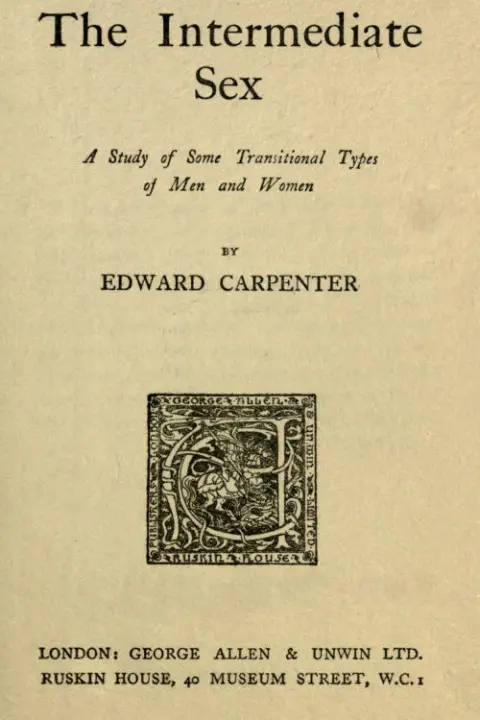
Edward Carpenter
BEHIND THE BOOK
This eBook is for the use of anyone anywhere in the United States and most other parts of the world at no cost and with almost no restrictions whatsoever. You may copy it, give it away or re-use it under the terms of the Project Gutenberg License included with this eBook or online at www.gutenberg.org. If you are not located in the United States, you will have to check the laws of the country where you are located before using this eBook. Read the source licence.
The original source file, including credits and licence, is retained by this library. Request an original-format copy at no charge. Please include the book title and Project Gutenberg identifier #72756.
KEEP YOUR CURIOSITY GOING
Wilfrid Scawen Blunt
Wilfrid Scawen Blunt

E. W. (Edgar Watson) Howe

David Patterson (Spirit) Hatch

David Patterson (Spirit) Hatch

David Patterson (Spirit) Hatch