THE CLASSIC COLLECTION✦Towards democracyCLASSIC FREE BOOKS
Towards democracy
Edward Carpenter
THE CLASSIC COLLECTION · 1892
"From Adam's Peak to Elephanta: Sketches in Ceylon and India" by Edward Carpenter is a travel narrative written in the late 19th century. This work captures the author's reflections and observations during his travels through Ceylon (modern-day Sri Lanka) and India, exploring the cultural, social, and natural landscapes of these regions. As a blend of personal memoir and social commentary, the book delves into the complexities of local life, interactions with native peoples, and the contrast between Western and Eastern philosophies. The opening of the narrative establishes Carpenter's intention to document his first impressions rather than rely on generalizations that could misrepresent the richness and diversity of the regions he visits. He begins his journey on a steamship through the Suez Canal, setting the stage for his exploration of Ceylon and India. Descriptions of the changing landscape, the vibrancy of Colombo, and the uniqueness of its inhabitants, including the rich tapestry of cultural identities among the Cinghalese and Tamils, provide a vivid backdrop. The author reflects on the social dynamics he observes, emphasizing the poignant contrasts between colonial power structures and the lived experiences of local populations, hinting at the complex tapestry of human interactions that will characterize his travels throughout the book.
Introduction adapted from the source catalogue; source summaries may be automatically generated.
Free to read · English · 90,601 words · No account needed
MAKE TIME FOR A GOOD BOOK
On by default. Untick to stop anonymous reading totals. Each page counts after 10 seconds in view. How this works.
Anonymous counting is on unless you have switched it off.
Colombo.--I fear that the Red Sea combined with mutual boredom had a bad effect on the passengers’ tempers, for terrible dissensions broke out; and after six days of the Indian Ocean, during which the only diversions were flying-fish outside and scandal-mongering inside the ship, it was a relief to land on the palm-fringed coast of Ceylon. The slender catamarans--or more properly outrigged canoes--manned by dusky forms, which come to take you ashore, are indeed so narrow that it is impossible to sit inside them! They are made of a “dug-out” tree-trunk (see frontispiece), with parallel bulwarks fastened on only 10 inches or a foot apart; across the bulwarks a short board is placed, and on that you can sit. Two arms projecting on one side carry a float or light fish-shaped piece of wood, which rests on the water 8 feet or so from the canoe, and prevents the vessel from capsizing, which it would otherwise infallibly do. Impelled by oars, or by a sail, the boat bounds over the water at a good speed; and the mode of traveling is very pleasant. There is no necessity however to embark in these frail craft, for respectable civilised boats, and even steam-launches, abound; we are indeed in an important and busy port.
A great granite mole, built five years ago, has converted an open roadstead into a safe and capacious harbor, and there is now probably no place in the East better supplied with mails and passenger boats than Colombo. It is the calling place for the great lines of steamers en route for Australia, for China and Japan, and for Calcutta and Burmah, not to mention smaller coasting boats from the mainland of India, and so forth. The city itself has only the slightest resemblance to a European town. There is a fort certainly, and a Government House, and barracks with a regiment of infantry (part of whom however are generally up country); there are two or three streets of two or even three-storied houses, with shops, banks, mercantile offices, etc.; a few hotels and big goods stores, a lighthouse, and a large engineering works, employing some hundreds of Cinghalese and Tamil operatives; and then you have done with the English quarter. The land is flat, and round about the part just described stretch open grass-covered spaces, and tree-fringed roads, with the tiny booths or huts of the darkies on both sides of them. Here and there are knots and congeries of little streets and native markets with multifarious life going on in them. Here is a street of better built cottages or little villas belonging to Eurasians--the somewhat mixed descendants of old Dutch and Portuguese settlers--small one or seldom two-storied houses of stuccoed brick, with a verandah in front and a little open court within, clustering round an old Dutch church of the 17th century. Here is the residential quarter of the official English and of the more aspiring among the natives--the old Cinnamon Gardens, now laid out in large villa-bungalows and private grounds. Here again is a Roman Catholic church and convent, or the grotesque façade of a Hindu temple; and everywhere trees and flowering shrubs and, as one approaches the outskirts of the town, the plentiful broad leaves of coco-palms and bananas overshadowing the roads. Nor in any description of Colombo should the fresh-water lake be forgotten, which ramifying and winding in most intricate fashion through the town, and in one place coming within a hundred yards of the sea, surprises one continually with enchanting glimpses. I don’t know any more delightful view of its kind--all the more delightful because so unexpected--than that which greets the eye on entering the Fort Railway Station at Colombo. You pass through the booking-office and find yourself on a platform, which except for the line of rails between might be a terrace on the lake itself; a large expanse of water with wooded shores and islands, interspersed with villas, cottages and cabins, lies before you; white-sailed boats are going to and fro; groups of dark figures, waist-deep in water, are washing clothes; children are playing and swimming in the water; and when, as I saw it once, the evening sun is shining through the transparent green fringe of banana palms which occupies the immediate foreground, and the calm lake beyond reflects like a mirror the gorgeous hues of sky and cloud, the scene is one which for effects of color can hardly be surpassed.
Your reading position is saved on this browser. Take it to another device with a library code. Reading pages adapt to text, rather than matching a printed edition.
Edward Carpenter
Edward Carpenter
Edward Carpenter
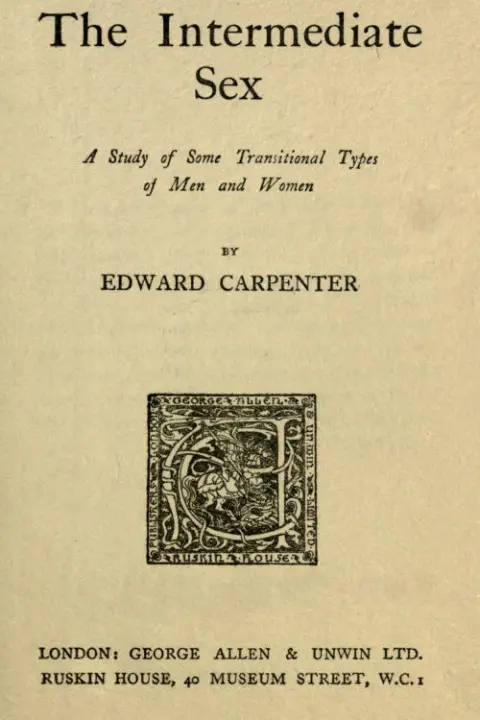
Edward Carpenter
BEHIND THE BOOK
This eBook is for the use of anyone anywhere in the United States and most other parts of the world at no cost and with almost no restrictions whatsoever. You may copy it, give it away or re-use it under the terms of the Project Gutenberg License included with this eBook or online at www.gutenberg.org. If you are not located in the United States, you will have to check the laws of the country where you are located before using this eBook. Read the source licence.
The original source file, including credits and licence, is retained by this library. Request an original-format copy at no charge. Please include the book title and Project Gutenberg identifier #72756.
KEEP YOUR CURIOSITY GOING
Wilfrid Scawen Blunt
Wilfrid Scawen Blunt

E. W. (Edgar Watson) Howe

David Patterson (Spirit) Hatch

David Patterson (Spirit) Hatch

David Patterson (Spirit) Hatch