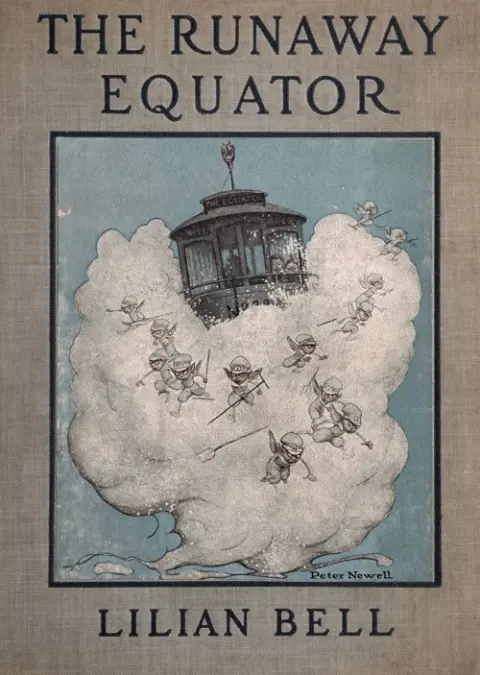
The Runaway Equator, and the Strange Adventures of a Little Boy in Pursuit of It
Lilian Bell
THE CLASSIC COLLECTION · 1897
"From a Girl's Point of View" by Lilian Bell is a social commentary written in the late 19th century, focusing on the dynamics of relationships and societal expectations surrounding women and men. Through a series of essays, Bell explores themes such as love, femininity, and the roles of men in romance, often using wit and keen observation to challenge the status quo. The narrative is likely imbued with the author's own views and experiences, showcasing the struggles and perspectives of women in a patriarchal society. At the start of the book, Bell presents her thoughts on the so-called "untrained man under thirty-five," a character archetype representing young men who, while self-absorbed and socially clumsy, are in the process of maturing. The opening delves into various observations regarding the interplay between men and women, particularly highlighting how untrained men often lack the emotional and social skills to effectively engage with women. Bell articulates her frustrations about societal expectations placed on women, the superficiality of many interactions, and the intricacies of romantic pursuits, setting the stage for a nuanced exploration of relationships throughout the book.
Introduction adapted from the source catalogue; source summaries may be automatically generated.
Free to read · English · 32,201 words · No account needed
MAKE TIME FOR A GOOD BOOK
On by default. Untick to stop anonymous reading totals. Each page counts after 10 seconds in view. How this works.
Anonymous counting is on unless you have switched it off.
Possibly because I also had dined and was therefore affable, I endeavored to see if there was any forgotten corner of his mind, any blind alley I hitherto had left unexplored, where I might find mine own and feel at home.
His face was dull, heavy, unemotional, but I said in sprightly tones
to coax his lethargy:
"I have made such a delicious discovery to-day. I have found that Carlyle has given the most acute definition of humor I ever read. Isn't that rather surprising, when Carlyle's humor is rather lumbering?"
He thought a moment.
"It is," he said, carefully, with that want of recklessness which should endear him to a stone image.
"Do you know it, or shall I tell you?" I said, with fatal geniality.
Another pause.
"Tell me," he said, heavily, wadding his mind with cotton, for fear some lightness should percolate through it.
"Why, he said that humor was an appreciation of the under side of
things. Isn't that delicious?"
I spoke with unctuous satisfaction, for I really expected him to comprehend. He looked at my beaming countenance with grave suspicion, and slowly reddened. He said nothing. I still smiled, but my smile was fast freezing.
"Well?" I said, impatiently.
"You are jesting," he said. "That isn't the real answer."
"Why, yes, it is. Do you mean to say that you don't understand?"
"You jest so much. I never can tell--" he broke off, helplessly.
"But surely you see that," I urged. "How would you define humor?"
"Why, humor is something funny. There's nothing funny about--er--that
that Carlyle said."
"Yes, but it's only a very delicate and occult way of exhibiting his acuteness," I said. "Don't you see? An appreciation of the under side of things--the side that does not lie on the surface."
"Are you serious?" he asked, as I leaned back to rest from my toil.
"Perfectly. But I can hardly believe that you are."
"Do you mean to say that you really see anything in that definition?"
"I do," I said, with ominous distinctness.
My manner indicated his stupidity, and he resented it. He grew
excited.
"Now, tell me, on your honor, do you really see anything funnier in the under side of that sofa than in the top side?"
I could have screamed with anguish. But, being in company, I only smote my hands together in my impotence and prayed for death.
Your reading position is saved on this browser. Take it to another device with a library code. Reading pages adapt to text, rather than matching a printed edition.
Lilian Bell
Lilian Bell
Lilian Bell
Lilian Bell
BEHIND THE BOOK
This eBook is for the use of anyone anywhere in the United States and most other parts of the world at no cost and with almost no restrictions whatsoever. You may copy it, give it away or re-use it under the terms of the Project Gutenberg License included with this eBook or online at www.gutenberg.org. If you are not located in the United States, you will have to check the laws of the country where you are located before using this eBook. Read the source licence.
The original source file, including credits and licence, is retained by this library. Request an original-format copy at no charge. Please include the book title and Project Gutenberg identifier #11608.
KEEP YOUR CURIOSITY GOING

David Patterson (Spirit) Hatch

David Patterson (Spirit) Hatch

David Patterson (Spirit) Hatch

Ralph Waldo Emerson

Maurice Baring

Oscar Wilde & James McNeill Whistler