THE CLASSIC COLLECTION✦Judith LeeCLASSIC FREE BOOKS
Judith Lee
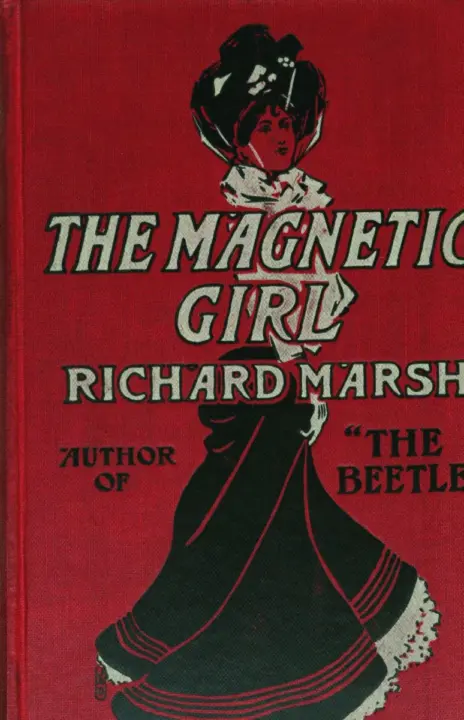
Richard Marsh
THE CLASSIC COLLECTION · 1899
"Frivolities, Especially Addressed to Those Who Are Tired of Being Serious" by Richard Marsh is a collection of humorous short stories written in the late 19th century. The stories explore various lighthearted and comedic situations that invite readers to take a break from the seriousness of everyday life. The characters are eclectic, including a clergyman, various applicants for a lost purse, and a whimsical waiter, all contributing to the comical tone of the narrative. The opening of the collection begins with an amusing scene focusing on a protagonist who has found a purse and is now dealing with a stream of eccentric characters claiming ownership over it. As several applicants arrive at his door, their increasingly desperate and often absurd attempts to describe the lost purse reveal a colorful tapestry of society's characters, from a seedy clergyman to the unemployed. The protagonist's exasperation grows as the chaotic situation unfolds, leading to humorous interactions that highlight the ridiculousness of their claims. This sets the tone for a series of amusing encounters that promise to entertain readers with lighthearted storytelling.
Introduction adapted from the source catalogue; source summaries may be automatically generated.
Free to read · English · 65,250 words · No account needed
MAKE TIME FOR A GOOD BOOK
On by default. Untick to stop anonymous reading totals. Each page counts after 10 seconds in view. How this works.
Anonymous counting is on unless you have switched it off.
"Sir,--I have the honour to inform you that I am shipping my son, John F. Stanley, to your academy. He will arrive per s.s. Aurania. I have decided to educate him in England. Please acknowledge enclosed bank draft for two hundred and fifty dollars ($250) in payment of six months' fees. Any sum in excess, to the amount of one hundred dollars ($100), will be paid, on demand, by my agents, Messrs. Rödenheim, of London.
"Yours faithfully,
"J. Bindon.
"P.S.--You will also receive, per same ship, my son, John R. Stephen.
Enclosed find second draft ($250). For balance, apply Messrs.
Rödenheim."
"Mr. Bindon," observed Mr. Harland when he had finished reading this epistle, "appears to be rather a curious man."
"What is the matter?" inquired his wife. "Is he going to withdraw that
son of his?"
"Not exactly. He has 'shipped'--the word is his own--two more. The second, who is 'shipped' in a postscript, is, apparently, a sort of afterthought."
When the lady and gentleman returned to Mulberry House the new-comers had arrived. The three Masters Bindon were interviewed together. One thing about them was noticeable--that they were all about the same age.
"How old are you?" asked the lady, addressing one of the strangers.
"Twelve."
"And you?"
"I'm twelve."
"Then," said the lady, "I suppose you are twins."
They did not look as though they were twins. One was big, and black, and bony; the other was short, and fat, and red. Still, as they both were twelve, and they were brothers--
"Twins?" said the red-haired lad. "I'm no twin. He's not my brother." He turned upon the two other Masters Bindon with scorn in his eyes. "They're neither of them my brothers. I disown them."
"John R. Stephen," remarked John F. Ernest, slipping his hand into that of the black-haired Master Bindon, "is my brother. John F. Stanley has disowned us from the first."
"Yes," said Rufus, "and I'll disown you to the last."
"You wait," observed the black-haired Master Bindon, whose claim to fraternity was thus denied, "till we get outside. I'll rub you down with a rail."
"I hope," said Mrs. Harland, when the Masters Bindon had withdrawn, "I do hope, Andrew, that there is nothing wrong."
"Pooh!" replied her husband. But when he was alone he rubbed his chin and murmured sotto voce, "It strikes me that there's not much difference between J. Bindon and 'Jolly Jack.'"
He thought that there might be even less than he had imagined when one day, before the term was half-way through, he received a cablegram from New York:
"Son coming Batavia, Forgot to write. Draw Rödenheim. BINDON."
Your reading position is saved on this browser. Take it to another device with a library code. Reading pages adapt to text, rather than matching a printed edition.
Richard Marsh
Richard Marsh
Richard Marsh
Richard Marsh
BEHIND THE BOOK
This eBook is for the use of anyone anywhere in the United States and most other parts of the world at no cost and with almost no restrictions whatsoever. You may copy it, give it away or re-use it under the terms of the Project Gutenberg License included with this eBook or online at www.gutenberg.org. If you are not located in the United States, you will have to check the laws of the country where you are located before using this eBook. Read the source licence.
The original source file, including credits and licence, is retained by this library. Request an original-format copy at no charge. Please include the book title and Project Gutenberg identifier #40454.
KEEP YOUR CURIOSITY GOING
Coulson Kernahan

Maurice Baring
Frances Wright
Cécile Tormay

Frederic Jesup Stimson

W. H. P. (William Henry Pope) Jarvis