
John Bull’s Womankind (Les Filles de John Bull)
Max O'Rell
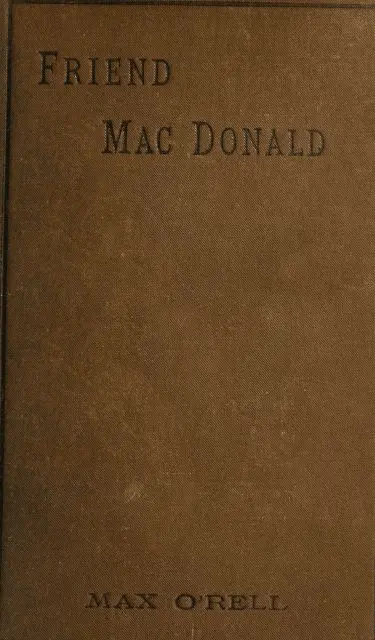
THE CLASSIC COLLECTION · 1887
"Friend Mac Donald" by Max O'Rell is a humorous and insightful account written in the late 19th century. The book offers a lively exploration of Scottish culture, character, and anecdotes, primarily reflecting on the unique traits of Scots, particularly a character named Donald. Through lighthearted anecdotes and observations, it attempts to paint an affectionate portrait of Scotland and its people, aiming to bridge cultural understandings, especially for a French audience. The opening of "Friend Mac Donald" introduces the author reminiscing about his time in Scotland, emphasizing the rich tapestry of anecdotes he gathered during his stay. He notes that while the English believe Scots lack humor, they actually possess a distinctive wit characterized by good-humor and cleverness. The author reflects on his conversations with Donald, highlighting the pride and lively spirit embedded in Scottish culture. Additionally, he briefly touches on how Scots, while increasingly incorporating English aspects into their daily lives, retain core elements of their identity, particularly their matter-of-fact good humor and cultural pride. This sets the tone for an engaging exploration of Scottish life filled with wit and a deep appreciation for the Caledonian spirit.
Introduction adapted from the source catalogue; source summaries may be automatically generated.
Free to read · English · 42,836 words · No account needed
MAKE TIME FOR A GOOD BOOK
On by default. Untick to stop anonymous reading totals. Each page counts after 10 seconds in view. How this works.
Anonymous counting is on unless you have switched it off.
The following little scene, of which I was a witness, proved to me that in the Scotchman the practical spirit is bound to assert itself. No matter whether it is Sunday: if he does evil on the Sabbath, he must do it well.
It was one Sunday afternoon in Edinburgh.
Several children were amusing themselves (proh pudor!), in a corner of Calton Hill Park, by piling up a heap of stones.
When the heap was a few inches high, the children retreated two or three yards and, each armed with a stone, began to try and knock down their little construction.
Up came a gentleman, indignant.
"Little scamps!" he began, "are you not ashamed of yourselves? Don't you know you are breaking the Sabbath?"
This impressive exhortation produced small effect upon the little arabs, who went on aiming at the heap, but without success, however.
By the movements of the man every time a stone missed its aim, I could see that if the worthy Scot was indignant at the scandalous conduct of the boys, their awkwardness inspired him with the most profound contempt.
Stone followed stone, but the heap remained intact.
The Scotchman could bear it no longer.
"Duffers!" he cried.
And picking up a stone, he aimed it at the heap, scattering it in all directions; then, with a last pitying glance at the young admiring troop, quietly resumed his walk.
Scotch moral.--Don't play at knocking down stones on the blessed Sabbath, it is a sin; however, if you do not fear to commit this sin, knock down the stones. Don't miss your aim, it is a crime.
This practical spirit shows itself on Sundays in many of the large towns
in Great Britain.
In London, for instance, certain tramway companies double the tram-fares on Sundays. The Pharisees at the head of these companies say to themselves:
"We commit a sin in working on Sundays; let the sin be at least a
remunerative one."
In France, our public gardens, such as the Jardin d'Acclimation and many others, reduce the price of admission on Sundays, in order to allow the working-people and their children to take a day of cheap and healthful recreation.
For a penny, I can any day of the week get taken by tram close to the magnificent Kew Gardens. The poor workman, who would like to go there on Sunday, is obliged to pay twopence to the company--one penny for his place, and another to appease the consciences of the shareholders.
Your reading position is saved on this browser. Take it to another device with a library code. Reading pages adapt to text, rather than matching a printed edition.
Max O'Rell
Max O'Rell
Max O'Rell
Max O'Rell
BEHIND THE BOOK
This eBook is for the use of anyone anywhere in the United States and most other parts of the world at no cost and with almost no restrictions whatsoever. You may copy it, give it away or re-use it under the terms of the Project Gutenberg License included with this eBook or online at www.gutenberg.org. If you are not located in the United States, you will have to check the laws of the country where you are located before using this eBook. Read the source licence.
The original source file, including credits and licence, is retained by this library. Request an original-format copy at no charge. Please include the book title and Project Gutenberg identifier #33883.
KEEP YOUR CURIOSITY GOING
Wilfrid Scawen Blunt
Wilfrid Scawen Blunt

E. W. (Edgar Watson) Howe
Francis Greenleaf Allinson & Anne C. E. (Anne Crosby Emery) Allinson
Cyrenus Cole

John Martineau