The orchestra and its instruments
Esther Singleton
THE CLASSIC COLLECTION · 1903
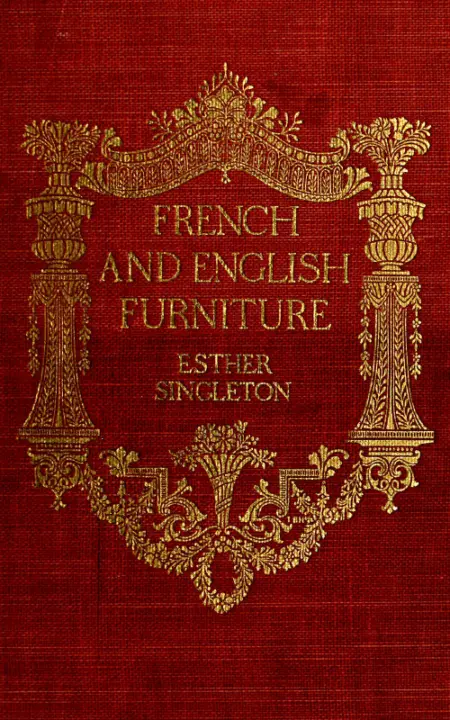
"French and English Furniture" by Esther Singleton is a historical account written in the early 20th century. The work provides an in-depth exploration of furniture styles and decorative arts from the French Renaissance to various English decorative periods, focusing on distinctive characteristics, functions, and historical contexts. Singleton aims to serve collectors, students, and interior decorators by offering a comprehensive guide to furnishing rooms in any given style. The opening of the text reveals Singleton's purpose of providing an extensive overview of French and English furniture from the Renaissance onward. She emphasizes the lack of comparable works that effectively describe and illustrate various styles, asserting that her book aims to enable readers to understand how to appropriately furnish rooms in specific historical styles, such as Louis XV or Heppelwhite. The preface also discusses the intricate details of the furniture, including upholstery, cabinetry, and decorative elements, highlighting the artistic achievements and evolution in taste from one period to another. Additionally, she mentions the inclusion of illustrations sourced from contemporary materials and designers to enrich the reader's understanding.
Introduction adapted from the source catalogue; source summaries may be automatically generated.
Free to read · English · 96,415 words · No account needed
MAKE TIME FOR A GOOD BOOK
On by default. Untick to stop anonymous reading totals. Each page counts after 10 seconds in view. How this works.
Anonymous counting is on unless you have switched it off.
Among other decorators, less inventive but of charming taste, who followed in the traces of Meissonier were Michel, René Stoldz or La Joüe, Chevillon, etc. The Print Room of the Bibliothèque Nationale possesses a collection of the beautiful designs of the two last-named artists in water-colour and gouache. These designers used many of the same motives as Meissonier, the shell, the cabbage-leaf, the shrimp (of course, the forms derived from these objects), but they added to their decorations still more fleeting and vague elements, such as falling water, the ostrich plume, etc. La Joüe is a real past master in the art of introducing into a decorative panel a cascade which sometimes falls from nowhere and loses itself in pearly foam: for him everything serves as a pretext for a cascade: neighing horses plunging in the water, an open-jawed dragon clinging to the base of a column, a hunted stag vomiting a jet of water into a fount whose marble rim is full of twists and contortions.
The list of artists who contributed to interior decorations during the Louis XV. period is a long one. It includes: Boffrand, Le Roux, Oudry, Brisseux, Huquier, Pineau, Mondon, Cuvilliés, Gravelot, Boucher, Blondel, Babel, Germain, Marvye, Chedel, Jombert, Babin, Cochin, Pillement, Peyrotte, Eisen, Demarteau and Martinet. These are the great masters of the style. The principal smaller ones are: Aubert, Crepy, Vassy, Bachelier, Roumier, Vervien, Caylus, Lassurance, Lange, La Collombe, Dubois, Bouchardon, Prevost, Le Grand, Fraisse, Blanchard, Marsenois, De La Cour, Canuc, Poulleau, Mollet, Mansart, De Jouy, Perault, Dumont, Aveline, Cornille, Chamblin, Bellay, Vanerve, Pelletier, Paty, Chopart, Borch, La Datte, Lamour, Girard, Ballechou, Herisset, Hubert, Metayer, Servandoni, Sloiste, Caque, L’Hermitais, Roy, Duval, François, Charpentier, Lebas, Radel, De Lorme, Courtelle, Viriclix, Tessier, Lattre, De Laborde and Harpin.
One of the cabinet-makers who best produced the ideas of Meissonier was Jacques Caffieri (b. 1678), who was “sculpteur, fondeur et ciseleur du roi.” Even if he did not himself manufacture, he directed the production of splendid cabinet-work. His work is distinguished by grace and aristocratic elegance. He executed a great quantity of bronze for the famous cabinet-maker, Œben. Many extant works bear the mark of a C surmounted by a fleur-de-lis, and these are usually attributed to this master, but the great inequality of excellence makes many critics doubtful. Œben was a pupil of Boulle, and devoted himself exclusively to the branch of marquetry in cabinet-making, leaving the metal decoration to his assistants, Caffieri and Duplessis. His work was in the greatest favour with Madame de Pompadour, who bought it through the merchant Duvaux, one of whose best customers was the king himself. Œben died about 1756, and his works helped to furnish all the mansions and castles of the Marquise and King in Paris, Fontainebleau, Compiégne, Versailles, Bellevue, Crécy, Champs, Saint-Ouen, and la Celle Saint-Cloud. His widow married his foreman, J. Henri Riesener. The other great cabinet-makers of this period whose works are to be found in the Rothschild, Wallace, South Kensington, and other famous collections, are Bernard, Boudin, Ollivier, Dubois and Cremer, who worked principally in artificially coloured marquetry, and Gamier, Pafrat and Roubo. The latter wrote a very valuable treatise called L’Art du menuisier.
Your reading position is saved on this browser. Take it to another device with a library code. Reading pages adapt to text, rather than matching a printed edition.
Esther Singleton
Esther Singleton
Esther Singleton
Esther Singleton
BEHIND THE BOOK
This eBook is for the use of anyone anywhere in the United States and most other parts of the world at no cost and with almost no restrictions whatsoever. You may copy it, give it away or re-use it under the terms of the Project Gutenberg License included with this eBook or online at www.gutenberg.org. If you are not located in the United States, you will have to check the laws of the country where you are located before using this eBook. Read the source licence.
The original source file, including credits and licence, is retained by this library. Request an original-format copy at no charge. Please include the book title and Project Gutenberg identifier #54866.
KEEP YOUR CURIOSITY GOING
Cécile Tormay

Moritz Busch
John L. Ransom
Frances Wright
Cécile Tormay

Mabel Potter Daggett