The orchestra and its instruments
Esther Singleton
THE CLASSIC COLLECTION · 1903
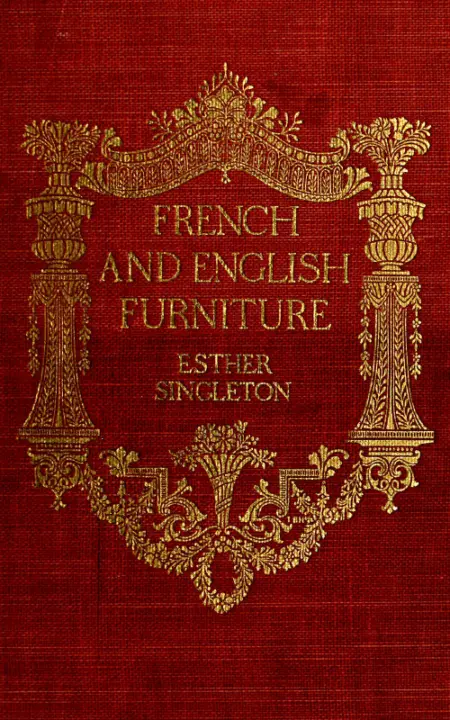
"French and English Furniture" by Esther Singleton is a historical account written in the early 20th century. The work provides an in-depth exploration of furniture styles and decorative arts from the French Renaissance to various English decorative periods, focusing on distinctive characteristics, functions, and historical contexts. Singleton aims to serve collectors, students, and interior decorators by offering a comprehensive guide to furnishing rooms in any given style. The opening of the text reveals Singleton's purpose of providing an extensive overview of French and English furniture from the Renaissance onward. She emphasizes the lack of comparable works that effectively describe and illustrate various styles, asserting that her book aims to enable readers to understand how to appropriately furnish rooms in specific historical styles, such as Louis XV or Heppelwhite. The preface also discusses the intricate details of the furniture, including upholstery, cabinetry, and decorative elements, highlighting the artistic achievements and evolution in taste from one period to another. Additionally, she mentions the inclusion of illustrations sourced from contemporary materials and designers to enrich the reader's understanding.
Introduction adapted from the source catalogue; source summaries may be automatically generated.
Free to read · English · 96,415 words · No account needed
MAKE TIME FOR A GOOD BOOK
On by default. Untick to stop anonymous reading totals. Each page counts after 10 seconds in view. How this works.
Anonymous counting is on unless you have switched it off.
As an example of the decorative use made of china by arranging it on brackets even above mirror or panel, the reader is referred to Plate XXIII., No. 2.
The Queen Anne room had its walls sometimes covered with tapestry and sometimes decorated with painted or carved panels. In accordance with the French and Dutch custom also, pictures were used with a conscious decorative effect. Sometimes they were hung on the tapestry, also, though not when the latter depicted a story of itself. In 1710, D’Aviler defines the word picture (tableau) as a subject of painting, usually in oil on canvas or wood, and contained in a frame or border. “Pictures greatly contribute to the decoration of the interior of buildings. The big ones figure in churches, drawing-rooms, galleries and other big places. Those of medium size called easel-pictures are placed in the spaces above the chimney-piece, above the doors and in the panels of the walls, or else on the tapestry against the walls. The small ones are symmetrically arranged in the chambers and cabinets of the curious.”
In the ordinary house, in the reign of Queen Anne, there was a strange jumble of the old and the new. The late Jacobean carved oak, or walnut, cane-bottom chair had not yet gone entirely out of use, but the new styles were varieties of the chair and stool on Plate XXI., Nos. 1 and 4. These were usually of walnut, but mahogany was just coming into fashion as a cabinet wood, and Queen Anne chairs with the frames made of that wood still exist. The characteristics of this chair consist of the cabriole leg, with and sometimes even without stretchers, the club foot, and solid curved splat which very frequently assumes the jar shape. Later in the period, the stretchers were discarded altogether. There was very little carving except on the spring of the knee. The claw-and-ball foot was rapidly coming into favour, and the tendency was constantly towards increased lightness of frame. Even where the characteristic square tapering leg of the Louis XIV. style is preserved, increased lightness is noticeable. The turned stretchers, both of chairs and settees, are shown on Plate XIX., Nos. 5, 6 and 7, and Plate XXI., Nos. 1, 4 and 10. Marot clung to the flat curved stretchers of the Louis XIV. style, and his chairs are very large and heavy. The reason of this is that he paid great attention to the upholstery, and his large and brilliant designs required a correspondingly large surface for adequate display. Many of his plates are devoted entirely to patterns for materials for upholstery, and the geometrical flower-bed is the apparent inspiration of much of his work of this nature. Some of Marot’s chairs and stools are shown on Plate XXI., Nos. 2, 3, 5, 8 and 9. The chairs on either side of the bed on Plate XXII. are also Marot’s. No. 7 on Plate No. XXI. shows the lighter form of frame of this class of chair. The settees, numbered 5, 6 and 7, on Plate XIX. should also be carefully studied as types of this style. They are taken from contemporary prints of court ladies. On one of them, Anne herself is sitting in the original. No. 6, Plate XXI., represents the top of a chair back which is very characteristic of the Marot school. One of the favourite ornaments of this period was the urn in some form or other. The acorn was also largely used for feet, and the flattened bulb was not entirely superseded. The effect produced by the above-mentioned detail is found in several other pieces of furniture of the day, clocks and mirrors particularly. The urn is seen in No. 5, Plate XXIII., and the effect is repeated in Nos. 1 and 6, Plate XX. Nos. 5 and 6 on that Plate also show the combination acorn and flattened bulb employed as feet. No. 6 also shows another decorative feature of the period in the heavy chutes of bell-flowers. The handsome clock, No. 6, Plate XX., from Marot’s design, shows many Louis XIV. features. The sun in splendour is noticeable and the winged cherub above the dial. The latter was made great use of in the Queen Anne style. The mascaron also was largely adopted. Another decorative feature which was carved on the centre lower rim of so many chests-of-drawers, and dressing-tables was the shell. The cabinet-makers were never tired of using the latter, and its constant appearance may perhaps be accounted for by the fact that it was the principal charge in the arms of the English company of cabinet-makers. It is seen on top of the mirror in No. 2, Plate XIX., and the mascaron is used to beautiful effect in the mirror No. 3 on the same plate. The mascaron appears as the chief ornament in No. 3, Plate XX. Strange to say, this is not a chair, as might be imagined, but a fire-back, as is also No. 4. The shape of this fire-back, however, is going to be that which will dominate in chair-backs in many styles and even to the present day holds its own. The chair No. 8, Plate XX., is transitional between Jacobean and Queen Anne. The couch (No. 9 of the same plate) is a fine example of the Queen Anne style with its scrolls, cabriole legs and stretchers. The winged effect of the scrolls connecting the legs is a very favourite feature of the day. This should be compared with the couch by Marot in Plate XVIII., which retains more of the Louis XIV. characteristics.
Your reading position is saved on this browser. Take it to another device with a library code. Reading pages adapt to text, rather than matching a printed edition.
Esther Singleton
Esther Singleton
Esther Singleton
Esther Singleton
BEHIND THE BOOK
This eBook is for the use of anyone anywhere in the United States and most other parts of the world at no cost and with almost no restrictions whatsoever. You may copy it, give it away or re-use it under the terms of the Project Gutenberg License included with this eBook or online at www.gutenberg.org. If you are not located in the United States, you will have to check the laws of the country where you are located before using this eBook. Read the source licence.
The original source file, including credits and licence, is retained by this library. Request an original-format copy at no charge. Please include the book title and Project Gutenberg identifier #54866.
KEEP YOUR CURIOSITY GOING
Cécile Tormay

Moritz Busch
John L. Ransom
Frances Wright
Cécile Tormay

Mabel Potter Daggett