The orchestra and its instruments
Esther Singleton
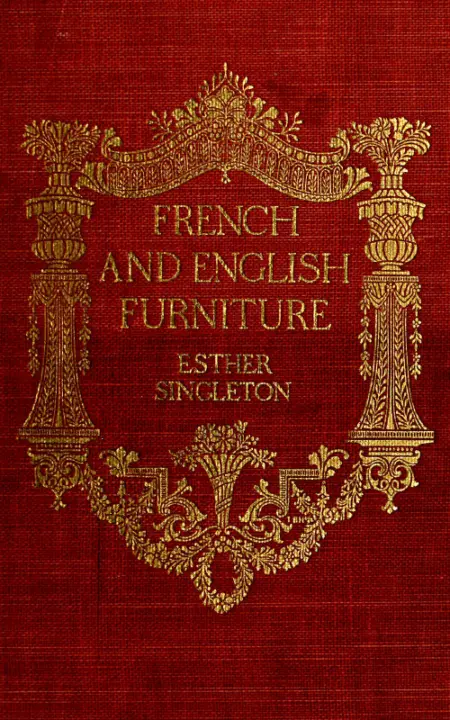
THE CLASSIC COLLECTION · 1903
"French and English Furniture" by Esther Singleton is a historical account written in the early 20th century. The work provides an in-depth exploration of furniture styles and decorative arts from the French Renaissance to various English decorative periods, focusing on distinctive characteristics, functions, and historical contexts. Singleton aims to serve collectors, students, and interior decorators by offering a comprehensive guide to furnishing rooms in any given style. The opening of the text reveals Singleton's purpose of providing an extensive overview of French and English furniture from the Renaissance onward. She emphasizes the lack of comparable works that effectively describe and illustrate various styles, asserting that her book aims to enable readers to understand how to appropriately furnish rooms in specific historical styles, such as Louis XV or Heppelwhite. The preface also discusses the intricate details of the furniture, including upholstery, cabinetry, and decorative elements, highlighting the artistic achievements and evolution in taste from one period to another. Additionally, she mentions the inclusion of illustrations sourced from contemporary materials and designers to enrich the reader's understanding.
Introduction adapted from the source catalogue; source summaries may be automatically generated.
Free to read · English · 96,415 words · No account needed
MAKE TIME FOR A GOOD BOOK
On by default. Untick to stop anonymous reading totals. Each page counts after 10 seconds in view. How this works.
Anonymous counting is on unless you have switched it off.
Striped silk was another favourite for the hangings of the bedroom. As a rule, when worsted materials were used, the curtains of both bed and windows were lined with silk. There was a great variety of silks, known variously as lutestring, paduasoy, tabby, taffetas, sarcenet, chaney, cheney or China, etc.; while the woollen goods included serge, darnick or dorneck, perpetuana, mohair, camoca or camak, camlet, say, serge, rateen, watchet, fustian, damask, and kitterminster or kidderminster, some of which were mixed with camel’s hair or threads of silk. There were also dimity, flowered chintz, and callimanco (a glazed linen), as well as Turkey-work and “wrought” (which, of course, was needlework). East India goods, such as printed calico and seersucker, were also used at the end of the period. White curtains for the bed are rarely employed.
The modern upholsterer will have no difficulty in finding suitable and equivalent materials for furnishing a Jacobean bed and bedroom.
The valance hanging from the tester, as shown on Plate IX., is adorned with fringe, as is also the stool that stands at the foot of the bed.
Beside the bed, there was always laid a narrow strip of carpet, or tapestry, or rug, always referred to as a “bedside carpet.”[9]
In the bedroom, we always find a large “trussing chest,” used as a receptacle for the bed clothes, and there may be another chest for the preservation of wearing apparel. The latter is more likely to be a chest-with-drawers, consisting of the chest proper, below which are two long drawers, appearing to the eye as four on account of the panels, mouldings and knobs. On lifting up the top, a deep well is revealed, at the side of which there is a “till,” or compartment, for small articles, trinkets, etc.
At first, the chest was decorated with carved panels and mouldings, and was usually rendered secure with a lock and great iron hinges that were extremely decorative. The date and the initials of the owner were carved upon it, as well as a fanciful motto or legend. At a later period, the chest was placed on a frame of short square legs. The next development was the addition of a long drawer below the chest. Another drawer was added, and another, until this piece of furniture gradually became, instead of a simple box or trunk, a “chest-of-drawers,” a “chest-with-drawers,” a “nest-of-drawers,” a “case-of-drawers,” a “press,” a “cupboard-press,” etc., etc. The bureau, or desk, or “screetore,” is another development; and, of course, the cabinet in its simplest form is nothing but a chest-of-drawers with shelves inside shut in by doors.
Your reading position is saved on this browser. Take it to another device with a library code. Reading pages adapt to text, rather than matching a printed edition.
Esther Singleton
Esther Singleton
Esther Singleton
Esther Singleton
BEHIND THE BOOK
This eBook is for the use of anyone anywhere in the United States and most other parts of the world at no cost and with almost no restrictions whatsoever. You may copy it, give it away or re-use it under the terms of the Project Gutenberg License included with this eBook or online at www.gutenberg.org. If you are not located in the United States, you will have to check the laws of the country where you are located before using this eBook. Read the source licence.
The original source file, including credits and licence, is retained by this library. Request an original-format copy at no charge. Please include the book title and Project Gutenberg identifier #54866.
KEEP YOUR CURIOSITY GOING
Cécile Tormay

Moritz Busch
John L. Ransom
Frances Wright
Cécile Tormay

Mabel Potter Daggett