THE CLASSIC COLLECTION✦Lost DiariesCLASSIC FREE BOOKS
Lost Diaries
Maurice Baring
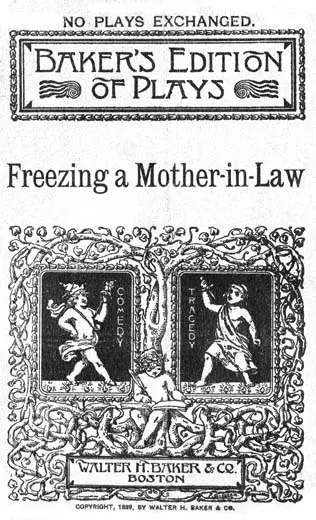
THE CLASSIC COLLECTION · 1889
"Freezing a Mother-in-Law; or, Suspended Animation: A farce in one act" by T. E. Pemberton is a comedic play written in the late 19th century. This work falls within the genre of farce and explores themes of marital relationships and the dynamics of family authority. Set in a domestic environment, the play humorously critiques societal norms and the struggles between love and parental influence. The story centers around Mr. Watmuff and his daughter Emily, who is in love with Walter Litherland, but their union is obstructed by Mrs. Watmuff, who adamantly refuses to consent to the engagement. The plot thickens with the introduction of Ferdinand Swift, a nephew with a bizarre invention involving suspended animation, which he proposes to experiment with on his aunt. In a twist of comedic fate, Mrs. Watmuff, initially oblivious to the scheme, becomes aware of the plot and takes the matter into her own hands. The farcical situation escalates with misunderstandings, cunning plans, and ultimately culminates in revelations that lead to an unexpected resolution for the characters. With its witty dialogue and absurd scenarios, the play captures the humor and challenges of navigating family relationships.
Introduction adapted from the source catalogue; source summaries may be automatically generated.
Free to read · English · 9,560 words · No account needed
MAKE TIME FOR A GOOD BOOK
On by default. Untick to stop anonymous reading totals. Each page counts after 10 seconds in view. How this works.
Anonymous counting is on unless you have switched it off.
MRS. W. How should I hazard a conjecture, Mr. Watmuff?
MR. W. For neuralgia! There! isn't that good news?
MRS. W. It would, indeed, be a boon, could some efficacious specific be found to war with that most terrible disorder.
FER. My dear aunt, it has been found. It may seem a curious thing to say, but, when I inquired after your health--which, of course, I did the moment I came into the house--and my uncle told me that you suffered from neuralgia, I was positively glad to know that I could be the happy means of at once and permanently relieving you from all pain.
MRS. W. If what you say is true, nephew, you will be a benefactor to suffering humanity. You should deem yourself very fortunate to be such an instrument.
FER. My dear aunt, I do think myself fortunate. To be running about from morning to night, as I am, continually relieving my fellow creatures from the excruciating pangs of neuralgia, makes life one long summer's day of happiness. It makes me so light-hearted that I'm always singing, or humming, or whistling, and so I'm known among my friends as the musical instrument.
MRS. W. And what, may I ask, is your remedy?
FER. The simplest thing in the world. You take--(feeling in his pocket for bottle)--Hullo! By Jove!--(seeing bottle on table)--Ah! yes, to be sure, I left it here. You take two or three drops of this colorless fluid, make the smallest of punctures in the lobe of the right ear, inject it, and the pain goes as if by magic. If you are suffering now, aunt--
MRS. W. I am always suffering.
FER. Then let me try.
MR. W. Yes, my dear. Let Ferdinand try.
MRS. W. It is your wish that I should do so, Mr. Watmuff?
MR. W. My dear, of course it is. I would give anything to see you free
from pain.
MRS. W. It is enough; my husband's wish is law to me. (TO FERDINAND.)
Apply your remedy, sir.
FER. With pleasure. (Brings down large easy-chair.)
WALTER (aside, appearing from behind screen at back). I am glad I made up my mind to see through this. Upon my soul, I'm beginning to admire Mrs. Watmuff. What ruffians these men are!
FER. Now, my dear aunt, sit in this chair, and lean back. You will soon
be free from pain.
MR. W. Yes, my love, do just as Ferdinand tells you, and you will soon
be free from pain.
Your reading position is saved on this browser. Take it to another device with a library code. Reading pages adapt to text, rather than matching a printed edition.
BEHIND THE BOOK
This eBook is for the use of anyone anywhere in the United States and most other parts of the world at no cost and with almost no restrictions whatsoever. You may copy it, give it away or re-use it under the terms of the Project Gutenberg License included with this eBook or online at www.gutenberg.org. If you are not located in the United States, you will have to check the laws of the country where you are located before using this eBook. Read the source licence.
The original source file, including credits and licence, is retained by this library. Request an original-format copy at no charge. Please include the book title and Project Gutenberg identifier #41507.
KEEP YOUR CURIOSITY GOING
Maurice Baring
W. B. (William Butler) Yeats
Edward Martyn

John Brougham & Charlotte Brontë
Marguerite Merington
Leonid Andreyev