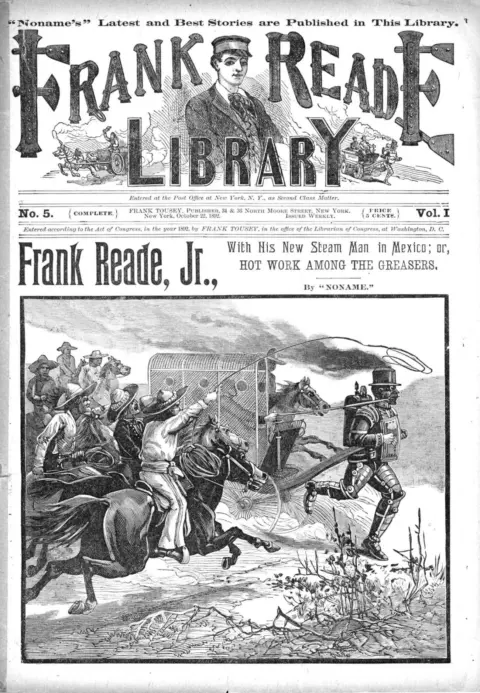
Frank Reade, Jr., with his new steam man in Mexico or, hot work among the greasers
Luis Senarens
THE CLASSIC COLLECTION · 1898
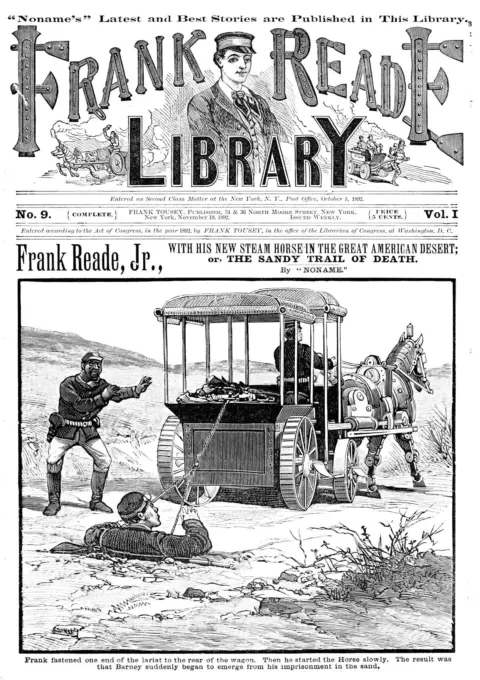
"Frank Reade, Jr., with His New Steam Horse in the Great American Desert; or, The Sandy Trail of Death" by Senarens is a fiction adventure story likely written in the late 19th century. The book follows the ingenious inventor Frank Reade, Jr., as he embarks on a daring journey into the American West with his latest mechanical creation, a remarkable steam horse. Accompanied by his loyal companions, Barney O'Shea and Pomp, Frank is determined to uncover the truth behind a wrongful murder conviction that has led to an innocent man's impending execution. The opening portion of the narrative introduces Frank Reade, Jr., and his mechanical marvel, the Steam Horse, setting the stage for an exciting expedition into the Great American Desert. The story begins with Frank preparing to investigate the mysterious case of Benjamin Astley, a man wrongfully accused of murder. Alongside the comical yet supportive Barney and Pomp, the trio faces challenges—including quicksand, unfriendly Comanches, and treacherous landscapes—that promise to test their skills and friendship. As they navigate through dangerous scenarios, the tale hints at the unfolding mysteries and personal dilemmas that will arise in their quest for justice.
Introduction adapted from the source catalogue; source summaries may be automatically generated.
Free to read · English · 22,613 words · No account needed
MAKE TIME FOR A GOOD BOOK
On by default. Untick to stop anonymous reading totals. Each page counts after 10 seconds in view. How this works.
Anonymous counting is on unless you have switched it off.
“All right,” he returned, “I’ll show you the way.”
“Lead on!”
Frank now skillfully led the way across the pass.
So silently and effectively did he do it, in the intense gloom that it was clearly demonstrated to Beaver Bill that the young inventor knew his business well.
The trapper from that moment reposed full confidence in his companion.
Frank reached the path which led up the cliff.
Here he halted and listened.
It was somewhile before he was satisfied that the coast was clear.
Then he whispered:
“All right, Bill; come on.”
The trapper followed without question.
Like silent phantoms they crept up the winding path. Up and up they went until they could overlook the Death Valley.
And there a curious spectacle was presented to their view.
In different quarters of the valley myriads of dancing balls of fire, ghastly in their radiance, seemed to spring from the soil, linger in the air a few moments, and then vanish.
It looked like a literal display of fireworks.
The two men gazed upon the spot wholly spell-bound. They had never seen
anything like it before.
It was now easy to understand why wandering tribes of Indians and ignorant white men shunned the valley.
The sight was one well calculated to appeal to one’s sense of
superstition.
To the untutored savages or the white man unfamiliar with natural sciences, the exhibition certainly partook of the supernatural.
There were large areas wholly free from this peculiar display.
Bill Swazey the hunter was unable to understand the phenomenon.
“Great bars!” he gasped, “thar ain’t much doubt about this place being ther abode of the devil is ther?”
“I think there is a good deal of doubt,” replied Frank.
The trapper was astonished.
“Eh!” he rejoined. “Praps’ ye kin account for thim devilish balls av
fire.”
“Of course I can.”
“What mought they be?”
“It is a peculiar characteristic of that sort of gas, that it is visible to the eye at night in this form. You have heard of the light of the Jack-o’-lantern or will-o’-the-wisp?”
“Sartin.”
“Well, this is explained in much the same manner. That is the outcome of swamp gas and practically harmless, but this gas undoubtedly has anaesthetic properties and swoons one to death, just as too much chloroform would.”
The trapper listened respectfully, but the superstitious element was too deeply imbued in his nature to allow of his accepting Frank’s explanation at once.
“That sounds all right, pard,” he declared, “but I’ll be doggoned if I’d want to go down thar.”
“To the contrary it is quite safe in my belief to go down thar at
night.”
Your reading position is saved on this browser. Take it to another device with a library code. Reading pages adapt to text, rather than matching a printed edition.
BEHIND THE BOOK
This eBook is for the use of anyone anywhere in the United States and most other parts of the world at no cost and with almost no restrictions whatsoever. You may copy it, give it away or re-use it under the terms of the Project Gutenberg License included with this eBook or online at www.gutenberg.org. If you are not located in the United States, you will have to check the laws of the country where you are located before using this eBook. Read the source licence.
The original source file, including credits and licence, is retained by this library. Request an original-format copy at no charge. Please include the book title and Project Gutenberg identifier #68067.
KEEP YOUR CURIOSITY GOING
Coulson Kernahan

Maurice Baring
Frances Wright
Cécile Tormay
Francis Greenleaf Allinson & Anne C. E. (Anne Crosby Emery) Allinson

Frederic Jesup Stimson