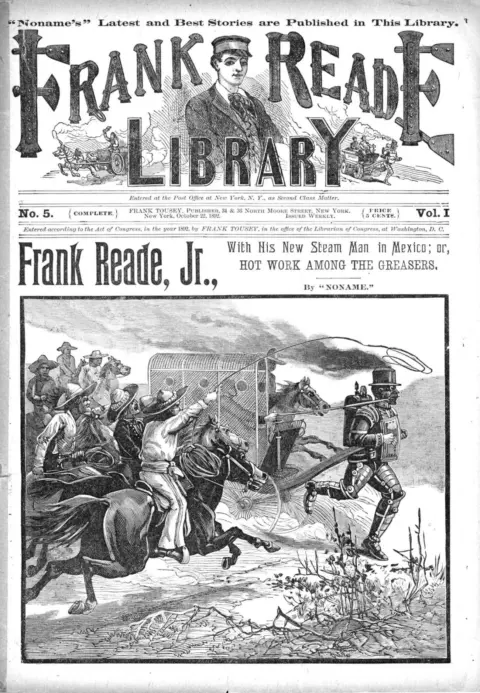
Frank Reade, Jr., with his new steam man in Mexico or, hot work among the greasers
Luis Senarens
THE CLASSIC COLLECTION · 1898
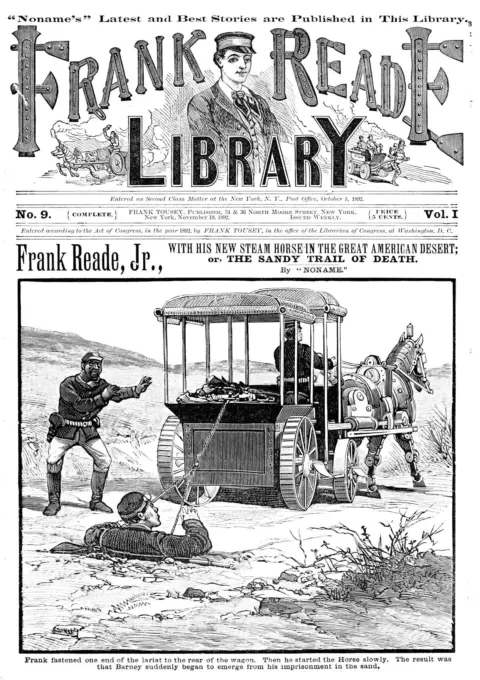
"Frank Reade, Jr., with His New Steam Horse in the Great American Desert; or, The Sandy Trail of Death" by Senarens is a fiction adventure story likely written in the late 19th century. The book follows the ingenious inventor Frank Reade, Jr., as he embarks on a daring journey into the American West with his latest mechanical creation, a remarkable steam horse. Accompanied by his loyal companions, Barney O'Shea and Pomp, Frank is determined to uncover the truth behind a wrongful murder conviction that has led to an innocent man's impending execution. The opening portion of the narrative introduces Frank Reade, Jr., and his mechanical marvel, the Steam Horse, setting the stage for an exciting expedition into the Great American Desert. The story begins with Frank preparing to investigate the mysterious case of Benjamin Astley, a man wrongfully accused of murder. Alongside the comical yet supportive Barney and Pomp, the trio faces challenges—including quicksand, unfriendly Comanches, and treacherous landscapes—that promise to test their skills and friendship. As they navigate through dangerous scenarios, the tale hints at the unfolding mysteries and personal dilemmas that will arise in their quest for justice.
Introduction adapted from the source catalogue; source summaries may be automatically generated.
Free to read · English · 22,613 words · No account needed
MAKE TIME FOR A GOOD BOOK
On by default. Untick to stop anonymous reading totals. Each page counts after 10 seconds in view. How this works.
Anonymous counting is on unless you have switched it off.
The most difficult matter, however, was the delicate armatures and
driving rods of the legs.
The cylinders were placed upon the shafts of the wagon.
These propelled the driving rods, which in turn worked heavy armatures, which caused the Horse’s legs to take a long and quick stride.
The hind legs were worked in the same manner by means of driving rods connected with the armature of the forward legs.
It was astonishing to note with what marvelous rapidity the Steam Horse would pick up its feet and gallop.
Steel spikes upon his feet enabled him to go all the faster.
We have imperfectly described the Horse; now, let us take a look at the
wagon.
In this the travelers were to ride, and it was necessary that it should
be safe and strong.
It was made with four strong iron wheels with grooved tires of rubber, so that the roughest ground could be traveled over.
The body of the wagon was of thinly rolled but tough steel.
The interior was quite spacious and vigorously divided up into various
uses.
A coal bunker was provided upon the sides of the wagon.
Over these were cushioned seats, easily made into sleeping bunks.
Forward by the high dasher was a compartment for the storing of provisions and any necessary stores.
But the most wonderful of all was the canopy or top which covered the
wagon.
This was made of thin but bullet-proof plates of steel arranged like a window-lattice, so that by touching a spring the four sides would promptly roll up, leaving the wagon open on all sides.
When the lattice work was down loopholes were provided in it by means of which shots could be fired at an attacking foe.
Altogether the new Steam Horse was a wonderful invention and quite a safe equipage to travel across the plains of the wild West with.
At least Frank Reade, Jr., thought so, and did not hesitate to risk the
trip.
His only traveling companions upon his famous trips were two faithful servants, a jolly Irishman known as Barney O’Shea, and a comical moke of a negro called Pomp.
Barney and Pomp were unique characters to a certainty.
While the best of friends in reality, they were constantly engaged in badgering and teasing each other.
One was as well gifted in this direction as the other, so they
generally came out about even.
The object of Frank Reade, Jr.’s proposed trip to the West was a
thrilling one.
His attention had one day been claimed by a singular statement in a
newspaper.
The statement read thus:
“The Mystery of a Marked Bullet.”
Your reading position is saved on this browser. Take it to another device with a library code. Reading pages adapt to text, rather than matching a printed edition.
BEHIND THE BOOK
This eBook is for the use of anyone anywhere in the United States and most other parts of the world at no cost and with almost no restrictions whatsoever. You may copy it, give it away or re-use it under the terms of the Project Gutenberg License included with this eBook or online at www.gutenberg.org. If you are not located in the United States, you will have to check the laws of the country where you are located before using this eBook. Read the source licence.
The original source file, including credits and licence, is retained by this library. Request an original-format copy at no charge. Please include the book title and Project Gutenberg identifier #68067.
KEEP YOUR CURIOSITY GOING
Coulson Kernahan

Maurice Baring
Frances Wright
Cécile Tormay
Francis Greenleaf Allinson & Anne C. E. (Anne Crosby Emery) Allinson

Frederic Jesup Stimson