THE CLASSIC COLLECTION✦A dead man’s diaryCLASSIC FREE BOOKS
A dead man’s diary
Coulson Kernahan
THE CLASSIC COLLECTION · 1922
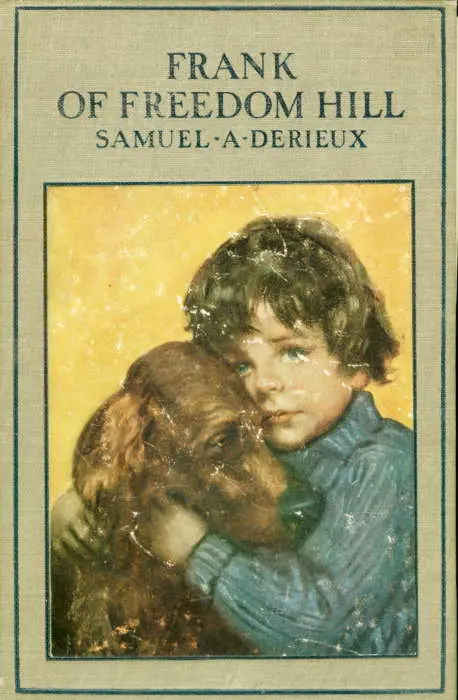
"Frank of Freedom Hill" by Samuel A. Derieux is a novel written in the early 20th century. The story centers on an Irish setter named Dan, later renamed Frank, who struggles with his transition from being a prized hunting dog in a luxurious home to facing the harsh realities of life in the wild after escaping captivity. It explores themes of freedom, loyalty, and the bond between dogs and their human companions. The opening of the book introduces Dan VI, the Irish setter, as he is transported away from his comfortable life. He becomes increasingly desperate to escape the confines of his chain and the train car, leading to his eventual flight into the wild where he tries to survive on his own. Through vivid descriptions, the narrative captures his challenges and instincts in the wilderness, alongside his yearning for companionship. As he navigates through the woods, he encounters a lost boy, Tommy Earle, marking the start of their new bond and a shift from survival to finding a place he can call home within the Earle family. Frank's story unfolds as he learns to adapt to his new life while grappling with his past.
Introduction adapted from the source catalogue; source summaries may be automatically generated.
Free to read · English · 68,689 words · No account needed
MAKE TIME FOR A GOOD BOOK
On by default. Untick to stop anonymous reading totals. Each page counts after 10 seconds in view. How this works.
Anonymous counting is on unless you have switched it off.
The old man stopped. It was as if he had found, in all this strangeness, a friend. He spoke before he thought--half under his breath.
"Old Whiskers," he said gently. "Old Gray Whiskers."
Simmons turned in a flash, his face suddenly more crimson than ever, his
eyes blazing.
"What did you say to that dog?" he yelled.
The old man looked at him steadily but did not reply.
"Now here!" The guard's voice rang out in the grove. "I know you, Abercrombie, and I know your game, you bloody, long-whiskered, knife-totin' throat-cutter. You are tryin' to make friends with that dog!"
He went to a near-by bush, got out his knife, and cut a heavy switch.
"Take this," he commanded. "Oh, you can catch hold of it! Catch it with both hands. Never mind the bracelets. Take it. Hit that dog. Hit him!"
The dreamlike state in which the old man had been wandering dissolved. His eyes narrowed to mere slits behind the beetling brows. The cold steel of the mountaineer, the mountaineer who weighs his words, was in the slow-drawled reply:
"Wal, now, I reckon I won't."
A moment they faced one another, Simmons' eyes murderous. Some fear of an investigation if he struck the old man, something daunting, too, that he saw in the mountaineer's eyes, restrained him.
"Abercrombie," he said, and moistened his lips with his tongue, "I brought out in that car three boxes of shotgun shells--buckshot--extra heavy loaded. Get me?"
Such was the initiation of old Tom Abercrombie as a convict. That afternoon he was entered on the books as a "dangerous" prisoner; that night he lay on an iron cot, staring up at the roof of a solitary tent, which, according to law, had to be provided for him. On his ankles were locked two steel anklets connected by a chain eighteen inches long. This chain, in turn, was locked to the cot.
Shame lay with him as he stared upward--shame and a terrible loneliness and dread of the future. At sunset he had watched a long line of shackled Negroes, followed by guards with shotguns, file into camp. To-morrow he himself would be one of that gang; and not only to-morrow, but for two years. Assault and Battery with Intent to Kill--this was the verdict of the court in Greenville in which he had been tried. And yet he hadn't intended to kill anybody, he had only meant to remonstrate.
Three young fellows, sitting at a table in a cheap ice-cream parlour--it had seemed a crystal palace to the old man and to Molly his wife, fresh from the deepest recesses of the mountains--had made fun of Molly and her sunbonnet.
Your reading position is saved on this browser. Take it to another device with a library code. Reading pages adapt to text, rather than matching a printed edition.
BEHIND THE BOOK
This eBook is for the use of anyone anywhere in the United States and most other parts of the world at no cost and with almost no restrictions whatsoever. You may copy it, give it away or re-use it under the terms of the Project Gutenberg License included with this eBook or online at www.gutenberg.org. If you are not located in the United States, you will have to check the laws of the country where you are located before using this eBook. Read the source licence.
The original source file, including credits and licence, is retained by this library. Request an original-format copy at no charge. Please include the book title and Project Gutenberg identifier #25991.
KEEP YOUR CURIOSITY GOING
Coulson Kernahan

Maurice Baring
Frances Wright
Cécile Tormay

Frederic Jesup Stimson

W. H. P. (William Henry Pope) Jarvis