THE CLASSIC COLLECTION✦Frank Merriwell’s dangerCLASSIC FREE BOOKS
Frank Merriwell’s danger
Burt L. Standish
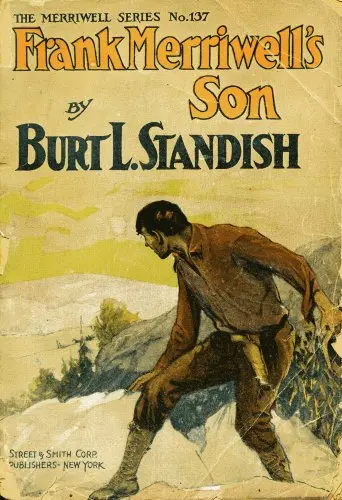
THE CLASSIC COLLECTION · 1906
"Frank Merriwell's Son; Or, A Chip Off the Old Block" by Burt L. Standish is a fictional novel likely written in the early 20th century. The story follows Frank Merriwell, now a father, as he navigates the joys and complexities of raising his newborn son while surrounded by a close circle of friends that includes Bart Hodge and Elsie Bellwood. The setup hints at themes of friendship, familial duty, and the challenges of parenthood, all woven into an adventurous narrative typical of standish's works. The opening of the novel introduces readers to a poignant moment in Frank Merriwell's life as he meets his newborn son for the first time, sharing this intimate joy with his wife, Inza. The scene is rich with celebration and excitement, setting the tone for a narrative centered on family and relationships. As friends gather to welcome the new addition to the Merriwell family, hints of subplots begin to unfold, particularly the ever-present tension concerning the mysterious nurse Lizette, who seemingly harbors secrets of her own. This combination of domestic warmth and underlying intrigue captures the reader's attention, promising a blend of adventure and drama as the characters' lives intersect in unexpected ways.
Introduction adapted from the source catalogue; source summaries may be automatically generated.
Free to read · English · 65,909 words · No account needed
MAKE TIME FOR A GOOD BOOK
On by default. Untick to stop anonymous reading totals. Each page counts after 10 seconds in view. How this works.
Anonymous counting is on unless you have switched it off.
The idea of playing a practice game with Merry's team delighted the Farnham Hall lads, and arrangements were quickly made.
"I presume you'll give us a show, Mr. Merriwell," said Sparkfair. "Are
you going to pitch?"
"I don't think I'll start the game," said Merry.
"I vill pitch mineselluf," announced Hans. "I vos der createst paseball pitcher dot efer seen you."
Sparkfair flipped a coin, and the choice of innings fell to Merry.
"We'll take the field," said Frank. "Go behind the bat, Hodge. Dunnerwurst will pitch. You'll play your old position at first, Browning. Diamond will cover second, and we'll have Mulloy on third. I'll play short."
"The middle lawn for me," announced Ephraim Gallup.
"That's all right," nodded Frank. "Badger will take left field and
Carson right field."
When the players had taken these positions Dunnerwurst held up his hand and asked permission to pitch a few over the plate.
"Chust gif me the privilege of letting my arm limber me up, vill you?"
"Go ahead," laughed Sparkfair.
Hodge adjusted the body protector and pulled on the big catching mitt.
"Keep open your eye for der curf uf der ball," warned Hans. "Uf I use too much speed for you, chust let me tell you so."
He presented a comical spectacle as he flourished, his arm with a windmill motion and delivered the ball to Bart. It was high and wide, but Hodge cuffed it down.
"Ho! ho!" shouted the Dutchman. "Did dot rise see you? Vosn't it a
peauty, Part?"
"That was a great rise!" said Hodge. "Better try a drop next time. Get
'em lower."
On receiving the ball Hans made another flourishing motion, shut his eyes, and threw the sphere with great force straight at the ground in front of him.
"Mine cootness!" he gasped. "I vill haf to look oudt for dot drop. It
vos a corker."
"Better start off with a straight ball," advised Hodge. "Give these youngsters a show. They can't hit your curves, Hans."
"I pelief me," nodded Dunnerwurst soberly. "Your advice vill took me."
A few moments later he announced that he was ready, and Bob Bubbs stepped out as the first batter.
Hans hit Bob with the first ball pitched, and Kilgore, who was umpiring,
sent Towser to first.
"Vy did you not dotge?" demanded Dunnerwurst, in exasperation. "Any vun vould pelief der ball did not see you coming. Vos you plind your eyesight in?"
"Oh, I knew I couldn't hit," chuckled Bubbs, "so I got hit. That's part
of the game."
"Veil, mebbe dot vos so, but you don'd pelief it. Der next man vill haf something different to did."
Netterby was the next man.
Your reading position is saved on this browser. Take it to another device with a library code. Reading pages adapt to text, rather than matching a printed edition.
Burt L. Standish
Burt L. Standish

Burt L. Standish

Burt L. Standish
BEHIND THE BOOK
This eBook is for the use of anyone anywhere in the United States and most other parts of the world at no cost and with almost no restrictions whatsoever. You may copy it, give it away or re-use it under the terms of the Project Gutenberg License included with this eBook or online at www.gutenberg.org. If you are not located in the United States, you will have to check the laws of the country where you are located before using this eBook. Read the source licence.
The original source file, including credits and licence, is retained by this library. Request an original-format copy at no charge. Please include the book title and Project Gutenberg identifier #25316.
KEEP YOUR CURIOSITY GOING
Coulson Kernahan

Maurice Baring
Frances Wright
Cécile Tormay

Frederic Jesup Stimson

W. H. P. (William Henry Pope) Jarvis