THE CLASSIC COLLECTION✦Frank Merriwell’s dangerCLASSIC FREE BOOKS
Frank Merriwell’s danger
Burt L. Standish
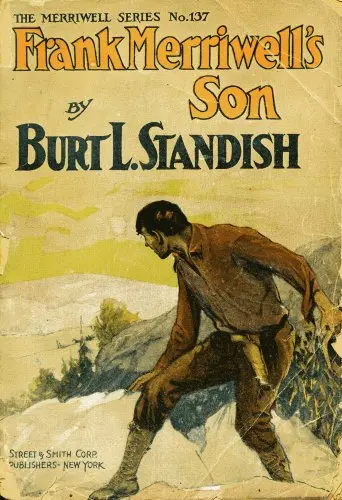
THE CLASSIC COLLECTION · 1906
"Frank Merriwell's Son; Or, A Chip Off the Old Block" by Burt L. Standish is a fictional novel likely written in the early 20th century. The story follows Frank Merriwell, now a father, as he navigates the joys and complexities of raising his newborn son while surrounded by a close circle of friends that includes Bart Hodge and Elsie Bellwood. The setup hints at themes of friendship, familial duty, and the challenges of parenthood, all woven into an adventurous narrative typical of standish's works. The opening of the novel introduces readers to a poignant moment in Frank Merriwell's life as he meets his newborn son for the first time, sharing this intimate joy with his wife, Inza. The scene is rich with celebration and excitement, setting the tone for a narrative centered on family and relationships. As friends gather to welcome the new addition to the Merriwell family, hints of subplots begin to unfold, particularly the ever-present tension concerning the mysterious nurse Lizette, who seemingly harbors secrets of her own. This combination of domestic warmth and underlying intrigue captures the reader's attention, promising a blend of adventure and drama as the characters' lives intersect in unexpected ways.
Introduction adapted from the source catalogue; source summaries may be automatically generated.
Free to read · English · 65,909 words · No account needed
MAKE TIME FOR A GOOD BOOK
On by default. Untick to stop anonymous reading totals. Each page counts after 10 seconds in view. How this works.
Anonymous counting is on unless you have switched it off.
"And when yeou git through lookin' at him," suggested Gallup, "yeou might cast an eye round in my direction. Me and Barney have been partners, and, by jinks! I've cleaned up ten thousand, too."
For a moment Carker seemed a bit staggered, but he quickly recovered.
"What's ten thousand in these days? What's that but a drop in the bucket when your big magnates accumulate millions upon millions?"
"Well, me bhoy," laughed Barney, with a comical twist of his mug, "tin thousand will do for a nist egg. Wid thot for a nist egg, we ought to hatch out enough to kape us from becomin' objects of charity in our ould age."
"A man is foolish to waste his time in argument with such chaps as you," said Greg, with a shrug of his shoulders. "Are you on this train?"
When they replied that they were, he explained that he was there to take the same train. Within the station he secured his battered old suit case, which he had left there.
"Have yeou a seat?" asked Gallup.
"Why, I expect to get a seat on the regular passenger coach," answered
Carker.
"You kin git a seat in our car, I guess," said Ephraim. "Not more'n half
the seats was taken."
At the steps of the parlor car Greg halted.
"Are you riding in this car?" he asked.
"Shure," nodded Barney.
"Then I'm sorry," said the young socialist. "I can't ride with you."
In a breath both Mulloy and Gallup demanded to know why.
"Parlor coaches are made for aristocrats," explained Greg. "I'm one of the masses. I'm democratic. I ride with common people in the common coaches."
"Begorra, ye'll roide in this car av we have to kidnap yez!" shouted Mulloy. "Av you're too close-fisted to buy a sate yersilf, Oi'll pay for it!"
This touched Carker's pride.
"You hurt me by such words, Barney," he protested. "Close-fisted! My boy, do you know I've given away nearly all my ready money in the last six months to the needy and suffering? I've seen big, fat-stomached, overfed men lolling in their parlor-car seats while weak invalids, wretched and faint from the strain of trouble, have sat in the common cars. Do you think I could be selfish enough to spend my money for my own comfort and luxury, knowing that such poor people might be suffering on this train?"
"Yer heart's all roight, Greg, ould bhoy," explained Barney; "but ye'll foind thot yer pocketbook isn't big enough to alleviate all th' suffering thot ye'll discover in the world. Come on, Ephraim, we'll put him on this car or l'ave him dead on the platform."
Your reading position is saved on this browser. Take it to another device with a library code. Reading pages adapt to text, rather than matching a printed edition.
Burt L. Standish
Burt L. Standish

Burt L. Standish

Burt L. Standish
BEHIND THE BOOK
This eBook is for the use of anyone anywhere in the United States and most other parts of the world at no cost and with almost no restrictions whatsoever. You may copy it, give it away or re-use it under the terms of the Project Gutenberg License included with this eBook or online at www.gutenberg.org. If you are not located in the United States, you will have to check the laws of the country where you are located before using this eBook. Read the source licence.
The original source file, including credits and licence, is retained by this library. Request an original-format copy at no charge. Please include the book title and Project Gutenberg identifier #25316.
KEEP YOUR CURIOSITY GOING
Coulson Kernahan

Maurice Baring
Frances Wright
Cécile Tormay

Frederic Jesup Stimson

W. H. P. (William Henry Pope) Jarvis