THE CLASSIC COLLECTION✦Frank Merriwell’s dangerCLASSIC FREE BOOKS
Frank Merriwell’s danger
Burt L. Standish
THE CLASSIC COLLECTION · 1898
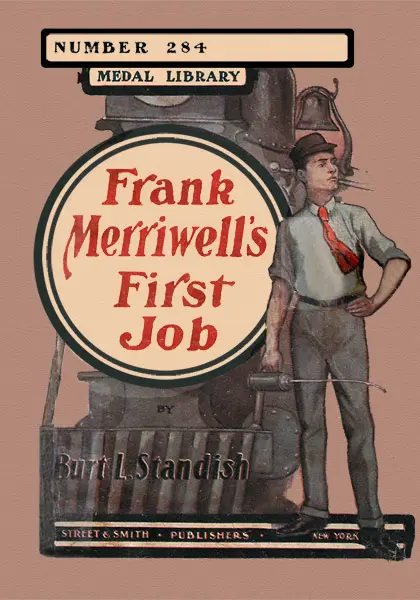
"Frank Merriwell's First Job; Or, At the Foot of the Ladder" by Burt L. Standish is a novel written in the late 19th century. The story centers around Frank Merriwell, a promising young man who has recently faced a life-altering setback as he must abandon his college career at Yale due to the loss of his fortune, which was mismanaged by his guardian. As he navigates his new reality, the book explores themes of resilience, ambition, and the transition from a care-free youth to the responsibilities of adulthood. At the start of the story, Frank is depicted as an athletic and determined individual engaged in a lively boxing match with friends, showcasing his charm and camaraderie. However, his world is turned upside down when he learns that his guardian has lost his inheritance through reckless speculation. With his future at stake, Frank packs his belongings and prepares to return home, where he contemplates a new path in life—one where he must earn his living through hard work. This opening portion effectively sets the stage for his character development, as Frank chooses to face adversity head-on, indicating his determination to rise above his challenges.
Introduction adapted from the source catalogue; source summaries may be automatically generated.
Free to read · English · 54,694 words · No account needed
MAKE TIME FOR A GOOD BOOK
On by default. Untick to stop anonymous reading totals. Each page counts after 10 seconds in view. How this works.
Anonymous counting is on unless you have switched it off.
“All right,” thought Merry, grimly. “You told me to come prepared for work, and I’m here. I’m going to work, too.”
He found plenty to be done, and also discovered that the other wipers took great satisfaction in giving him the very dirtiest jobs. Still he did not complain, but, no matter what he was asked to do, he kept about his work steadily and quietly.
“How do you like it, dudie?” asked one of the wipers, mockingly.
“Speaking to me, sir?” inquired Frank, placidly.
“Yes.”
“My name is Merriwell.”
“Oh, it is?”
“Yes, sir.”
“Well, dudie is good enough, and that goes.”
“Hey, Bill,” called another wiper, “you don’t know who you’re chinnin’
there.”
“Why, I’m chinnin’ the new superintendent of the road,” grinned the
taunting wiper.
“You’re talkin’ to the chap that knocked the stuffin’ out of Old Slugs
yesterday.”
“The blazes I am! What, that soft-looking guy?”
“That’s the one.”
“Well, may I be gosh-darned!”
The man stared at Frank as if unable to believe such a thing possible.
“Why, he’s a kid!”
“If you think so, just get him after ye. Slugs gave you a thrashing, and you wouldn’t last half as long with that kid.”
After this the man did not call Frank “dudie” again, but there were others who did. Whenever two or three wipers were together in Frank’s vicinity, they did their best to jolly him.
Merry did not get angry. He knew that would be the worst thing for him. He said very little, but occasionally he made some retort, and in every case it proved cutting for the one at whom it was aimed. The men began to realize after a while that the soft-looking youth could use his tongue quite as skillfully as his fists.
What surprised everybody was the fact that Frank did not show hesitation in taking hold of any kind of a job, no matter how dirty. He was not squeamish, or, if he was, he did not betray it.
Nearly half the forenoon had passed before Frank learned that Martin Hall, or Old Slugs, as he was generally called, had not put in an appearance that morning, but was reported to be ill in bed, unable to work.
Then some strange workmen came round to see the boy who had whipped Old Slugs. They looked him over doubtfully, and were inclined to disbelieve the story.
“Slugs could chaw him up in a minute,” one declared.
“That’s what everybody thought till they saw him try it,” said a
witness of the fight.
“Well, it must have been an accident if that boy knocked Slugs out.”
Your reading position is saved on this browser. Take it to another device with a library code. Reading pages adapt to text, rather than matching a printed edition.
Burt L. Standish
Burt L. Standish

Burt L. Standish

Burt L. Standish
BEHIND THE BOOK
This eBook is for the use of anyone anywhere in the United States and most other parts of the world at no cost and with almost no restrictions whatsoever. You may copy it, give it away or re-use it under the terms of the Project Gutenberg License included with this eBook or online at www.gutenberg.org. If you are not located in the United States, you will have to check the laws of the country where you are located before using this eBook. Read the source licence.
The original source file, including credits and licence, is retained by this library. Request an original-format copy at no charge. Please include the book title and Project Gutenberg identifier #64635.
KEEP YOUR CURIOSITY GOING
Coulson Kernahan

Maurice Baring
Frances Wright
Cécile Tormay

Frederic Jesup Stimson

W. H. P. (William Henry Pope) Jarvis