THE CLASSIC COLLECTION✦Frank Merriwell’s dangerCLASSIC FREE BOOKS
Frank Merriwell’s danger
Burt L. Standish
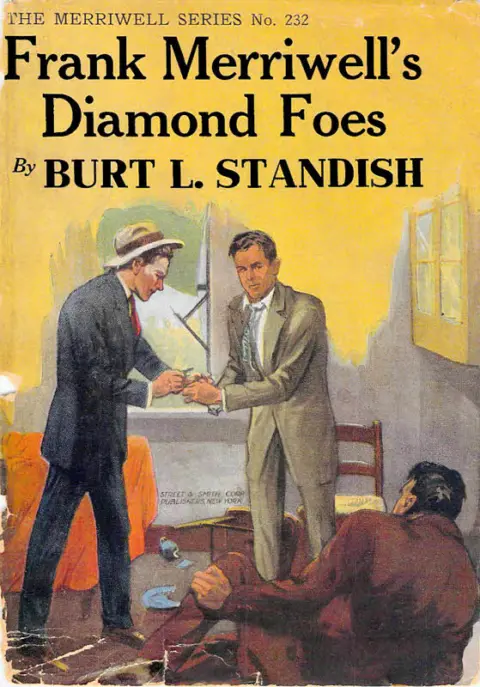
THE CLASSIC COLLECTION · 1914
"Frank Merriwell's Diamond Foes; Or, Straight Over the Plate" by Burt L. Standish is a novel written during the early 20th century. The story revolves around Frank Merriwell, junior, and his friend Billy McQuade as they navigate the challenges presented by Colonel Carson, a powerful and unscrupulous local figure in Carsonville, who threatens the livelihood of Billy's family over an unpaid mortgage. This tale encapsulates themes of friendship, sportsmanship, and moral integrity as the boys take on the local baseball team, hoping to defy the odds and save the day. At the start of the novel, we meet Chip Merriwell and Billy McQuade, who are enjoying their spring vacation and taking a cross-country run. Their day takes a turn when they encounter a runaway horse and buggy, resulting in a confrontation with the irate driver, who turns out to be Colonel Carson. As tensions rise, we learn of the colonel's mistreatment of local families and his ambition to uphold his reputation through his amateur baseball team. Amidst this backdrop, Chip and Billy gather support to form a local team, the Clippings, and prepare to challenge the Clippers, led by Bully Carson, setting the stage for a classic showdown that intertwines personal stakes with athletic rivalry.
Introduction adapted from the source catalogue; source summaries may be automatically generated.
Free to read · English · 67,885 words · No account needed
MAKE TIME FOR A GOOD BOOK
On by default. Untick to stop anonymous reading totals. Each page counts after 10 seconds in view. How this works.
Anonymous counting is on unless you have switched it off.
“Let’s have it, old man,” said Merry gravely. “Nothing helps a fellow so much as being able to spout out his trouble to some one else.”
“I know,” sighed Billy Mac hopelessly. “But this is different. I s’pose you remember about--about dad dying just before Christmas holidays?”
“Yes,” said Chip sympathetically. “And we were all mighty sorry to hear of it, old fellow.”
“Well,” went on the other, “things didn’t look so bad just then. Mother had a thousand dollars of insurance money, while the house and orchard was ours. We’ve got some mighty fine fruit trees there, and they promised to take care of things pretty well.”
“I should think they would! Those apples you dug up yesterday were something fine, Billy Mac.”
“They were the last of the ones we buried last fall, Chip. We shipped off some of them, for with the apples and other things we get high prices from the city. They seem to appreciate getting extra fine fruit.”
“Of course they do. The trouble with most farmers is that they don’t take pains enough to market their crop right, and take care of it on the way. But go ahead.”
Billy sighed again, and glanced heavily at the river.
“This here Colonel Carson,” he broke out, “suddenly produced a mortgage on the house and orchard for two thousand dollars. That was just before vacation, when mother wrote for me to come home.”
“But you knew that he had the mortgage?” queried Chip, frowning.
“We thought dad had paid it. You see, dad--well, dad was kind of careless about money. Just the same, we knew he had paid that mortgage. Mother could find no receipt, however, and Carson vowed that it had never been paid.”
“Somebody ought to teach him something,” said Merry warmly. “Hadn’t you any proof whatever?”
“Not a scratch, Chip. We couldn’t find a single thing. Mother pleaded with him, and he agreed to give us a little time in which to pay it--over again. It hit us pretty hard, you see. We knew that dad had paid it, but that villain Carson only wants to get hold of the place.”
“Looks as though the scoundrel had you,” said Merriwell thoughtfully. “Can you pay it, Billy?”
“Maybe. Mother has that thousand insurance money, and--well, to tell the truth, I’ve arranged to get a job as clerk in the Carsonville general store. If we can hold the colonel off a while, I guess we can fix it.”
“Pretty hard lines, just the same,” commented Merry. “So that’s why you wrote that you wouldn’t be back to Fardale, eh?”
Your reading position is saved on this browser. Take it to another device with a library code. Reading pages adapt to text, rather than matching a printed edition.
Burt L. Standish
Burt L. Standish

Burt L. Standish

Burt L. Standish
BEHIND THE BOOK
This eBook is for the use of anyone anywhere in the United States and most other parts of the world at no cost and with almost no restrictions whatsoever. You may copy it, give it away or re-use it under the terms of the Project Gutenberg License included with this eBook or online at www.gutenberg.org. If you are not located in the United States, you will have to check the laws of the country where you are located before using this eBook. Read the source licence.
The original source file, including credits and licence, is retained by this library. Request an original-format copy at no charge. Please include the book title and Project Gutenberg identifier #60463.
KEEP YOUR CURIOSITY GOING
Coulson Kernahan

Maurice Baring
Frances Wright
Cécile Tormay

Frederic Jesup Stimson

W. H. P. (William Henry Pope) Jarvis