THE CLASSIC COLLECTION✦Frank Merriwell’s dangerCLASSIC FREE BOOKS
Frank Merriwell’s danger
Burt L. Standish
THE CLASSIC COLLECTION · 1914
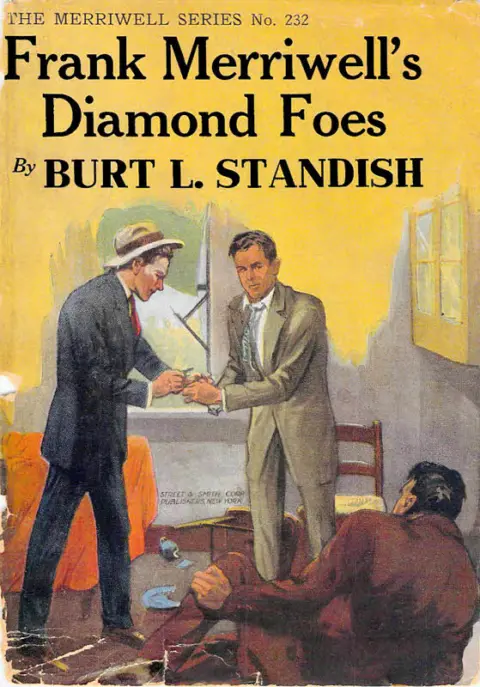
"Frank Merriwell's Diamond Foes; Or, Straight Over the Plate" by Burt L. Standish is a novel written during the early 20th century. The story revolves around Frank Merriwell, junior, and his friend Billy McQuade as they navigate the challenges presented by Colonel Carson, a powerful and unscrupulous local figure in Carsonville, who threatens the livelihood of Billy's family over an unpaid mortgage. This tale encapsulates themes of friendship, sportsmanship, and moral integrity as the boys take on the local baseball team, hoping to defy the odds and save the day. At the start of the novel, we meet Chip Merriwell and Billy McQuade, who are enjoying their spring vacation and taking a cross-country run. Their day takes a turn when they encounter a runaway horse and buggy, resulting in a confrontation with the irate driver, who turns out to be Colonel Carson. As tensions rise, we learn of the colonel's mistreatment of local families and his ambition to uphold his reputation through his amateur baseball team. Amidst this backdrop, Chip and Billy gather support to form a local team, the Clippings, and prepare to challenge the Clippers, led by Bully Carson, setting the stage for a classic showdown that intertwines personal stakes with athletic rivalry.
Introduction adapted from the source catalogue; source summaries may be automatically generated.
Free to read · English · 67,885 words · No account needed
MAKE TIME FOR A GOOD BOOK
On by default. Untick to stop anonymous reading totals. Each page counts after 10 seconds in view. How this works.
Anonymous counting is on unless you have switched it off.
After twenty minutes of vigorous exercise, the three friends pulled themselves out on the grassy bank and enjoyed a sun bath.
Somewhat to his surprise, Chip Merriwell found that Chub Newton was older than he appeared, and was an expert swimmer. Also, he had no high opinion of the autocrats of his native town.
“I hope the Cl-l-lippers get l-l-lambasted good and proper this year,” he announced pleasantly. “Bul-ly Carson has the worst case o’ swel-l-led bean you ever saw!”
“He looks like it,” said Chip, stretching out lazily. “Can he pitch?”
Chub Newton snorted disgustedly, but Billy spoke up.
“Sure he can pitch, Chip. Chub has a private grouch on, that’s all. Bully isn’t any great favorite off the diamond, but he has the knack of tossing the ball, all right.”
“Yah!” sniffed Chub. “He’s got l-l-luck with him.”
“That’s what he said about Billy,” said Merriwell. “What’s your private grievance against the colonel’s son?”
“Why, I wanted to pl-l-lay on the Cl-l-lippers,” bubbled the little chap. Every time he struck the letter “l” his tongue seemed unwilling to let go of it. “I tried out with ’em and made good. Then a bunch o’ city fel-l-lers come out here and got jobs whil-le they pl-l-layed bal-l-l. They done me, al-l-l right, and three or four other fel-l-lers, too. I was too short to pl-l-lay third, and one o’ them guys was a swel-l-l shortstop. That l-let me out. L-l-lot o’ folks think that Colonel Carson ought to ’a’ favored home pl-l-layers.”
“I don’t know about that,” said Merry thoughtfully. “Of course, sentiment can’t enter into ball games that way, Chub. If the odds were about even, though, he might have done so, I should think. Those city chaps aren’t ringers, are they?”
“No, I guess not,” spoke up Billy. “I don’t think that even Colonel Carson would try that game, Chip. He made quite a bit of bad feeling among the young fellows here, just the same.”
“Time we were gettin’ dressed,” observed Chub uneasily. “I hate to go, but those orders have to be in before noon.”
The three took a last plunge into the cool water, had a quick rub down, and dressed. Then Chub and Billy Mac departed to take a short cut back to town along the river banks, while Merry returned to the house in order to write a letter to his father. On the way, however, he reconsidered.
“I think I’ll let it wait till to-night,” he reflected. “I’ll have a talk with Mrs. McQuade first, if I can work it, and see how the idea strikes her.”
Your reading position is saved on this browser. Take it to another device with a library code. Reading pages adapt to text, rather than matching a printed edition.
Burt L. Standish
Burt L. Standish
Burt L. Standish
Burt L. Standish
BEHIND THE BOOK
This eBook is for the use of anyone anywhere in the United States and most other parts of the world at no cost and with almost no restrictions whatsoever. You may copy it, give it away or re-use it under the terms of the Project Gutenberg License included with this eBook or online at www.gutenberg.org. If you are not located in the United States, you will have to check the laws of the country where you are located before using this eBook. Read the source licence.
The original source file, including credits and licence, is retained by this library. Request an original-format copy at no charge. Please include the book title and Project Gutenberg identifier #60463.
KEEP YOUR CURIOSITY GOING
Coulson Kernahan

Maurice Baring
Frances Wright
Cécile Tormay

Frederic Jesup Stimson

W. H. P. (William Henry Pope) Jarvis