THE CLASSIC COLLECTION✦Frank Merriwell’s dangerCLASSIC FREE BOOKS
Frank Merriwell’s danger
Burt L. Standish
THE CLASSIC COLLECTION · 1914
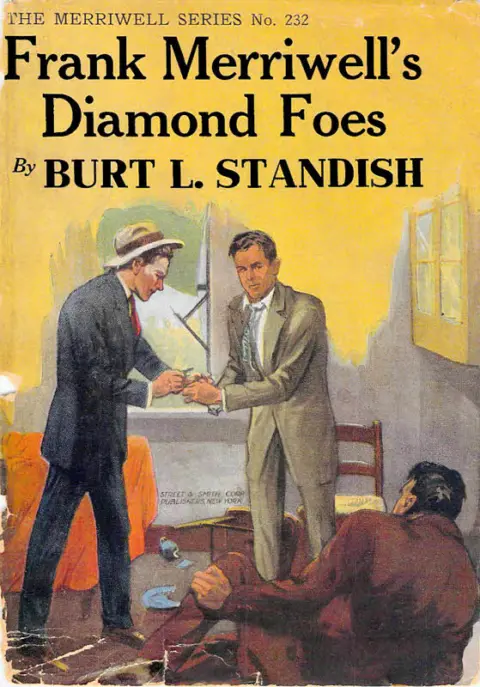
"Frank Merriwell's Diamond Foes; Or, Straight Over the Plate" by Burt L. Standish is a novel written during the early 20th century. The story revolves around Frank Merriwell, junior, and his friend Billy McQuade as they navigate the challenges presented by Colonel Carson, a powerful and unscrupulous local figure in Carsonville, who threatens the livelihood of Billy's family over an unpaid mortgage. This tale encapsulates themes of friendship, sportsmanship, and moral integrity as the boys take on the local baseball team, hoping to defy the odds and save the day. At the start of the novel, we meet Chip Merriwell and Billy McQuade, who are enjoying their spring vacation and taking a cross-country run. Their day takes a turn when they encounter a runaway horse and buggy, resulting in a confrontation with the irate driver, who turns out to be Colonel Carson. As tensions rise, we learn of the colonel's mistreatment of local families and his ambition to uphold his reputation through his amateur baseball team. Amidst this backdrop, Chip and Billy gather support to form a local team, the Clippings, and prepare to challenge the Clippers, led by Bully Carson, setting the stage for a classic showdown that intertwines personal stakes with athletic rivalry.
Introduction adapted from the source catalogue; source summaries may be automatically generated.
Free to read · English · 67,885 words · No account needed
MAKE TIME FOR A GOOD BOOK
On by default. Untick to stop anonymous reading totals. Each page counts after 10 seconds in view. How this works.
Anonymous counting is on unless you have switched it off.
“A highly proper--ah--sentiment, Mr. Randall,” said the colonel. He stopped Merry with uplifted hand. “One moment, sir! Mr. Randall was seen to enter the hotel in question, and to leave, each time by the back door, and in a stealthy manner. When I asked him for an explanation, he--ah--asked that you be sent for.”
Merry looked at the Southerner in astonishment. Randall stood erect, a dark flush in his cheeks, his eyes desperate. But he had regained his self-control.
“I was frightened, Chip,” he said quietly. “Of course, you know nothing about it, only the evidence seemed so terribly circumstantial that you were the first person I thought of.”
“I’m glad you did think of me, old man,” said Chip, smiling. “But let’s get this business straightened out. May I ask who observed Randall’s entry and departure, Colonel Gunn?”
“Mr. Dobbs himself,” stated the colonel, referring to his paper. “But allow me to--ah--mention that Mr. Randall makes no denial, and no explanation.”
Frank glanced again at Randall, in perplexity.
“What’s the answer, old man?”
“I received a letter from my cousin, Edward Carson, the son of Colonel Carson, of Carsonville,” said Randall. “He asked me to meet him at the hotel on important business. I was unable to get away before taps, so I left my room by means of a rope, and entered the hotel quietly, hoping to avoid observation.”
“Ah, Mr. Randall,” wheezed the colonel, “and what, may I inquire, was the nature of the--ah--important business to which your cousin referred?”
“I must refuse to answer, sir,” and Randall suddenly went white. “I give you my word, sir, that it was entirely personal and private. More than that, I cannot say.”
A little silence ensued. Frank studied Randall, but could find no trace of guilt in the dark, handsome features. Nor did he believe the Southerner guilty.
“You know nothing of the theft, of course?”
“Nothing, Chip.”
“I must say, colonel,” exclaimed Frank, turning to the principal, “that I do not think Randall at all guilty. He could have easily lied out of the whole thing, and the inspector’s report would have borne him out. The fact that he refused to do so must surely count in his favor?”
“Most certainly, Merriwell. It has just--ah--occurred to me that if we could locate this Carson, we might thus exonerate Mr. Randall completely. Such a consummation would be--ah--highly pleasing to me.”
“He ain’t at the village,” spoke up the constable. “Mr. Hostetter was lookin’ fer him, sir.”
“Hostetter knew him, then?” inquired Chip quickly.
“They was friends,” replied the constable. Frank turned.
Your reading position is saved on this browser. Take it to another device with a library code. Reading pages adapt to text, rather than matching a printed edition.
Burt L. Standish
Burt L. Standish

Burt L. Standish

Burt L. Standish
BEHIND THE BOOK
This eBook is for the use of anyone anywhere in the United States and most other parts of the world at no cost and with almost no restrictions whatsoever. You may copy it, give it away or re-use it under the terms of the Project Gutenberg License included with this eBook or online at www.gutenberg.org. If you are not located in the United States, you will have to check the laws of the country where you are located before using this eBook. Read the source licence.
The original source file, including credits and licence, is retained by this library. Request an original-format copy at no charge. Please include the book title and Project Gutenberg identifier #60463.
KEEP YOUR CURIOSITY GOING
Coulson Kernahan

Maurice Baring
Frances Wright
Cécile Tormay

Frederic Jesup Stimson

W. H. P. (William Henry Pope) Jarvis