THE CLASSIC COLLECTION✦In Bohemia with Du Maurier: The First of a Series of ReminiscencesCLASSIC FREE BOOKS
In Bohemia with Du Maurier: The First of a Series of Reminiscences
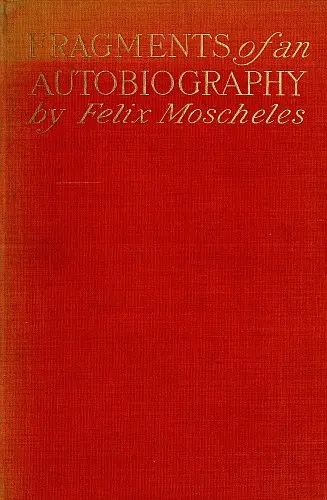
Felix Moscheles
THE CLASSIC COLLECTION · 1899
"Fragments of an Autobiography" by Felix Moscheles is a memoir written in the late 19th century. The book recounts the author's life experiences, particularly those connected with his family, early recollections, and interactions with notable figures in the music world, all presented as reminiscences rather than a systematic narrative. The author provides insights into his childhood, his family's artistic background, and the influence of great musicians on his upbringing. The opening of the memoir sets a personal tone as Moscheles reflects on early impressions from his childhood, particularly during a tumultuous journey through a stormy night. The narrative introduces his father, a concert pianist, and the love and protective nature of his mother, who played significant roles in his childhood experiences. As he shares these early memories, he hints at the joyful yet chaotic environment that nurtured his artistic spirit, featuring charming anecdotes about his father's musical engagements and his youthful misadventures. The stage is thus set for a richly detailed account of his life filled with artistic exploration and personal anecdotes in the chapters to follow.
Introduction adapted from the source catalogue; source summaries may be automatically generated.
Free to read · English · 97,616 words · No account needed
MAKE TIME FOR A GOOD BOOK
On by default. Untick to stop anonymous reading totals. Each page counts after 10 seconds in view. How this works.
Anonymous counting is on unless you have switched it off.
This was by no means the first experience he had had of studio life. On his entrance into the Atelier Gleyre, he had set himself to draw the figure of Sinel, one of the leading models of the day, and had betrayed more self-confidence than was compatible with his position as a nouveau. He had been working for a couple of days, when Monsieur Gleyre came to visit his students. The bear-garden was suddenly transformed into a grave academy. Respectful silence and order prevailed, as the master passed from easel to easel, criticising here and encouraging there, and generally enunciating wise artistic saws for the benefit of the students. When Gobelot's turn came, he paused a while before he expressed an opinion on his work. At last he said kindly but firmly: "Young man, you have come to study with me, and it is my duty to advise you honestly and straight-forwardly. Believe me, devote all your attention to the human foot; learn to draw that correctly,--and then perhaps you may be successful as a bootmaker." Therewith he passed on to the neighbour. Shortly afterwards the real Monsieur Gleyre came in, for the whole thing was a plant, and Gobelot was officially introduced as the nouveau by the sham professor.
It is not a sinecure to be the nouveau. One is the butt of endless jokes, and has to take them meekly; one is at everybody's beck and call, to pick up a brush, or to run for a ha'porth of bread or a penn'orth of fried potatoes. When I was the new boy, I knew resistance was useless, so I served my time cheerfully, swallowing snakes, as the French call it, with apparent relish.
But one day I was caught napping. I had joined in the general conversation, and had so far forgotten myself as to make a joke, and, what was worse, they said, not a bad one. This was adding insult to injury; a storm of indignation broke forth, and the cry of "À l'échelle" ("To the ladder") was raised. I should then and there have suffered the penalty of my rashness, had not Dupont interposed. He mounted the rostrum, i.e. the model table, and made an eloquent appeal on my behalf. I was an Englishman, he pleaded, and as such I had been reared on raw beef and bran puddings; he would himself now see that I was kept on lighter food (I suppose he meant frogs). Yes, I had presumed to trespass on the domain of "esprit," the exclusive property of Frenchmen in general, and of the duffers now before him in particular--he would not offend them by calling them gentlemen. My joke, he admitted, was a good one, but then, what could you expect from a benighted foreigner, who did not know the value of a bad one. And so on. However feeble his defence may appear to us as we read it in cold blood, it had the desired effect, and I was saved from my impending fate. But I was not to get off for long. Only a couple of days afterwards, an incident led to my punishment. It was luncheon time and I was studying the greasy paper that my potatoes had been wrapped up in, probably a leaf from some old register, so many tons of which are issued daily by bureaucratic Paris. I had got to my second course, roast chestnuts done to a T, when I had a sort of secret forewarning that a certain long stick with a hook, one of the studio properties, was stealthily approaching towards the stool I was sitting on. A sudden jerk, and the stool was pulled from beneath me; but being fully prepared, I failed to collapse, and remained as if seated, continuing my meal as if nothing had occurred. Such independence could not be tolerated. Stop, the well-known caricaturist, now formally moved that I be "mis à l'échelle," and the resolution was unanimously carried. So the ladder was laid on the floor, and I was bound to it hands and feet; then it and I were hoisted up and placed against the wall. Next Stop proceeded to bare my breast, and to paint thereon a highly coloured picture representing several pigs and their doings. In the meanwhile the poker was being made red-hot in the stove. The occasion must be marked by a scar, I was given to understand, and I can assure those who have never gone through a similar experience, that a touch from a red-hot poker is very painful, even if the red is only vermilion and the heat imaginary. I was informed that I should have to preserve the pig picture for a fortnight, after which time I should be called up for inspection.
Your reading position is saved on this browser. Take it to another device with a library code. Reading pages adapt to text, rather than matching a printed edition.
BEHIND THE BOOK
This eBook is for the use of anyone anywhere in the United States and most other parts of the world at no cost and with almost no restrictions whatsoever. You may copy it, give it away or re-use it under the terms of the Project Gutenberg License included with this eBook or online at www.gutenberg.org. If you are not located in the United States, you will have to check the laws of the country where you are located before using this eBook. Read the source licence.
The original source file, including credits and licence, is retained by this library. Request an original-format copy at no charge. Please include the book title and Project Gutenberg identifier #33185.
KEEP YOUR CURIOSITY GOING

Charles G. (Charles Griffith) Ross
Hannah Webster Foster

Emily Lawless
Edwin Hamlin Carr

Charles De Lano Hine
Andrew Ure